
Blog
-
PowerPress 7.0 is here! PowerPress Podcast Episode 20
 MacKenzie and Mike are excited about the new release of PowerPress 7.0 as discussed on this episode of the PowerPress Podcast. They have some great news articles, Podcasting in Not the New Black, and another called Podcast Presentation Skills. Mike completely agrees that ‘podcasting is not the new black’ but MacKenzie sees some merit in the idea. And MacKenzie comes to realize she is not a fan of the process of booking guests on the show in her podcast chronicle. Last but not least, they also discuss a recent blog post on our site about taking a break from your podcast.
Show notes:
Taking a Break Without Losing Your Audience
Elite Man Conference
-
4 Ways To Promote Your Podcast (Beyond iTunes!)
Of course you already know that submitting your podcast to directories like iTunes, Google Play Music Podcast Portal, and the Blubrry Podcast Directory are the first steps in getting your show out to the wider world. But in today’s noisy internet ecosphere, just listing your show and hoping people will find you usually isn’t enough! Instead of relying on any one directory or list to elevate your podcast in the ranks, focus on a long-term strategy that incorporates audience development, consistency and a few clever promotional techniques. Here are some ideas for elevating your promotion strategy and getting more people to tune into your show: (more…)
-

6 Ways To Take A Break From Podcasting Without Losing Your Audience

With summer just around the corner, many podcasters are asking whether or not it’s OK to take some time off from recording and publishing to make more time for vacations and leisure. While it’s tempting to think “hey, how much can it really hurt to take a few weeks off?” that “short” break can easily confuse listeners, stall momentum, or become a slippery slope into “podfading” (when a podcast becomes published less and less frequently, until it eventually just fades away.)
While members of the Blubrry team have experimented with taking time off from podcasting, most of us recommend against taking an extended vacation. However, here are some tips that can make occasional breaks less disruptive to your usual schedule and make it more likely that listeners will stick around until you get back.
- Consider your podcast’s age and following. An older, more established podcast with a solid and loyal audience may be able to get away with occasional breaks, but take a vacation when you’re just a few months into podcasting and you may find that your audience forgets about you while you’re gone. “I have created 1120 shows over 11+ years, and my audience has literally built me and my show into their lives,” explains Todd Cochrane, CEO of Blubrry. “While we all need to take breaks from time to time, my first break was 4-5 years into doing my show and then only 1 or 2 episodes at a time.”
- Keep breaks short and schedules consistent. A week off here and there (particularly if you give plenty of notice) isn’t likely to cause your audience to disappear, but 2-3 weeks can easily lead them to give up on you and go looking for new content. The biggest trick is to be consistent and deliver on expectations. For example, if you plan on going from daily to weekly episodes during the month of July, be sure you really follow through on whatever you’ve promised your audience. If they eagerly open up their podcast app on Tuesday expecting your episode and it isn’t there, you may lose them for good.
- Give your listeners plenty of advance notice. Communicating your plan to your listeners will help them understand what to expect and also help keep you accountable and organized during a break or reduced podcasting schedule. If you’ve promised your listeners you’ll be back every other Thursday over summer break, it’ll be that much harder to slack off on that day you’d really rather be at the beach.
- Keep communicating with your audience. Blog posts, social media, and utilizing your email lists are all great ways to stay in touch with your listeners when you aren’t actively publishing. Make sure to stay in front of them in a variety of different ways: after all, if you’re in “vacation mode” chances are so are they, and you’ll need to work harder to stay front of mind.
- Take your podcast on the road. Vacations don’t have to completely disrupt your podcasting schedule! Take a portable studio when you travel so you don’t have to miss a publishing date. It’s OK to keep this simple! “I used to take a massive packout,” explains Cochrane. “I now carry a headset and a zoom for shows I record on the road – it’s no more than 2-3 pounds and packs up in a shaving kit.” If you worry about sound quality, explain to your audience up front that you’re on the road so you might sound a little different than usual. Loyal listeners will just be happy to hear from you, even if the quality is a touch less than usual. If it fits your show topic, you may even be able to incorporate your vacation location into your show!
- Change up your format. Switching to shorter episodes while you’re on vacation or during a time of year that your audience is less engaged may be a welcome way to stay in touch with listeners without spending hours in a recording studio each week (or requiring them to log as much listening time to stay current.) You can also consider bringing in guest hosts, or switching to a less time-intensive recording format (i.e. quick off-the-cuff breakdowns of trending topics rather than lengthy interviews) during times when you’d rather be out flying a kite than inside recording.
Podcasters, how do you stay relevant and front-of-mind while traveling or vacationing?
-
6 Great Productivity Tools For Podcasters
As any podcaster knows, creating a great show requires a lot more than just showing up and recording. Between collaborating, planning and organizing your time, it helps to have access to great tools to help. Here are some favorites among podcasters we know:
Scheduling:
While Google Calendar is great for keeping track of your overall schedule, it can be great to give guests an easy way to sign up for an available recording time. Here are two options podcasters love:
- “I use SetMore for scheduling – It’s free and it integrates with google calendar! It’s awesome to just send guests a link for scheduling and have this tool take care of the rest. – Bryn from The Birth Hour podcast.
- “I use Calendly as my scheduler. It’s so easy to use, and I love the clean interface. I love not having to email back and forth, and being able to set automatic reminders is so helpful.” Heather from the Happiness Mama podcast.
Collaboration:
Even if you’re a one-person show, chances are good you’ll need to collaborate with others at some point, whether that be sponsors or special guests. These options are popular with podcasts we know:
- “I love DropBox for sharing files and making them accessible anywhere.” – Kelsey Wharton, the Girl Next Door Podcast.
- “Initially my co-host and I were were winging it with scheduling content from week to week, but now we look a month out on a shared Google calendar and can build episodes into each week and see what makes the most sense to come next. We also had a meeting to talk about our personal goals and visions for the show and how best to use each other’s strengths, whether that be editing, writing outlines, show notes promotion and social media. We feel this can be such a useful tool for shows with multiple hosts- otherwise you’ll end up tripping over each other trying to do everything at once which makes it more complicated, and less productive.” – Rachel Cassinatt, The Table Chat Show.
Communication:
- Here at Blubrry, we use Slack for almost all internal communications. With an interface that acts like a messaging platform plus the ability to upload files from documents to graphics and great searchability, it’s the best of all worlds for teams that like to communicate quickly on the fly and share short bursts of information throughout the day.
- If a separate messaging platform is overkill for your podcast, you might consider using Google Hangouts as a scaled-back way to communicate with guests and co-hosts without ever leaving your Gmail inbox.
-
Getting feedback from listeners with Arsalan Ahmed
 MacKenzie is back this week with a new episode with Arsalan Ahmed, who was our first in-studio guest. Both somewhat new podcasters, they discussed how to get feedback from listeners as well as some podcasting news. MacKenzie certainly doesn’t think the word ‘podcasting’ is hurting the medium and have you guys heard of RadioPublic yet? They discuss this new company and what they think will come of it.
Interested in our guest this week?
Mentoring Developers is a podcast for new and aspiring developers and their mentors. If you have ever wondered what it takes to be a professional software developer or if you find yourself wondering how to be successful as a software developer, earn a good living, and grow in this cut-throat profession with dignity, you should know that we are here to support you regardless of your background. The key to developing a nurturing work environment is empathy and Mentoring Developers exists to provide you with the guidance and direction you seek.Show notes:
Is the name ‘podcasting’ hurting the medium?
-
Where Are Your Podcast Listeners Tuning In? Blubrry Has Some Surprising Stats
As any content creator knows, understanding your audience is key to success – and for podcasters, that includes having a good sense of where listeners are tuning in. Armed with solid information about which applications and platforms consumers are using at the highest rates, podcasters can make necessary decisions about where to invest time, energy, money and other resources.
To help our customers better understand their audience, RawVoice / Blubrry is sharing that information with the tens of thousands of podcasters who use our services, and the podcasting community as a whole. Following is a breakdown of global statistics data from April 2016, constituting a sampling of over 40,000 shows and over 100 million listener downloads and on-demand podcast plays. We’ve been collecting, analyzing and studying podcast statistics data since 2006, and recently have seen fairly rapid changes in this ever-evolving space. Some of the data you’re about to read may surprise you.
How Podcasts Are Being Consumed:
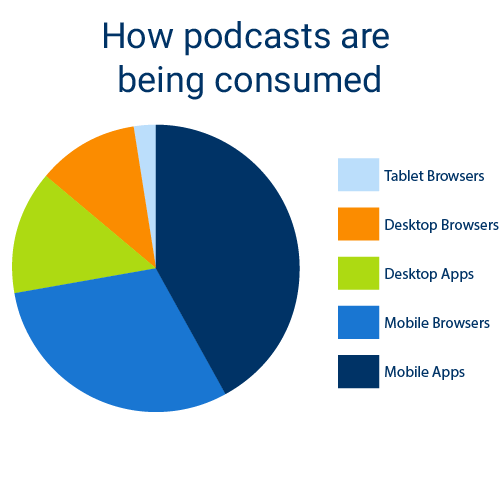
- Mobile Applications 42.00%
- Mobile Web Browsers 30.30% (may include some mobile apps that do not specify their own user agent)
- Desktop Applications 13.90%
- Desktop Web Browsers 11.30%
- Tablet / Pad Web Browsers 2.50%
The Takeaway: While it’s not surprising that mobile apps are the most popular stand-alone method of podcast consumption, don’t miss the fact that tablet browsers, mobile web browsers, and desktop web browsers combined make up a potentially even higher portion of listens. What that means for podcasters: the audio player you use makes a difference to what potentially could be a big chunk of your audience. (Did you know that Blubrry/PowerPress recently revamped our free audio podcast player?)
Mobile Applications – 42% Overall
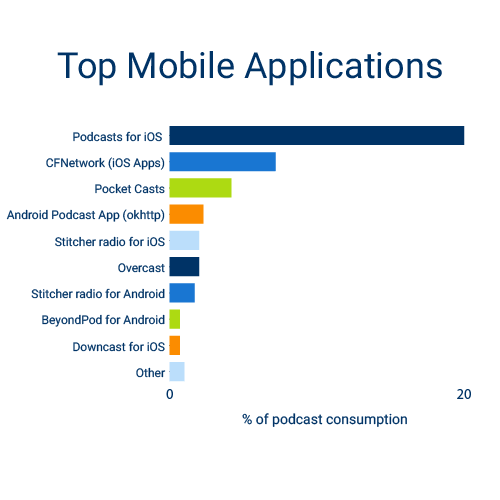 Note: The data points below only highlights the top 30 clients with 100+ clients referred to in any category as other..
- Podcasts for iOS – 20.2%
- CFNetwork (iOS Apps) – 7.2%
- Pocket Casts – 4.2%
- Android Podcast App (okhttp) – 2.3%
- Stitcher radio for iOS – 2.0%
- Overcast – 2.0%
- Stitcher radio for Android – 1.7%
- BeyondPod for Android – 0.7%
- Downcast for iOS – 0.7%
- Other – 1.0%
The Takeaway: While Podcasts for iOS still reigns, all those other mobile apps add up to an even-bigger chunk of listeners. Don’t ignore Android apps, and pay particular attention to up-and-coming apps with loyal followings, like PocketCasts and Overcast. Sadly though, since Stitcher was acquired, it has lost 3-4% of global market share according to our data.
Client Breakdown:
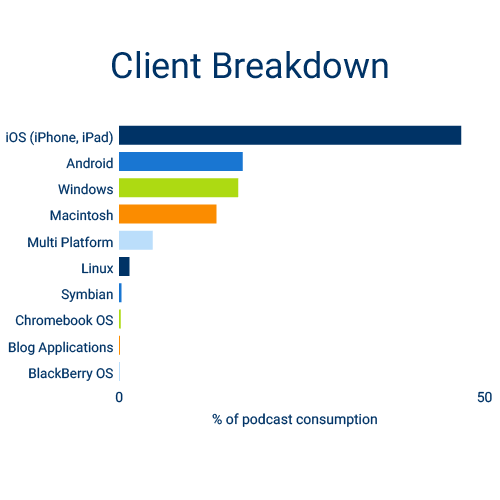
- iOS (iPhone, iPad) – 46.8%
- Android – 16.9%
- Windows – 16.3% (Includes 5.9% iTunes Desktop)
- Macintosh – 13.3%
- Multi Platform – 4.6%
- Linux – 1.4%
- Symbian -0.3%
- Chromebook OS – 0.2%
- Blog Applications – 0.1%
- BlackBerry OS – 0.1%
Clients By Platform:
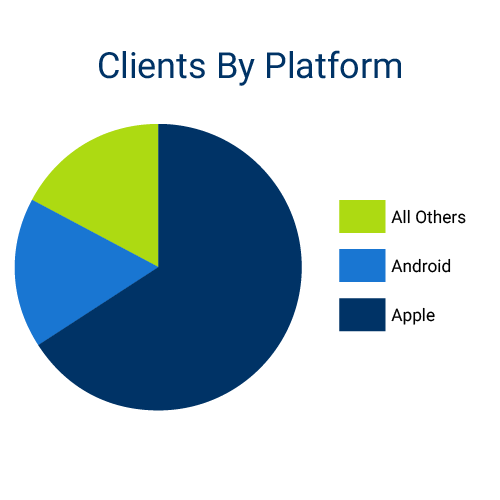 Apple Ecosphere – 65.9%
- Podcasts for iOS -20.20%
- iPhone Browser Media Player – 17.50%
- iTunes Desktop Applications (Mac/Win) – 11.60%
- CFNetwork (iOS Apps) – 7.20%
- Pocket Casts (IOS Apps) – 2.20%
- iPad Browser Media Player – 2.30%
- Stitcher radio for iOS -2.0%
- Overcast (IOS Apps) -2.0%
- Downcast (iOS Apps) – .7%
- Other – .2%
Android Ecosphere – 16.9%
- Android (smartphone) – 7.80%
- Pocket Casts – 2.0%
- Android Podcast App (okhttp) – 2.30%
- Stitcher radio for Android – 1.70%
- Samsung with Android – 1.10%
- BeyondPod for Android – 0.70%
- DoggCatcher – .20%
- AntennaPod – .20%
- Player FM for Android – .20%
- Other .7%
The Takeaway: While global listener volume is continuing to increase across all platforms, it is very apparent to our month to month, year to year data that Android is making significant gains in the global podcast ecosphere. For the first time in many years we are seeing a significant increase in Android consumption, specifically, applications that support Blubrry’s one-click Subscribe on Android that are now breaking out in the top 30 used.
Below is an even more detailed breakout of individual applications, browsers and platforms:
Mobile Web Browsers – 30.3%
- iPhone Browser Media Player – 17.5%
- Android (smartphone) – 7.8%
- Chrome (Mobile) – 3.2%
- Samsung Android – 1.1%
- Other – 0.70%
Desktop Applications – 13.9%
- iTunes – 11.6%
- Windows Media Player – 1.6%
- Other – 0.7%
Desktop Web Browsers – 11.3%
- Chrome (Desktop) – 5.5%
- Internet Explorer – 2.6%
- Firefox – 2.1%
- Safari (Desktop) – 0.5%
- Other – 0.6%
Tablet / Pad Web Browsers – 2.5%
- iPad Browser Media Player – 2.3%
- Other – .20%
Note:
The averages above are calculated from our filtered totals that appear in our client’s individual podcast statistics dashboards.
These totals do not include our enterprise clients like ESPN or ABC, nor do they include media buyers that utilize our enterprise solutions for measuring their podcast advertising campaigns.
There are over 100 additional applications and clients that are not included in this list, as they have less than 1 percent of global market share.
News, media agencies, podcasters, and bloggers are welcome to quote this information so long as full attribution to Blubrry/RawVoice, with a hyperlink to this article, is provided.
-
On-Demand Vs. Streaming Podcasts: It’s the Listener’s Choice (And Why We Support That)
Recently there has been a fair amount of chatter about download / on demand vs. streaming podcast and whether one delivery method is better than the other. “If a segment of the podcast services market had it their way today, they would eliminate the download option – some because they want podcasting to align with their current business model, and for some the download is hard to explain to media buyers,” says Blubrry/RawVoice CEO Todd Cochrane. “Largely for those reasons, they don’t want customers to have a choice.”
But let’s not forget why podcasting is so popular: we listen on our terms, where and when we want to – not just when we have a internet connection. Streaming removes a huge amount of convenience and cost-effectiveness for the consumer.
Here’s why Blubrry will continue to support both downloading and on demand as options for podcasters and podcast listeners:
1. On-demand is convenient. “Consumers should be allowed to choose where and how they listen to content,” argues Cochrane. “If they choose to pre-download a podcast while they’re on a WiFi connection because they don’t want to use their mobile bandwidth or are in a place where WiFi isn’t readily available, that’s their choice.”
2. On-demand is more cost-effective for the listener. “Most people cannot afford huge data plans. If you’re a listener with two kids, you might have four people sharing on a single mobile data plan with maybe 4-5 gigs of data,” Cochrane says. For a serious podcast consumer – the kind we all want to reach! – that may not be enough to support a streaming-only option. Also, consider that listeners in developing nations may have even less access to data – they’re more likely to be using Internet cafes to download shows and then listen on the go, explains Cochrane.
3. Downloads can be (and are being) measured accurately. “We’ve been measuring on-demand without an issue for a long long time,” says Cochrane. “Pro-streaming people don’t like downloads because once a piece of media goes into the Apple ecosphere or is downloaded in an app, they don’t know what happens to it afterward. But we do. Because of Apple iOS having such a huge market share, and because we know that the Apple podcast app stops downloading after three unplayed episodes, there is well-defined trending data that help us know the audience performance of a show.”
4. On-demand audio is why podcasts were created in the first place. Being able to listen to a podcast wherever and whenever you want to – whether that’s on an airplane, that one place on your commute where your cell signal always drops out, or the room in your basement where you can never get a good data signal – is one of the crucial things that’s made podcasting so popular to begin with. “Even Google Play recognized the importance of download by allowing it,” Cochrane points out.
Bottom line: while it’s possible down the road that customer preferences or needs will shift to using their data plan primarily to stream podcasts, the data does not bear out a shift now. Until that point, the industry should not be forcing a change, but instead supporting what the consumer wants. It’s pretty clear that right now, listeners want to be able to listen to podcasts on demand, and smart service providers will do what they can do meet that need.
-
Making Money With Your Podcast: 5 Monetization Models And How They Work
One of the biggest questions we get at Blubrry is “How do I make money as a podcaster?” While the answer to that question is pretty much always “it depends,” we have identified some of the most popular ways podcasters are finding to monetize their work:
- Ad Networks
Joining an advertising network is one of the easiest ways to get matched up with potential sponsors. Blubrry’s advertising network is just one example of a company that can match you up with advertisers in your niche. One of the biggest benefits we offer is that we actively track statistics and work to match our podcast customers with relevant advertisers. We also recently updated our application process, collecting more information to help make a better match between podcasters and potential sponsors. Blubrry’s advertising rates have hovered around $20 – $25 CPM (cost per thousand downloads) for the past ten years and are based on mid-roll placements (i.e. a live-read ad spot in the first 25% of your show.) - Affiliate sales
Sometimes sponsorships come not via direct advertising sales, but affiliate partnerships, where the podcaster only receives a fee if listeners actually click through and/or make a purchase. Though the barrier to entry is relatively low when it comes to affiliate relationships, it’s wise to be choosy: if every podcaster and her sister are hawking the same affiliate brand, what are the chances that you’ll be able to convert many new customers? A more effective plan may be to Google the brands you already love and talk about, + “affiliate,” and see what comes up. Or sign up with a service like Share a Sale or Commission Junction and searching for brands and product/service types that are a good fit for your show. You can also include Amazon Associates links when sharing resources in your show notes posts. The relatively low commissions may only result in a small trickle of cash, but it may at least cover incidental costs and give you a nice boost in revenues when you have a more popular show. - Selling Your Own Products/Services
Your podcast doesn’t have to be directly monetized to help you earn more money. A podcast is a great way to increase your authority and help you sell your products or services to a hungry audience. It could also potentially put you in front of people in a position to hire you for freelance work down the road. Most importantly, podcasts are a great way to build a strong relationship with your audience. - Donations
If your show isn’t quote-unquote “sponsor friendly,” you may need to rely on the loyalty of your audience to keep it funded. Patreon is just one service that allows you to tap into your audience’s devotion to help you keep your show in the black. - Integrated sponsorships
If you’re a blogger or social influencer who’s worked with brands in the past, it may be worth your while to talk to your current partners about including your podcast in future sponsorship packages. Many brands are still skittish about working with podcasts, since they don’t fully understand the metrics or reach. Being able to sell them on a full package that includes social sharing and other added value, like a blog following or substantial email list, can seriously up your chances of landing a great sponsorship deal and potentially building advertiser relationships for years to come.
- Ad Networks
-
Listener’s Choice
On this episode of the PowerPress Podcast Todd Cochrane discusses multiple topics ranging from advertising to Blubrry's new phone support. MacKenzie has been busy at the Blubrry headquarters working on the upcoming Blubrry WordPress Website launch, coming out May 9th!, and wasn't able to get a new episode in this week. Don't worry, she'll be back in two weeks with a fresh episode about using PowerPress.
Thinking about heading to Podcast Movement? We've got a discount for you. Use the code Blubrry and save $40 off of your ticket. Get registered now!
Ready for another conference a month later? The Elite Man Conference is happening August 5-7 in the Boston area. Use our code to save 10% off your ticket. Learn more here and use Blubrry10 to save!
Leave us a review for PowerPress!Show notes:
Blubrry WordPress Website
Free phone support at Blubrry!
Email MacKenzie
Email Todd
Episode Music – Phonophage

