

Blog

  • Show Me the Monetization

    Show Me the Monetization

    Cartoon man holding idea light bulb and moneyOnce the podcasting bug bites, many podcasters want to work on their podcast full time. This might be easier said than done, but with the right strategy and a whole lot of hustle, making money off your podcast is entirely possible. Here are a few ways to monetize your way into being a boss!

    THE CLASSIC ROUTE – ADS/COMMERCIALS

    Ads are still how most podcasts make money. Whether it’s selling 15-second spots, or one-minute slots, you can make a deal with a company to insert their ad into your podcast. There are various guides to figuring out what to charge based on your listenership and download stats (which are easily accessible to Blubrry customers), but how you structure your deal is entirely up to you.

    Another popular way for companies to get ads on your show is for the host to read the ad directly (host-read advertising). These ads are generally placed “pre-roll” or “mid-roll” and the cost for each varies, but the “mid-roll” ad usually fetches a higher fee. Sponsors also tend to like a host-read ad as it feels more organic to the show and that the host is more connected to the product or service.

    SPONSORSHIP

    You’ve likely heard a podcast that begins with, “This program is brought to you by…” with a company sponsor named after that. If you have an industry specific show, let’s say you examine the wide world of golden retrievers, you could reach out to a dog food company or anything in the pet space, and they may love the show enough to be your sole sponsor. Having consistent downloads (even if they’re lower number) is a key element to partnering with a corporate sponsor.

    SUBSCRIPTIONS AND DONATIONS (AKA YOUR FAN CLUB)

    Why not come right out and ask your listeners to support your show directly? If you have a loyal fan base, they definitely want to support what you do. Crowdfunding services such as Patreon or GoFundMe have a variety of options for you to set up your revenue streams. 

    Many successful podcasts offer all sorts of bonus content, members-only events and/or members-only swag via these services and even grow their listener base from having successful crowdfunding campaigns.

    BROADCAST ON YOUTUBE

    This is a natural transition for the savvy podcaster. You’re already setting aside time to record your show. If you don’t want to, or don’t have a camera to video record your shows, you can simply put a static graphic on the screen as your podcast plays underneath. 

    Consider editing your videos before posting them as opposed to live streaming. Both will garner you views, but editing your videos into shorter buzz-worthy or “best of” segments can make them easier to share on social media.

    Taking the next step of publishing videos of your recordings on YouTube will not only make you money from the views, but it can also get your podcast greater exposure.

    MERCH TABLE

    At some point, you’re going to find a catch phrase, a show byline or a fun image that is uniquely identifiable to your show. You can have that fun tidbit put on a T-shirt, mug, blanket, sticker or nearly anything else you can dream up. If there’s ink, there’s a way.

    You don’t even have to shell out the cash up front to have these items made. There are websites such as Shopify that will put your image you want on an item, create it, send it to the customer and then send you a check. As your show grows, it may be more cost effective to dedicate a portion of your garage to storing your merch, but you don’t have to wait until then to have a rad merch table.

    SELL YOUR SERVICES OR CREATE A CLASS

    Many podcasters offer services or are on a mission to spread their insights. Even if you don’t start out thinking you have something to teach, you may find that people start asking you how you do the things you do, or how to get better at the things you excel at. 

    You can craft a single course on, say, the best ways to train your cat to stop waking you up at 5 a.m. (this author is currently seeking out this course), or how to bake the perfect cookie. Even if you offer this course for $5, you’re engaging with your fans and once you create an online course, you never have to record it again.

    If your service is a multi-class or multi-hour service, consider adding bundles for larger amounts or special discount codes for your subscription based audiences.

    START A PODCAST NETWORK

    If you’ve really cornered the market on your expertise, you may find that one podcast just isn’t enough to cover everything you want to cover. Or, maybe you are in contact with another like-minded podcast and you might already be doing cross promotions. Creating a podcast network of cultivated shows can not only be great for the individual shows to boost their audiences, but listeners love not having to think too hard about what they’re going to listen to next if they trust that what you partner with will be something they like. 

    START NOW

    No matter what option you choose, the sooner you start making a plan, the better you can craft your content to reach your goals. Even if you haven’t hit record yet, making a game plan on how to monetize your show will pay dividends well into the future.

    Written by: Tara Jean O’Brien

    Tara Jean O'BrienTara Jean O’Brien has been a writer, actor, improviser, podcaster, and stand-up for nearly 800 years. When not producing, editing, and hosting her podcast, Single Vs. Married, or co-hosting, Cinema Craptaculus Presents: B-sides, she also writers on Medium and recently found a floor safe hidden in her coat closet.


  • Finding Podcast Advertisers You Like (and Will Like You Back)

    Finding Podcast Advertisers You Like (and Will Like You Back)

    AdvertisementObtaining consistent and lucrative advertising partners can be one of the biggest mysteries and pain points for independent podcasters. However, you don’t have to wait until you hit the illustrious 10k downloads per episode mark to start having great advertisers and partnerships on your show. It may take a little elbow grease and strategy, but here are a few ways to find podcast advertisers that you are jazzed about, even as a small to mid-sized podcast.

    What Brands Do You Like and Use?

    Partnerships where you are truly a fan of the brand makes pitching them as an advertiser easier because the connection is authentic. A powerful practice is to track every brand you use for a week. Keep a notebook handy, and from when you wake up to the time you go to bed write down the brands you use for everything. This includes beauty and hygiene, subscriptions, favorite food brands, coffee, socks, your car, anything! At the end of that week, pick three to five of these and message them through their website or social media, even simply asking for the email of the person that handles partnerships. From there, you can craft a pitch email telling them about your show, how you are a personal fan of the brand and would love to strike up a deal, whether it’s paid, affiliate, trade, etc.

    What Brands Does Your Audience Use?

    • Ask your listeners in person, via email or a social media poll what some of their favorite brands are. You can even make it fun and interactive by breaking it up into different categories.  
    • Get creative and brainstorm everything about your listeners’ purchase decisions and their own brand loyalty. Where do they vacation? What types of advertisements would be fun for them to hear on your show? Are your listeners comedy nerds, history buffs, sports enthusiasts? From there, some new brands and possible advertising partners could pop up.

    Take the Path Less Traveled

    There are the big players that show up in many podcasts week after week, and we can probably all name the green powder, underwear brands and dinners in a box that take up a lot of the space. Instead of trying to sit at the popular kids’ table, think about the other companies within the genre that might also want some love. I recently had success when I direct messaged a brand of a green powder that wasn’t Athletic Greens, and told them I was a big fan. After talking with their marketing team, they confirmed that they were also looking for podcasts, and it’s a partnership love story now on both sides.

    Who Needs To Sell Stuff in a Town Near You?

    • If your podcast has a more local listenership, reach out to the neighborhood music venues, theaters, comedy clubs, museums and hotels. These places always have a need to advertise on a rotating basis.
    • Look at the local papers and in alternative magazines to see who is advertising. Just because they aren’t already advertising on podcasts doesn’t mean you can’t be their first! Be ready to communicate with their team what a podcast is, and why it’s so special.

    Wow Them with Value

    • To beef up the value of the partnership, you can offer added goodies such as Instagram Reels, TikTok, LinkedIn, etc. 
    • Build in a way to tie in the products into live listener events or a podcast listener Zoom party. 
    • Do a giveaway with the product through your podcast. 
    • Be proactive and ask them if they have any new messaging for your reads or posts, or any special seasonal offerings.

    Follow Blubrry to stay up to date with all podcast news while you are finding those dream advertising partnerships. Blubrry’s pro hosting podcasters can utilize the dynamic ad insertion capabilities now, and all Blubrry users should look for our next offering, programmatic podcast advertising, coming later this summer. Be sure to follow @Blubrry or @Blubrry_podcasting on all social media places.  Facebook, Twitter, LinkedIn and Instagram.

    ____________

    Meryl Klemow

    Meryl Klemow is a podcast writer, guest booker, and co-host of the Campfire Sht Show podcast. Meryl is a part of the Blubrry content team, and a Senior Copywriter at Podfly Productions. She also has a T-shirt line, Pre-Canceled. Say hi to Meryl on Instagram at @MerylKlemow.
  • Blubrry Podcasting Introduces Podcast Media Kits

    Blubrry Podcasting Introduces Podcast Media Kits

    Create your own podcast media kit in minutes.

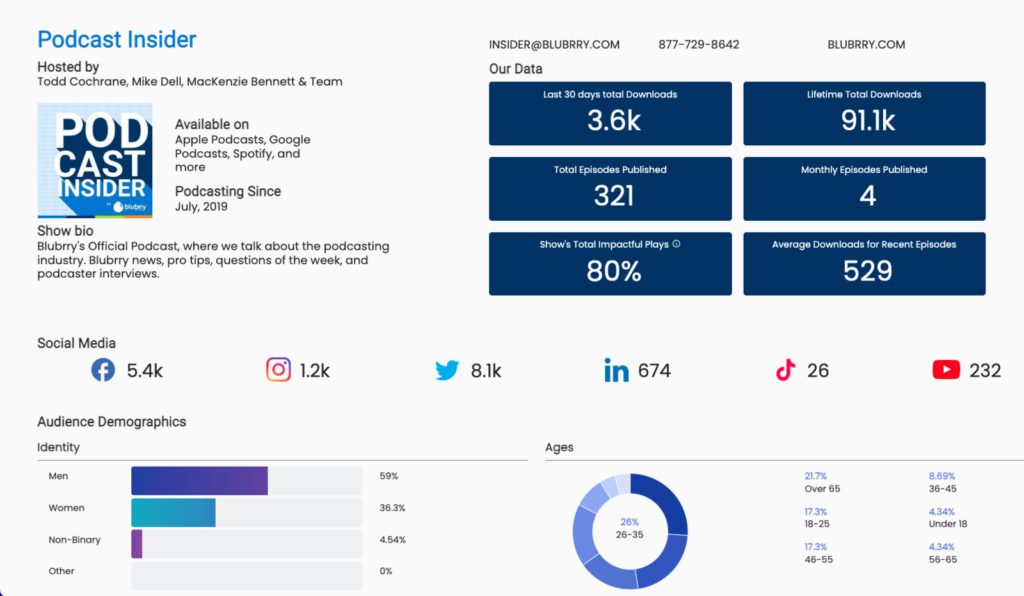
    Blubrry is introducing a podcasting industry first by providing all Blubrry paid customers a podcast media kit that updates daily with information you choose to include. The kit includes data you provide, podcast statistics and audience survey results.

    Podcast Media Kits can be expensive and time-consuming to put together and are always out of date as soon as you publish them. Our media kits are refreshed daily with the newest data.

    Who to Share Your Podcast Media Kit With

    • Advertisers
    • Sponsors
    • Media writers
    • Partnership deals
    • Future guests
    • Event and speaker coordinators

    The data provided in the media kit listed below includes the ability to toggle specific data points on and off, under your discretion.

    Podcast Data Points

    • Podcast website link
    • Show start date
    • Average monthly episodes published
    • Audience survey results (minimum 10 responses)
    • Number of episodes published overall
    • Monthly episodes published
    • Host bio
    • Show description
    • Social media follower count
    • Contact information

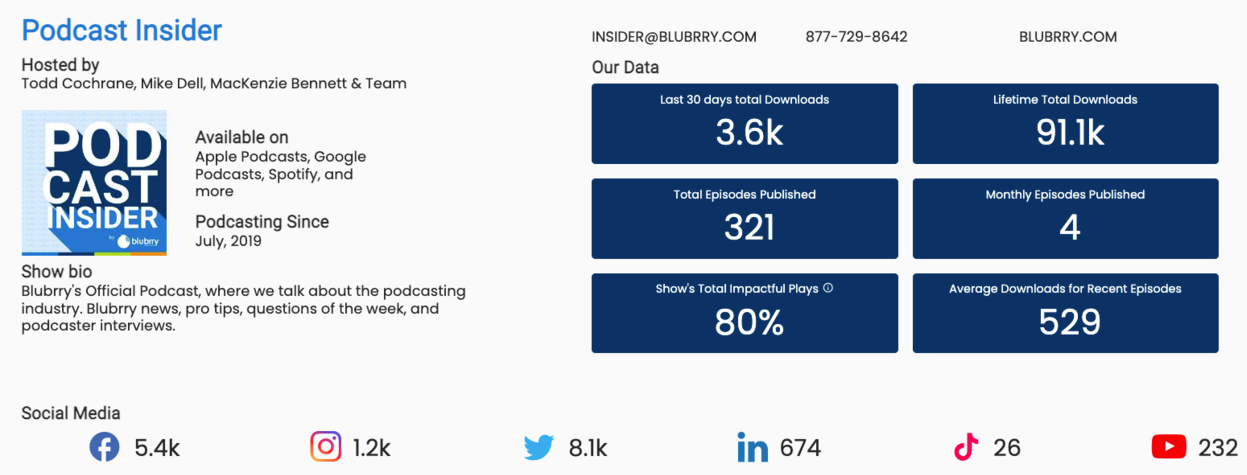
    Media Kit example

    Once you’ve completed the media kit, a public URL will be provided in its dashboard. This URL is unique and complex for search engines to index, but it is possible, especially if it’s shared on social media.  Automatic updates to the media kit will be done daily, but podcasters can change/update the media kit whenever they’d like. You can find the media kit within the podcast statistics section of the dashboard.

    Take a look at the Podcast Insider media kit here. We’ve chosen to include all of the data points that are made available. As always, we want your feedback. We came to this version after much debate on how fancy or bare bones to make these media kits, based on how we think they would benefit most podcasters. We know podcasters are eager to point out ways we can improve. So let our support team know here and if you love the final result, share it with your audience on social.

    Get started to showcase your podcast in an accurate, creative way!

  • Your Company Should Be Podcasting

    Your Company Should Be Podcasting

    CompanyIf you’re ready to be nominated for employee of the month, or possibly employee of the year, it’s time to suggest that your company start a podcast. There’s nary a company in existence that wouldn’t benefit from starting its own podcast. Whether you sell a product, offer a service, or anything in between, there’s no downside to promoting your brand on your own terms and own time.


    ON PITCH

    You may clearly see the value of a podcast for your company, but getting the rest of your team on board might take a little more convincing. The higher-ups could be concerned that this would take time away from the tasks you already have. Or, they may not truly understand how their brand fits within a podcasting format.

    Crafting a convincing pitch involves not only mapping out the format and episode details, but also demonstrating that podcasting is a low-time commitment, yet high-impact means to raise brand awareness. Point out the benefits of crafting your company’s message and making that message available 24 hours a day for possibly years to come.

    A podcast can be about more than just a company’s message; it can also be a fun way to bring a staff together. You likely have coworkers that would love to work on the company podcast, which could potentially boost morale and foster an even greater sense of teamwork.

    LOW COST, HIGH RETURN

    As many of Blubrry’s previous articles have already covered, podcast listenership is increasing with each passing day. Sure, many people listen to the chart-topping podcasts, but niche podcasts have incredibly loyal listeners.

    A podcast gear startup kit can be purchased nearly anywhere and be setup in any quiet space. The only other recurring cost is your hosting site, which should be Blubrry so we can help you grow with your show!

    After those costs, it’s truly up to you and your team what kind of bells and whistles, if any, are needed to help customers find your message and content. Your team can release episodes at whatever rate works for your workflow. Adding special episodes for product releases, holiday sales or any sort of special news may be another way to add value to your podcast, without having to add anything to what has already been spent.

    THE MARVELOUS MARKETING DEPARTMENT

    If your company has a marketing department, odds are they already have money earmarked for advertising and innovative ways to promote the brand. Approaching the marketing department with your podcast idea is a great place to start.

    HOOK A HOST

    Some industries have influential people within their field who are looking to diversify their image. Perhaps you work in design and there’s an artist you’ve been dying to connect with. Why not contact that artist to see if they might want to host the show on behalf of your company? Approaching a like-minded, industry-known host can further broaden the potential for the company’s podcast reach and be mutually beneficial for both sides.

    RECORD TODAY, PODCAST FOREVER

    No matter what gear or episode format you choose, once your episodes are posted, they are out there for as long as your company wants them to be. You can have an episode detailing the benefits of a specific aspect of your brand and you only had to record and produce it once. The upfront effort could pay off for your business for years to come.

    LISTEN IN NEXT WEEK…

    No longer do you have to wait for larger media outlets to tell the world what your business is all about. Your team can craft the message you want your customers to know about your company and you can release that message on your timeline, and on your terms. There isn’t another advertising medium available to businesses of all shapes and sizes quite as powerful as podcasting.

    Written by: Tara Jean O’Brien

    Tara Jean O'BrienTara Jean O’Brien has been a writer, actor, improviser, podcaster, and stand-up for nearly 800 years. When not producing, editing, and hosting her podcast, Single Vs. Married, or co-hosting, Cinema Craptaculus Presents: B-sides, she also writers on Medium and recently found a floor safe hidden in her coat closet.

  • Making the Most of Your Summer Break

    Making the Most of Your Summer Break

    SummerVacation is all we ever wanted, but it’s hard to take quality time off when you are a podcaster with a consistent show to keep moving along. Taking a summer break is something that is completely up to you; and it’s your choice how long you decide to be off. If you are feeling the pull to take some time off this summer but still keep your show moving and grooving, check out our tips below.


    The advantages of taking a podcasting summer break include: 

    • Time spent with family, friends or even just by yourself 
    • The ability to pause and look at the past season to see what worked, the upcoming shows you plan for after your break and how you want to shape them from your previous experience 
    • The chance to keep recording even without releasing a new episode and get ahead for when you do return. You can use this time to bank recordings, get them edited and even start to create marketing materials.

    I caught up with podcaster Ian Shoff of the Movie Cinema Film Club podcast, who has a great perspective on taking a summer break. “After a year of recording on a nearly weekly basis, I’m taking off from mid-August to October to bicycle across America. It has been a bucket list item of mine for 10 years and I’m finally going for it! Being on the bike will be good for me to disconnect and dream up new content for the show.”

    If you choose to, there are plenty of options to stay top of mind with your subscribers.

    • Everyone loves a good “best of” or recap episode. Podcaster and Purely Elizabeth CEO Elizabeth Stein ran a Season 3 wrap-up to her show, where she included some top tips she learned over the season run.
    • Give your audience advance notice by mentioning the break on your show for the two to three episodes before you take off.
    • Post about what you are doing while on break, and your audience will feel more connected with you and as though they are on your journey with you. Keep that parasocial relationship strong.
    • Take this time to really hone in on your strongest social platform and post-behind-the-scenes content, respond to trends or create audiograms from recent episodes and repurpose them as shareable posts.
    • Ask your audience via IG poll or email list what they want to see more of when you return.
    • Consider premium content or a subscription model like Patreon to stay in touch. Maybe premium subscribers still get an episode, while general subscribers have to wait it out.

    Fears may arise of your audience moving on and forgetting about you, or the show losing the momentum you worked so hard to create. As long as it’s clearly communicated with your audience in as many ways as possible, they will support you and will be even more excited about your return.

    Follow Blubrry to stay up to date with all podcast news while you are enjoying that break. Be sure to follow @Blubrry or @Blubrry_podcasting on all social media places.  Facebook, Twitter, LinkedIn, and Instagram. They’ll be releasing the 300th episode of their company show, Podcast Insider, this week, stay tuned for a lively conversation!

  • Branding For Your Podcast

    Branding For Your Podcast

    Creating a Brand For Your Podcast

    BrandingA podcast with amazing content can easily be overlooked if you don’t have and eye-catching brand. Establishing a brand for your podcast is an important part of podcast audience growth and eventual monetization. Do you know how to create a memorable brand? Or what branding might entail? Keep reading.

    Some of What Branding Entails

    1. Artwork: People say not to judge a book by its cover, but they do. Make sure you’re not losing people because of bland artwork. If you’re not comfortable creating an amazing logo, hire it out. And don’t forget to follow the directory requirements.
    2. Social media presence: Will you be adding this to your current social or creating a podcast identity? Don’t feel the need to be active on all social channels. Consistently participating in one or two platforms is more useful than random interactions on multiple platforms.
    3. Directories: Be found everywhere; submit correctly to each directory. Blubrry can help you make sure you’re following all of the requirements.
    4. Website: Create a homebase. A Blubrry tried and true. A solid website for your podcast, blog posts, links to social, other content, etc. will help you establish yourself online. We provide a WordPress website with all hosting, but you’re able to use any website you’re comfortable with.
    5. Guidelines: Things like colors, logos, fonts, etc. How are you presenting yourself online?

    Creating a brand for your podcast is more than just the minute work. Here are things to keep in mind when creating and executing your new brand.

    Embellish a Bit

    Fake it ’til you make it, right? There is a certain amount of anxiety and uncertainty that comes with establishing a brand and marketing strategy for your podcast, especially if you’re just starting out. If you’re feeling overwhelmed, master the combination of faking it and humorously sharing your pitfalls so far. People like to relate to others and encourage you; however, a bad attitude and woe-is-me attitude can burn your followers out.

    Bring in a Second Opinion

    No one is the best at everything, which means that a second pair of eyes is always beneficial before you release something or make a final decision. This really comes back to the finer details mentioned above. A trusted friend, colleague, etc. can provide feedback that you can either accept or reject. Either way, projects are always easier when you aren’t going it alone.

    Stand Out in the Crowd

    If there are several podcasts similar to yours (and you should know if you’ve done your research) then you need to establish how you’ll be able to stand out above the rest. Offer something that others aren’t, but remember that content is king. Why will you be memorable compared to the other shows similar to yours? 

    Provide Value

    You can have the most amazing marketing and branding around, but if your content doesn’t provide actual value, you’ll find yourself having a hard time building a loyal audience. Demonstrate your high standards and then stick to them. A consistent host is a reliable host. Everyone wants to create a podcast to partake in a community, and you are responsible as the host for setting the tone.

    In a world of around 4 million podcasts, we want you to be proud of yours. If you’re ready to start your podcast or make a major change to the one you already have, follow these steps and as always, reach out to Blubrry for any issues you may run into.

  • Why You Need a Template For Your Podcast

    Why You Need a Template For Your Podcast

    For your collaborators’ sake, don’t attempt to record your show without using a template. A template is your roadmap to a successful, streamlined, focused episode. It’s a simple document that keeps you on target and makes your show more enjoyable for your listeners.

    Start your template with important information about your podcast. This typically includes the name of your podcast, the name of the hosts and guests, the episode number of your podcast and the name of the episode. You should also let listeners know the date of the recording.

    Here is a simplistic template for the start of your show:

    “You are listening to (name of podcast). I’m your host, (your name), and I’m here with (name of co-host and/or guest). Today is (month/date/year). This is episode number (050), and it is titled (catchy name that reflects what you will talk about).”

    When you are ready to do your next episode, refer back to the show introduction template. Change out the old episode number to the new one, pick a new episode title, and fill in the current date. It doesn’t take long to do, and it will help you sound consistent and professional.

    There are many podcasts where the host and co-host feel comfortable using their real names on their show. Gaming podcasters, however, often use the name of their main character from whatever video game their show primarily focuses on. Whichever way you go, it helps your audience to recognize you.

    Here are some things that can also be part of your template:

    Pre-recorded intros and outros: Instantly get listeners attention by using a pre-recorded intro and outro in your episode. This will quickly get the attention of your listeners, while giving them information such as the name of your show, the names of the host and co-host and perhaps some amusing sound clips from previous episodes. Make it fun! Music can be included – but you need to be super careful about copyright. 

    The outro should include the name of the podcast and a reminder to your audience where to find the website of the podcast and where to find the show’s accounts on social media. 

    Recent news that fits the topic of your show. Tell your listeners the title of the article and where it came from. Put a link to that article in your template – it will make creating show notes faster. 

    Advertisements: Monetization has become a big deal in podcasting because ads can (potentially) generate money to keep the show going. Your template can help you to wrap things before switching to a host-read ad. To make things easier, put the entire text of what you need to read into your template, so you aren’t fumbling around while reciting the ad. 

    Where to share your template:

    If you are a solo podcaster, you can put your show’s template on your computer, phone or tablet. Whatever works best for you. Just remember to update the episode number, name of episode and date before you start your next episode. Podcasters who meet in person to record the show can send a copy of the template to the co-host.

    Podcasters who do their show remotely, with people who live far away, can make use of Google Docs. The free version allows you to invite in people who will take part in the newest episode of your podcast. The host(s) and co-host(s) can access the Google Doc in between episodes to add in topic ideas, links to relevant news and more. Make sure to update the date, episode number and show title before you hit record.

    Do you use your show’s Discord to gather a live audience and record new episodes? Prepare a template before you jump into a host/cohost-only voice channel. Fans can listen in while participating in a text chat. It is a great way immediately answer questions, highlight amusing comments and get a sense of audience’s interest.

    ____________

    Jen Thorpe wearing glasses, hat and face maskJen Thorpe has been podcasting since 2005. They are the host of the Shattered Soulstone podcast, which releases new episodes every week. When they aren’t podcasting, they are playing video games or Dungeons & Dragons.

  • Blubrry Offers Annual Billing for Podcast Hosting

    Blubrry Offers Annual Billing for Podcast Hosting

    iPhone calculatorYou are making an impact with your podcast. You’ve already decided that you’re sticking to your show and want to ensure you’ve made it as easy as possible to maintain the momentum. To make it even easier for podcasters to stay on track, we’ve introduced annual billing for hosting customers. Forget monthly payments and pay upfront to ensure there’s no interruption to your podcast hosting.


    Save Money

    Our Standard and Advanced hosting plans are included in the annual option. On average, you’ll save about 10% a year, no matter the hosting plan, for choosing an annual subscription versus a monthly subscription. Save yourself some money and a little bit of hassle, too.

    Annual Hosting Costs

    • Standard Hosting 125MB of storage: $120 billed annually ($10 month), save $24.
    • Advanced Hosting 400MB of storage: $204 billed annually ($17 month), save $36.
    • Check out additional hosting plan options on our website.

    Make the commitment whenever it makes sense for you. You can sign up at any time.

    Great Use Cases

    We’ve worked directly with many customers over the years to provide this on an individual basis, and have experienced a vast number of reasons why podcasters find it useful. Below are some examples of who would benefit from a one-time payment subscription.

    • Government organizations
    • Nonprofits
    • Educational organizations
    • Those with a strict budget
    • Churches
    • Teams with an annual budget
    • Company cards and finance teams that don’t want to manage monthly payments
    • Podcast seasons! I.e, you’re going to release episodes for only one or two years
    • Retired shows. Our standard hosting plan is the least expensive option for those who aren’t actively publishing, but want to keep their show online.

    Where to Sign Up

    Annual billing is available to people just signing up for a podcast hosting plan or those adjusting the plan they are currently on. New plans can sign up on the we-moved-the-blog-to-this-site-when-we-made-a-new-website.blubrry.com/ homepage; and adjusting your current hosting level can be done in the Billing section of the Blubrry dashboard while logged into your account. At the end of your subscription, you’ll be able to automatically renew.

    Please reach out to our sales and technical support team if you have any questions or problems with the process. Do so here.

  • Stalking Your Prospective Audience Without Being Creepy

    Stalking Your Prospective Audience Without Being Creepy

    Using Social Media to Locate Podcast Listeners

    StalkingA podcast audience is usually built slowly, mostly by word of mouth. Personal recommendations have always been the most valuable way to spread the news about any new product. While it might look better to buy social media ads, in many podcasters’ experiences, ads on the social media platforms aren’t very effective.


    Here’s why:

    • The podcaster doesn’t specify the audience they want to reach. 
    • The social media platform has primarily a different audience.
    • The ads themselves are not compelling or don’t stand out to get attention.
    • The investment is too small to make an impact.

    So what do you do to build an audience?

    1. Build Your Credibility

    Social media isn’t a waste of time. It’s simply how you approach it. Your audience is probably on some or several social media platforms. But which one?

    Doing research into your ideal listener will identify what platform you want to be on: It’s not only about what’s the most popular right now. TikTok currently has a large impact, but so did Myspace before Facebook plowed it under. Did anyone predict the recent resurgence of Reddit?

    Once you find out where your people are, get there yourself. But don’t announce your podcast just yet.

    Build your credibility and your name by participating in groups, discussions, comments and messages on the best platform for you. Reddit, for example, has participation restrictions written into the platform and the audience there can be challenging. Drop in and announce your podcast without creating a persona there and the other Redditors will react – often not in the way you want.

    Still, Reddit is becoming a big player these days. Even national news magazines such as Newsweek now use Reddit stories as content. There are podcasters who are publishing content on Reddit, but they’ve been on the platform for a while. When you go on Reddit and find podcasters promoting episodes, it’s because they’ve built an audience.

    This sounds very chicken-and-egg but, in fact, those podcasters did the work on Reddit to start out with and built their credibility before making announcements about their shows. One technique I’ve seen used by new podcasters/Redditors is to enter a conversation with a question for the original poster, and take time before recommending a particular episode of their own podcast. So, if you’re a new podcaster, you’ll need to build up your library at the same time.

    2. It’s About Content and Relationships

    This American Life is a highly regarded, well-known podcast that started on radio. At one point, that organization decided to take the risk of putting its content out for people to listen on their own schedule, aka a podcast. Back in the day, getting a repeat or rerun was subject to the whims of the producers. Now it’s in our hands as listeners. This makes a different dynamic – one that favors podcasters. We reach our audience on their terms.

    This is why our content makes a play for the audience through more personal and intimate methods. We are asking for the most valuable commodity a listener has: their time. If we’re not respecting that, we’ll never gain their attention.

    Great content delivered in an echoey, hard-to-hear format is as useless as perfect sound but useless information. Yet it’s not only about the quality of the sound in the podcast. To provide content in the way our audience wants to hear it, we could reconsider the “throw it on the wall and see what sticks” method of content development.

    Finding out what people want challenges us. But social media platforms have a wealth of answers when you’re willing to do the searches to find out.

    Suppose your podcast is about the television smash hit Bridgerton. The next season’s release date is on the lips of every fan. Promos are coming out, theories are discussed. If you’re into historical romance, those discussions can provide you with potential content:

    • What is it about that first season that people loved and are looking for in the next?
    • What other books/series do these fans follow?
    • How does the book series differ from the show?
    • How did the producers reproduce the look described in the story into the visual world of TV?

    When you know what your audience is asking for, you can provide it. Respect and relate to your audience. When you’ve earned the right to promote your podcast, then you’ll see your audience grow because you’ve invested the time on social media to get to know them.

    But not in a stalker way. Don’t do that. That’s creepy. Keep it professional. Keep it respectful. Keep it fun.

    Need more tips on growing your audience? Check out Blubrry’s free, online Podcast Manual and let us know what has worked best for your show on our social media.

    Twitter
    Facebook
    Instagram
    TikTok
    LinkedIn

    ____________

    Kim KrajciKim Krajci, host of Toastmasters 101 podcast, has been podcasting for 7 years and writing since the creation of the stylus and clay tablets. She also teaches speech and debate and works as a social media manager.

  • When Outliers Come Together, Good Things Happen

    When Outliers Come Together, Good Things Happen

    The Outlier Podcast Festival Review – Thursday May 5 and Friday May 6 at the Native Hostel in Austin, Texas

    Todd Outlier 2022The Blubrry team packed up our cowboy boots and denim shorts this week and headed to Austin, Texas. Our destination was the Outlier Podcast Festival, a traveling event held in major cities across the country that provides the podcasting community in the hinterlands a chance to connect with each other and with industry giants.

    The event,  founded by  Ever Gonzalez and run by Ever and Outliers co-creator Arielle Nissenblatt,  was held at the funky Native Hostel. Blubrry’s CEO Todd Cochrane kicked off the festival on Thursday with a keynote on the state of the podcasting industry; and a glimpse into the future with some important tips on building diversity and protecting your brand. The night followed with talks on remote recording, overcoming podfade and easier ways to leverage podcast subscription and premium platforms.

    Saturday morning started with delicious breakfast tacos, sponsored by the Podcast Movement, which fueled attendees and speakers for the busy day of learning and networking about to come. The event featured panels and keynotes on marketing, branding, monetizing and developing your own identity as a podcaster/podcasting expert.

    A few key takeaways from the Outlier Podcast Festival: 

    • Record for your audience; write for Google.
    • We are making momentum toward more diversity and inclusion in podcasting, but there is still much work to do.
    • Podfade is real, and our industry has a very high rate. In the past 30 days, out of the 4 million listed podcasts, only 372,000 published new episodes. 
    • It’s important to support other podcasters in your community and to ask for help when you need it. The podcast community is made up of many “Outliers” who are a great resource to bounce ideas of and can help to keep you accountable.
    • Having your own website is critical. Don’t rely on having your home-base on someone else’s platform. It’s important for podcasters to protect their brand.
    • Social media (and marketing in general) can seem overwhelming, but you don’t have to be all things to all people. Find one or two places that you enjoy posting, where your audience also hangs out, and focus your efforts there.

    Stay tuned with Outlier’s announcements to see when the festival is coming to a city near you. Word on the street is that the Outliers will be hitting the West Coast with a Los Angeles festival in September.

    Follow Blubrry to see what Podcasting Events we are headed to next. Be sure to follow @Blubrry or @Blubrry_podcasting on all social media places.  Facebook, Twitter, LinkedIn and Instagram.

    ____________

    Meryl Klemow

    Meryl Klemow is a podcast writer, guest booker, and co-host of the Campfire Sht Show podcast. Meryl is a part of the Blubrry content team, and a Senior Copywriter at Podfly Productions. She also has a T-shirt line, Pre-Canceled. Say hi to Meryl on Instagram at @MerylKlemow.