
Category: Marketing

  • Stalking Your Prospective Audience Without Being Creepy

    Stalking Your Prospective Audience Without Being Creepy

    Using Social Media to Locate Podcast Listeners

    StalkingA podcast audience is usually built slowly, mostly by word of mouth. Personal recommendations have always been the most valuable way to spread the news about any new product. While it might look better to buy social media ads, in many podcasters’ experiences, ads on the social media platforms aren’t very effective.


    Here’s why:

    • The podcaster doesn’t specify the audience they want to reach. 
    • The social media platform has primarily a different audience.
    • The ads themselves are not compelling or don’t stand out to get attention.
    • The investment is too small to make an impact.

    So what do you do to build an audience?

    1. Build Your Credibility

    Social media isn’t a waste of time. It’s simply how you approach it. Your audience is probably on some or several social media platforms. But which one?

    Doing research into your ideal listener will identify what platform you want to be on: It’s not only about what’s the most popular right now. TikTok currently has a large impact, but so did Myspace before Facebook plowed it under. Did anyone predict the recent resurgence of Reddit?

    Once you find out where your people are, get there yourself. But don’t announce your podcast just yet.

    Build your credibility and your name by participating in groups, discussions, comments and messages on the best platform for you. Reddit, for example, has participation restrictions written into the platform and the audience there can be challenging. Drop in and announce your podcast without creating a persona there and the other Redditors will react – often not in the way you want.

    Still, Reddit is becoming a big player these days. Even national news magazines such as Newsweek now use Reddit stories as content. There are podcasters who are publishing content on Reddit, but they’ve been on the platform for a while. When you go on Reddit and find podcasters promoting episodes, it’s because they’ve built an audience.

    This sounds very chicken-and-egg but, in fact, those podcasters did the work on Reddit to start out with and built their credibility before making announcements about their shows. One technique I’ve seen used by new podcasters/Redditors is to enter a conversation with a question for the original poster, and take time before recommending a particular episode of their own podcast. So, if you’re a new podcaster, you’ll need to build up your library at the same time.

    2. It’s About Content and Relationships

    This American Life is a highly regarded, well-known podcast that started on radio. At one point, that organization decided to take the risk of putting its content out for people to listen on their own schedule, aka a podcast. Back in the day, getting a repeat or rerun was subject to the whims of the producers. Now it’s in our hands as listeners. This makes a different dynamic – one that favors podcasters. We reach our audience on their terms.

    This is why our content makes a play for the audience through more personal and intimate methods. We are asking for the most valuable commodity a listener has: their time. If we’re not respecting that, we’ll never gain their attention.

    Great content delivered in an echoey, hard-to-hear format is as useless as perfect sound but useless information. Yet it’s not only about the quality of the sound in the podcast. To provide content in the way our audience wants to hear it, we could reconsider the “throw it on the wall and see what sticks” method of content development.

    Finding out what people want challenges us. But social media platforms have a wealth of answers when you’re willing to do the searches to find out.

    Suppose your podcast is about the television smash hit Bridgerton. The next season’s release date is on the lips of every fan. Promos are coming out, theories are discussed. If you’re into historical romance, those discussions can provide you with potential content:

    • What is it about that first season that people loved and are looking for in the next?
    • What other books/series do these fans follow?
    • How does the book series differ from the show?
    • How did the producers reproduce the look described in the story into the visual world of TV?

    When you know what your audience is asking for, you can provide it. Respect and relate to your audience. When you’ve earned the right to promote your podcast, then you’ll see your audience grow because you’ve invested the time on social media to get to know them.

    But not in a stalker way. Don’t do that. That’s creepy. Keep it professional. Keep it respectful. Keep it fun.

    Need more tips on growing your audience? Check out Blubrry’s free, online Podcast Manual and let us know what has worked best for your show on our social media.

    Twitter
    Facebook
    Instagram
    TikTok
    LinkedIn

    ____________

    Kim KrajciKim Krajci, host of Toastmasters 101 podcast, has been podcasting for 7 years and writing since the creation of the stylus and clay tablets. She also teaches speech and debate and works as a social media manager.
  • Tips For Using Discord As A Podcaster

    Tips For Using Discord As A Podcaster

    Using ‘Discord’ to Connect Fans with Fans 

    Discord logoYou probably have Twitter and Facebook accounts for your podcast. Some podcasters also use Instagram or Mastodon. Those are all great ways to let listeners know when your newest episode is up. That said, sometimes the social media algorithms will make it difficult for new people to find your show. One way around that is to make a Discord channel that is dedicated to your podcast and its fans.

    Discord gives fans of a podcast a way to meet and get to know each other. It also gives those fans a connection to the host (or hosts) of the show. Include a link to your channel on your website (like Blubrry’s free site), mention it in your podcast; give people a call-to-action to get started.

    What is Discord?

    Discord https://discord.com has a very welcoming description of itself:

    “Imagine a place where you can belong to a social club, a gaming group, or a worldwide art community. Where just you and a handful of friends can spend time together. A place that makes it easy to talk every day and hang out more often.”

    Each Discord is unique. Podcasters can set up the Discord for their show as they like. You can choose to make your Discord invite-only if your community wants to feel safe. Or, you can let anyone join in without vetting. Either way, it is a good idea to make someone a moderator, or to have several moderators. Removing the bad actors is important because they are the ones who tend to come in and try to undermine things. Don’t let them destroy a healthy community!

    The majority of Discords have topic-based channels where people can add things or make comments. There can also be channels where only the admins can add to it. The most important channel topics you need to create are ones that match the topic of your podcast. 

    A News channel can be used to post recent information that directly relates to the topic of your podcast. A gaming podcast will add news about the game (or games) that their podcast focuses on. A podcast that has guests in every show can post about who the next guest is.

    Make a channel where you post a link to the newest episode that has been released. This helps people who aren’t on social media and who won’t see tweets or posts about it. Doing this also reminds people who frequent the Discord about the new episode. 

    A Community channel can be used by anyone who joined your Discord. Typically, people tend to stick to topics that match the main focus of the podcast. If that channel gets too cluttered, you can make new channels where people can chat about random or unrelated things. I’ve seen Discords with channels such as “cute,” “general,” “food” and “Discord suggestions.” 

    It is also possible to have voice channels where people can talk to each other directly, without using text. Gaming podcasts often have one of these because it makes it easier for people to communicate in the game they are playing together. Another great use of the voice channels is to keep your community up to date on the conference that you are attending.

    Some podcasters like to record their episodes directly into Discord, where the community can listen to it live and post chat comments. Others prefer to record it first and then add a link to the show notes in the Discord. Either way can work well.

    Be Present

    Discord is a very social experience. People who join a Discord are either doing it because some of their friends are in it, or because they are big fans of the podcast. For best results, you need to make an effort to pop into the Discord and say hello or join in a conversation. People like it when the host of the podcast shows up and makes themselves accessible for conversation.

    Another great way to use Discord is to connect with other Discords that match your show’s topic. Recently, I participated in a “campfire” conversation that was recorded on someone else’s Discord. A person from that Discord invited me to join the campfire and asked permission to post a recording of it on my podcast’s server after it was finished. It was fun! Sharing exclusive content like that can benefit both Discords, as people who are on one might decide to join the other.

    Podcasters should check in on what’s happening in their Discord often. Take a second to “wave hi” to people in the Welcome channel who recently joined. Make a post in the Community channel to announce new channels you have added (and why they are useful). Watch for the little red circle that appears next to your Discord’s icon and pop in and respond to it. 

    In short, the best thing about Discord is the connectivity between fans and even the host (or hosts) of the show in a way that cannot be replicated on other types of social media.

    ____________

    Jen Thorpe wearing glasses, hat and face maskJen Thorpe has been podcasting since 2005. They are the host of the Shattered Soulstone podcast, which releases new episodes every week. When they aren’t podcasting, they are playing video games or Dungeons & Dragons.

  • Audience Survey Results Added to Blubrry Podcast Stats

    Audience Survey Results Added to Blubrry Podcast Stats

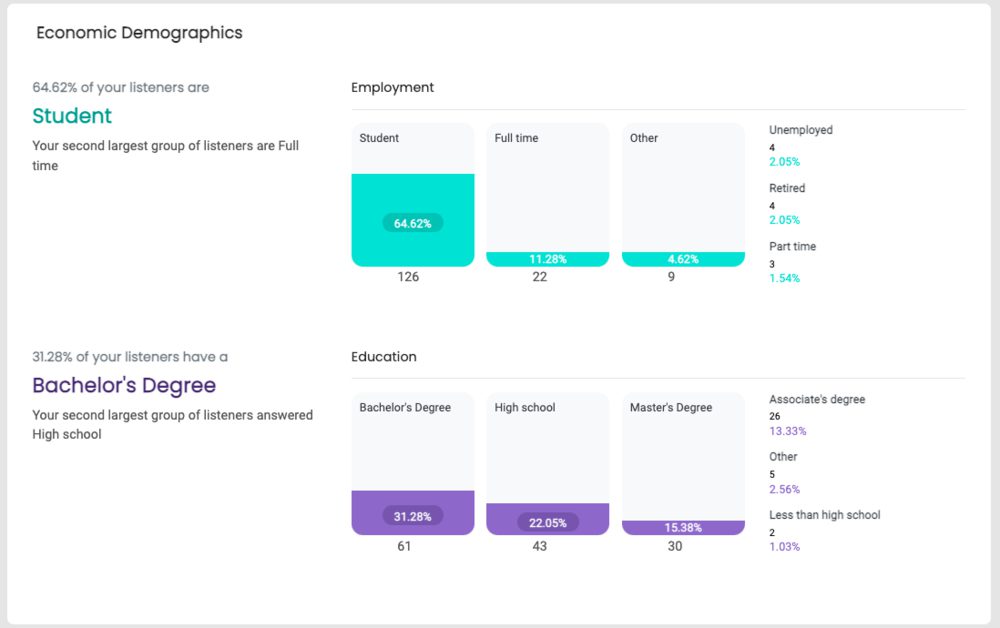
    Audience demographics graphically available in podcaster dashboard.

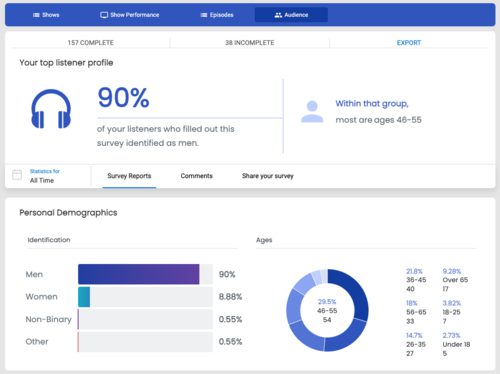
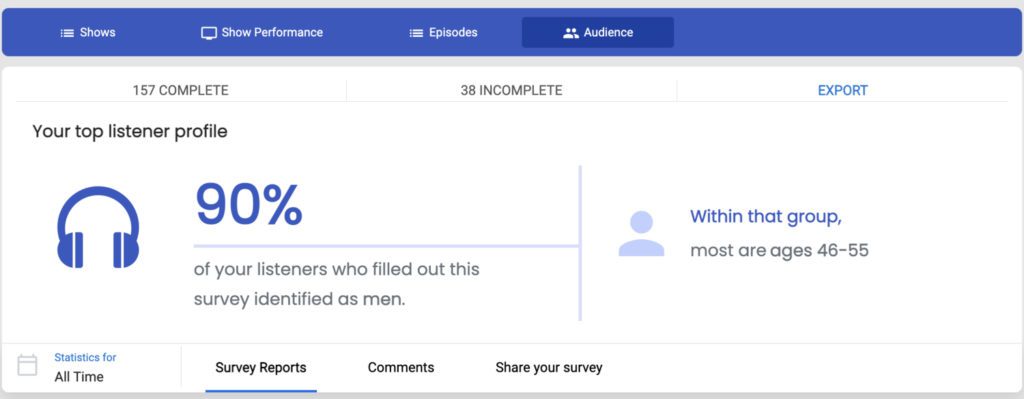
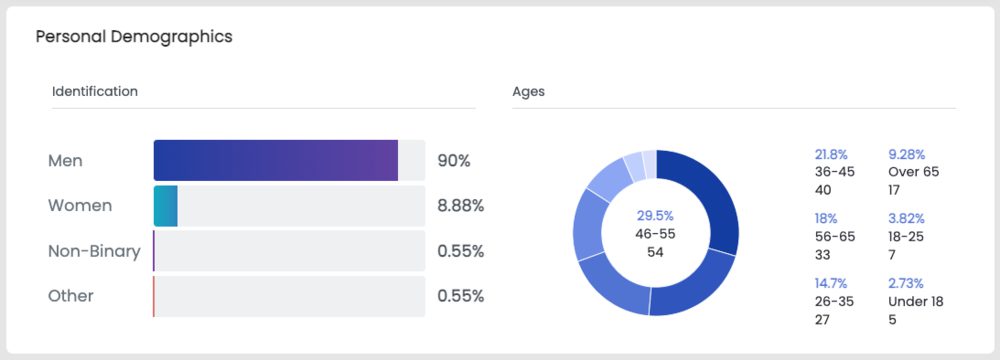
    Last month we updated our audience survey and promised an audience survey results section within our podcast statistics. You can now check your results with beautiful charts and graphs that look into the type of listeners listening to your podcast. If you’re curious about your potential audience results but want to learn more about audiences for the industry, check out the latest from Edison Research’s 2022 Infinite Dial Report, where they provide podcasting data.

    Where to Find Audience Survey Results

    A newly updated tab in the podcast statistics section is called audience. From there, you’ll see new charts and graphs representing the results, and you can download a CSV of your results overall.

    How to Use This Data

    • Add it to your media kit.
    • Back up your podcast stats info with relevant info about your listeners.
    • Make strategic marketing decisions, such as connecting more with your younger Gen Z audience and their interests.
    • Take it to heart, and by that, we mean sit back and reflect on your results and how they connect to your Impactful Play and Retention data.

    Focus your efforts on pleasing your audience with more curated content and working better to fit your listeners’ habits, lifestyles, and preferences. This reliable demographic data is in demand all over the podcasting industry, and you have the power to get it directly from your listeners. 

    One of the most exciting parts of the new survey data is that those surveyed can leave you a comment, which they can keep private or be shared publicly on Twitter. If a listener left you a positive comment and clicked ‘public,’ you can share that with your Twitter audience directly through Blubrry.

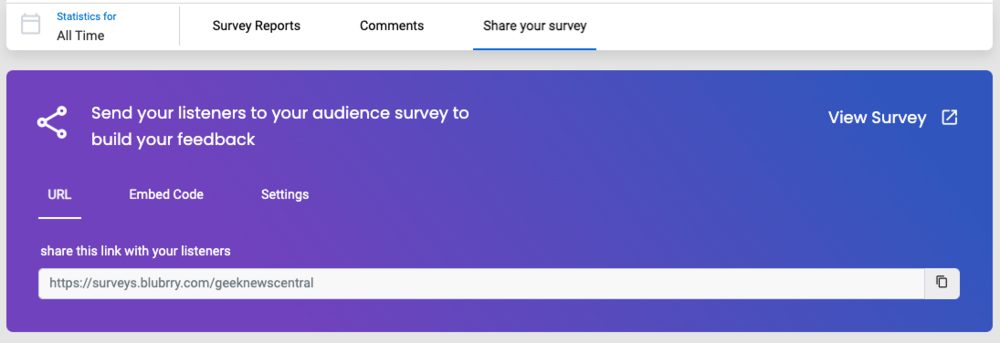
    If you’re not already using our audience survey, it’s incredibly easy to get started. We provided some ideas on how to do that here. An audience survey can help you grow your audience. This is one of many tools we’ve refined and re-released to assist podcasters in publishing their show and continuously analyzing and learning how to best grow their show. 

    Those who have used the audience survey previously will see their past results already implemented. Those not utilizing the audience survey will see results after one completed survey.

    Lastly, our audience survey is available to anyone with a Blubrry account. You’ll find the best use case for the survey results is when you’re also using our hosting and have access to the Impactful Play and Retention data from our stats. Standard stats users receive the visual results, but free stats users do not and can download the raw data in a CSV.

    A visual representation of collected data is now easier to comprehend and view changes over time. We hope you find the visual results compelling and helpful in addressing your audience and podcast content in the future. Read here and get started with yours, found under Audience in Blubrry’s podcaster dashboard, to learn more about audience surveys.

  • There are Times You Want to Keep It Private Your Company can Secure Content for Exclusive Audiences

    A recent report estimates that in 2021 the number of monthly U.S. podcast listeners will increase by 10.1% to 117.8 million. This means not only are there more listeners, there is more of a need for carefully segmenting content designed for limited listeners.

    Employees at your company are already consuming podcasts. Their favorite shows fit their lifestyle: they like to listen whenever and wherever is convenient for them, whether at work or on the go.

    That’s a key to how many employees want to be educated and trained by their employers. Many companies still try to connect with employees through written communications (i.e. via email or the company’s intranet). But, given the choice, a lot of people would prefer to listen vs. read. We live in an age where people expect the option to consume their content via audio and video media, the way they learn best.

    Companies have shown an interest in using the podcast medium to communicate internally, with use-cases ranging from company announcements and interviews to onboarding and training. But they’re being held back for a very important reason: security. Even if the content isn’t controversial or sensitive, no company really wants their internal content to get out. We’re not just talking about company trade secrets; most executives don’t want any content intended for internal audiences to be accessible outside the company.

    You won’t need to search long to find hosting services offering “private podcasting.” Beware! Many services suggest or imply their product is secure, but in reality it’s simply an obscure RSS feed. The fact you can’t find the latest episode on Apple Podcasts or Spotify doesn’t mean the media is truly secure. Security Tip: Secure private podcasts require login credentials and authentication.


  • Become a Headliner

    Become a Headliner

    Even if you’re not a standup comedian with a full hour of material, you can be a headliner! Headliner is an app that takes your podcast promotions to an 11 (for all you Spinal Tap fans out there). This app allows you to create shareable videos using the audio content from your podcast. It’s like creating your own music videos for your rockin’ podcast content.

    We all know the best way to spread the word about your podcast is via social media. The more interesting the content you put out, the more likely you’ll get interaction with your posts. Not only does Headliner put visual images to your audio content, but it also gives you the ability to add subtitles. Now, people scrolling Twitter, Instagram, or Facebook at work (not that anyone does that!), or in places where they can’t hear their phone audio, can read the content of your episodes. Headliner is a great resource if you want to hook an audience and leave them wanting more. Check out some of these podcasts to see how they are integrating Headliner with their content.

    Headliner offers a free version that gives you up to five free videos per month, and two different paid versions that unlock a whole new level of bells and whistles to make your Headliners pop. You can create videos to the length of your choosing; add your own graphics, cool waveforms, animation and transcription. There are multiple format options so you can customize the content for each social media platform. With just a few clicks, you can make an eye-catching video you can post right from inside the app.

    Another bonus is that Headliner is a Blubrry partner, so our hosting customers can easily navigate to their published episodes right within their podcast dashboard. After you publish an episode, it’s one click to get to Headliner.

    We all have episodes we think deserve an extra boost. A fun technique to get new listeners to take the extra step to listen to your entire episode is to cut off your content at a key moment in a Headliner. Say your episode involves the details of a true crime and right when your host is about to reveal the killer, your Headliner ends. Or, if your host and guest are in the middle of a debate, cut off your Headliner when it sounds like the debate is about to get heated. Don’t be afraid to stop mid-sentence or mid-thought. After all, who can resist a great cliffhanger?

    Over 100,000 podcasts have used Headliner to promote their content. Not only is it free and easy, but it’s also fun to create them. Once you create your own library of Headliners for your podcast episodes, you might even consider combining them to create a “best of” reel. The point is, don’t let standup comedians think they’re the only ones capable of headlining! Get started with Headliner today!

    Written by: Tara Jean O’Brien

    Tara Jean O'BrienTara Jean O’Brien has been a writer, actor, improviser, podcaster, and stand-up for nearly 800 years. When not producing, editing, and hosting her podcast, Single Vs. Married, or co-hosting, Cinema Craptaculus Presents: B-sides, she also writes on Medium and recently found a floor safe hidden in her coat closet.

  • Samsung Podcasts Open for Submissions

    Samsung Podcasts Open for Submissions

    Podcasters can submit to the Samsung app to grow their audience.

    Expanding your distribution is an important aspect of growing your audience. We’re happy to report that the Samsung Podcasts directory is now accepting submissions from any podcaster.

    The Samsung Free app features numerous types of media content, including podcasts and podcast hosts, who can submit here. After a quick sign-up to create a Samsung Publisher account, you’ll be on your way to new listeners in no time.

    As with any podcast submission, make sure you have your RSS feed on hand. Blubrry users can find this in their dashboard: In the sidebar navigate to Show, then Manage and under Tools you’ll see your RSS feed. Samsung has made it easy to submit multiple shows at once, so it is an easy process for those with podcast networks. Recently, Samsung  updated its RSS feed specifications to use RSS 2.0, including a few categories. Subcategories are not included at this time.

    Samsung Podcasts launched earlier this year. By submitting now, you’ll be able to reach new and eager audiences of listeners — available exclusively on Galaxy and Note Samsung devices. Currently, the Samsung Free app, where podcasts can be found, is only available in the United States; expanding to the UK, Italy, Switzerland, Spain, Germany, Austria and France by the end of October.

    Blubrry podcasters can find many additional destinations, aka directories, to submit to directly within the newly updated dashboard. Those who have already submitted through Blubrry’s partner launch do not need to submit again.

    If you are unsure whether you submitted earlier this year, please contact Blubrry. You can read here on our blog to learn more about the initial release this past March.

  • Episode Titles: Get Your Audience to Click Play

    The power of a great episode title.

    You’ve recorded your best episode ever. You produced an amazing interview with timely and funny commentary. Your audience wants this information. But you named it My Podcast, Episode 47. Will that episode title get your audience hit the play button?

    Our episode titles and our show notes introduce us to new listeners. If our titles don’t attract them, they will move on to the next recommendation.

    What keys can open the door to new listeners, build your podcast SEO and motivate people to respect you as a thought leader?

    What do you need to consider to get more plays?

    1. Give your episodes names that create curiosity: You may have the single most important guest on your topic on your episode. The content may change lives. But if the audience doesn’t know the guest, then they probably don’t know what this guest has to offer. How do you entice them to listen?

    Create curiosity with your episode titles. Make your audience wonder — and don’t give them the answer. Sometimes all you need to do is ask a question:

    • Do You Know How to Entice Your Audience to Hit Play?
    • Is Your Potential Audience Finding Your Podcast?

    You can also hint at what’s inside:

    • Three Simple Tips to Build Your Podcasting Audience
    • Encourage Plays with Your Episode Titles

    You can learn how to write enticing titles by going over* to Buzzfeed.com. Their titles compel us to click. They have made a science of writing clickbait titles.

    Am I telling you to write clickbait titles?

    No, I want to challenge you to write compelling episode titles. When you write captivating titles and you’re honest — not just reeling them in to increase your ad sales — you get more listeners. Promise only something that you can deliver. But you can write that episode title in a way that makes someone decide that they can’t wait to hear your podcast.

    If you need help, find a headline generator online. Free headline generators will suggest dozens of titles for you to choose from. Those titles might even inspire new podcast ideas.

    2. Use the right keywords in your episode title: Search Engine Optimization (SEO) is the key to making Google and the other search engines find your podcast. Now that Google has a podcast player, it’s easier than ever to find a podcast, or an episode on a specific topic. 

    What’s your podcast episode about? What will someone who needs the information put into Google?

    If you’re doing a podcast with a specific guest, you should include their name and the topic in the episode title of the URL . . . 

    • MyPodcastShow.com/Podcast-Titles-Todd-Cochrane
    • MyPodcastShow.com/Name-Your-Podcast-Todd-Cochrane

    . . . but make sure the title of your episode focuses on the topic.

    • Episode Titles: Todd Cochrane Talks About Episode Names
    • Name Your Episodes with Todd Cochrane

    The words that you start your titles with matter to search engines. If the important keyword comes first, then the search engines will rank your episode higher.

    That’s why naming your episode Episode 47 doesn’t help anyone find your podcast in a search engine. You’ll get found, along with hundreds of other Episode 47s.

    Several podcasts sound like they have used a podcast episode number in the name. A podcaster might tell their listeners to go to Episode 47, but in that case, they may have used a redirecting plugin such as Pretty Links.

    We need to think about what people are going to see in their podcast players. Regardless of the player, the episode title is the first thing a potential listener is going to see.

    3. Find the Right Verb: Hint, “Is” Isn’t: Should you use descriptive words in your episode title? Don’t those attract listeners? Will your listeners be more attracted to . . .

    Your Podcast Title is Simply the Best

    or

    Find the Podcast Title That Brings New Listeners

    . . . and hit the play button?

    Those titles don’t differ from each other, but find tells your audience what they need to do: find the right word. That clarifies to the audience what they will hear in your podcast. Is doesn’t sell your episode; it doesn’t tell the listener what they will take away from your podcast.

    When you tell the audience what they will get from your episode or the benefits they receive from listening, you create value in their mind. They know what knowledge they gain from you and how to apply it to their lives. That makes your advice valuable to them. You become a leader in your field and gain some authority. If you want to build your position, pick the right verbs. 

    Features don’t sell. Benefits do. Use those benefits to pitch to your audience about what they will glean from your podcast that will help them. Keep the focus of your episode title to sell your podcast. New listeners will come.

    ____________

    Kim KrajciKim Krajci, host of Toastmasters 101 podcast, has been podcasting for 7 years and writing since the creation of the stylus and clay tablets. She also teaches speech and debate and works as a social media manager.

  • Get More Listeners with a Podcast Website

    The importance of owning the gateway to your podcast kingdom

    Laptop keyboardBlubrry believes you should have a website dedicated to your podcast that is separate from any page that your podcast media host provides for you. Blubrry believes that you should make it a robust website that engages your current podcast listeners and also drives new listeners to your show. Blubrry believes you should ‘own’ your podcast website so that YOU can control the functionality, look and full experience of your website visitors. Blubrry believes this so strongly that it details how to create your own podcast website in the Blubrry Podcast Manual.

    Some of you may be convinced that you need a podcast website simply because Blubrry believes you do. If so, you can follow the instructions in Blubrry’s Podcast Manual and have a podcast website in place in no time. Some of you might need a little more convincing; let’s address that.

    Make your podcast more relevant in search results.

    Both Google and Apple say that their search results are ranked by a website’s relevance to what is being searched. While you can spend quite some time learning Search Engine Optimization skills that will impact the perceived relevance of your podcast, below are two tried-and-true practices that boost your rankings in search results.

    1. Say you produce a fan podcast dedicated to the broadcast journalist Savannah Guthrie and someone is searching for a podcast about her, you’ll rank higher if ‘Savannah Guthrie’ is in your primary domain name. The website thesavannahguthriefanpodcast.com will rank higher than mypodcasthost.com/thesavannahguthriefanpodcast. Further, every post on your website will be viewed as a more relevant search result. The savannahguthriefanpodcast.com/ guestjeopardyhost will rank higher than mypodcasthost.com/thesavannahguthriefanpodcast/ guestjeopardyhost.
    2. You produce a weekly podcast on Unidentified Aerial Phenomena (UAPs) and you post your episodes to your podcast webpage every time you release a new episode (either manually or automatically). Since your website is being updated weekly, it will be viewed as more relevant by search engines than other websites that are not updated as often. This pushes your website up in the search results.

    Control your branding and user experience.

    If you are using a free service for a media or website host for your podcast, you are allowing them to benefit in some way from your content. The ‘free’ services usually do this by at least one of the following ways.

    1. They ‘brand’ your podcast with their name. Let’s say you produce a weekly podcast dedicated to true crime named, True Crime Nation and you upload to a free media host that provides a free webpage. That company may promote their service using your podcast. They may promote your show online as, ‘True Crime Nation: A MyMediaHost Podcast.’ In this way your show is forever connected to their service regardless of their corporate reputation. Several media hosts have actually changed the podcast name or description to officially include the services name.
    2. These ‘free’ companies may also place ads on your ‘free’ website. You do not have control over the ads on your website and the company receives payment each time your listeners click on their ads. The company is incentivized to display ads that receive the most clicks regardless of whether they are related to your podcast or support your podcast’s image.

    Use the service that your podcast deserves.

    To fully explore this principle, we will use a logic exercise rather than using an example. These ‘free’ companies are incurring expenses to provide their services and making money from somewhere else. As a business they are trying to maximize profits, so they are trying to make as much revenue as they can and provide the service for as little expense as they can. Since you are a customer of their ‘free’ service you are subject to the least expensive service that the company can provide that they deem viable. You are putting your time and skills into a podcast that is going to be hosted on someone else’s least-expensive service.

    To revisit a phrase from before, Blubrry believes it is better for you to pay for a service from a company that guarantees a certain level of quality in exchange for your money. This allows you more control over the media hosting / website experience. Also, this allows you to fully portray what you want to say about your podcast to the world. This benefits your podcast in the long run.  

    If you would like to know more about how to create your own podcast website, you can find that information over in the Blubrry Podcast Manual. And feel free to visit Blubrry Support to have your questions answered.

    ____________

    Troy PriceTroy Price is the co-founder of Front Porch Studio in Berea, Kentucky. He has been involved with podcasting for over a decade. Listen to his show Podcasting Tips from the Front Porch here.

    Contact Troy by email at troy@frontporchstudios.com.

  • Focus on Features: Blubrry’s Podcast Destinations

    Focus on Features is an ongoing series that explores the catalog of tools/services offered by Blubrry.

    Smartphone appsPodcasting is all about distribution. The more places your podcast can be found, the larger your audience can grow. There are many places where people consume podcasts. Blubrry wants to help you get your show into as many of these places as possible. That’s what the Destinations section of your Blubrry Podcaster Dashboard is all about.

    What it is: Blubrry’s Destinations feature allows you to submit your show to a number of different podcast-consumption platforms. Spotify, Amazon Music, Podcast Index, Podchaser, Gaana, JioSaavn, and Deezer are all available Destinations.

    How it works: Log in to your Blubrry account and find the Destinations section of your Podcaster Dashboard. Click the link for a Destination you’d like to submit to and follow the instructions from there. Submitting to Spotify requires an active Blubrry Media Hosting subscription. All other Destinations can be used for free, regardless of whether or not you’re using any paid Blubrry services.

    What it isn’t: The Destinations feature isn’t for all podcast-consumption platforms. You will still need to submit your show directly to services like Apple Podcasts, Stitcher, and TuneIn. Also, the Destinations feature covered here is different than the Destinations tab found in the PowerPress plugin.

    You never know where your show’s audience may be. Making your show available in as many places as possible is the best way to reach them. Use Blubrry’s Destinations feature to get your show to these previously unreached listeners, and watch your audience grow! Learn more here in our Podcast Manual.

  • Sticking to a Podcast Schedule

    Why Sticking to a Schedule is the Most Important Aspect of Podcast Growth

    Looking at watchEveryone starts somewhere, and more often than not, it’s at the bottom, especially when we are talking about podcasts. “What’s the fastest way to grow my podcast?” is a question that everyone asks when they start out, and there are tons of correct answers. Some of the best answers are:

    • Post on a specified and reliable timeline
    • Do guest spots and outreach
    • Become well versed in sound editing
    • Find reliable places online to do promotion
    • Focus on making every episode better than the last
    • Treat podcasting like a job

    If you want your podcast to take off, it’s a good idea to treat it seriously. And what’s the best way to treat it seriously? Stick to a schedule. 

    Having a schedule is like having a list of checkboxes that you do in regular intervals. When the schedule is respected, listeners are rewarded regularly, outreach and guest spots are achieved consistently, and the podcast is always improving.

    Set a Release Schedule

    Remember Pavlov’s dogs? Pavlov rang a bell every day before feeding his dogs, and before long, they would drool at the sound of that bell ringing, whether or not there was food. That’s what happens to listeners when they can rely on a new release on a certain day or on a set schedule. 

    If listeners can rely on a podcast every Monday, eventually that podcast becomes part of their routine. Retaining new listeners is just as important as being heard by new listeners.

    Some podcasts release every Wednesday; others choose to release on the 13th of every month. Make sure to pick a release schedule that is achievable and stick to it. Make sure to have a few pre-recorded episodes saved up for emergencies such as sick days.

    One Day a Month, Do Outreach

    Easiest to ignore and the hardest to achieve, it makes sense why guest spots and outreach frequently are ignored. Yet it’s one of the most important factors for podcast growth and it’s a skill set that only gets better with practice. For those reasons, it’s a good idea to have one day a month where you do some outreach. 

    Sit down and reach out to a few other podcasts via email or social media. Monitor your methods of communication and realize many others don’t reliably check their email or social media channels. If you get one opportunity a month to guest on another show, that’s huge! 

    Doing this exposes your podcast to a whole new audience; even if it’s a smaller audience than yours, it’s still a win. One small win a month can equal a big payoff overall in numbers. 

    Regularly Edit the Podcast

    I see many beginning podcasters out there asking if they can pay someone to edit their podcast, and I get why. It’s hard to learn a new skill such as audio editing, and it seems like a huge time sink. In the beginning, it is a huge time sink – but soon, you will become adept at audio editing. 

    Podcasting is about more than just talking into a mic, and the more that the podcaster becomes proficient, the more value is added to the show.

    Plus, no audio engineer will care as much about your show as you, and that’s the truth.

    Regularly Improve the Show

    This is a big one. It’s why people love the old episodes, because “Back then, they barely knew what they were doing!” Every year, people ought to be able to look at the previous year and say, “You’ve come a long way.”

    Whether it be something simple like trimming the fat in the show intro or something big like coming up with a new format that is more compelling, the goal should be for every episode to be better than the last.

    Always be looking for ways to improve, which means going back and listening to episodes, no matter how much it makes you cringe.

    More Podcast Scheduling Means More Gets Done

    If podcast growth is the goal, doing as much as you can for the podcast is the way to attain the goal. The best way to ensure more gets done is to make it a regular part of the daily, weekly or monthly schedule. 

    Let us know what your podcast schedule is and any tips on how you remain consistent!

    ____________

    David DayDavid Day is the co-founder and co-host of Horror Movie Talk Podcast. When he isn’t watching horror movies he is focused on growing the podcast. Listen to his show Horror Movie Talk here.