

Category: Marketing

  • How To Be a Good Fan of Podcasts

    How To Be a Good Fan of Podcasts

    How To Be a Good Fan of Podcasts

    We address the role of podcasters all the time, but what role, if any, does the podcast fan play? Listeners are ultimately the ones who decide the fate of a podcast. They are the reason hosts, writers, editors, producers – and everyone in between – create content in the first place. Fans are the most crucial part of a podcast’s success.

    LIKE, SUBSCRIBE & REVIEW

    This might seem like the most obvious action for any avid podcast listener, but if you examined the statistics of podcasts available on Blubrry, you’d see that there is often a great disparity between download numbers and subscribers. Taking the extra step to like and subscribe is really valuable to podcasters.

    These statistics provide great feedback for podcasters to know when they’re doing something well and when their fans like something; and these stats also can bump their show up in podcasting rankings. Higher rankings mean the show can grow and attract more listeners (and more money) to keep the content flowing. When in doubt, “like” it out!

    SOCIAL NETWORKS

    Interacting on social media is the lifeblood of podcasting these days. Any platform is helpful for fans looking to find one another as well as people looking for new podcasts in general. Here are some of the best ways to be a great fan on social media.

    • Facebook Groups: Though this platform is falling out of favor for some people, its user base of nearly 3 billion people is hard to ignore. Creating private or invite-only groups is a fantastic way to connect with fellow fans, commiserate on episodes – and it can be a great way for podcasters to share exclusive content with their most active fans.
    • Clubhouse: Much like Facebook, you can create private rooms to discuss every detail of your favorite show. Since this is also an app where you listen to people’s voices, it’s not unlike listening to a podcast.
    • Twitter: In spite of the recent drama, it is still incredibly easy to share podcasts and create groups on this platform.
    • Instagram: Sharing on Insta has gone well beyond photographs. With companion apps such as Headliner and the growing popularity of Instagram Reels, finding or creating a fan community here is easier than ever.

    CONNECT WITH YOUR FAVE POD IRL

    If a podcast you love does an in-person recording, a meetup, or even a live online session, you should attend! Not only will you get to meet the people you love listening to, but you’ll also get to meet a group of people who love the same content you do. With everything we’ve gone through as a collective during the past few years, it’s more important than ever to get face time in with new people.

    SHARING IS CARING

    Another thing that might seem as obvious as liking and subscribing is sharing podcasts with your friends, family, and even your enemies. (A listen is a listen!) Next time you want to give someone a gift that is low-cost, but full of love, curate a Spotify playlist of your favorite podcasts and episodes to share.

    MIND YOUR MANNERS

    It can be easy to fall into bad behavior online. Bullying or name-calling people with opposing views may seem anonymous and harmless. In reality, it’s never helpful, and these days it’s rarely anonymous. Your behavior can negatively affect the podcast you think you’re supporting.

    SUPER-LEGIT SUPERFAN

    Not only do your favorite podcasters need your support, but you often help them curate their content. They might do episodes based on a question you posted on Reddit or start a listener call-in segment based on how much interaction they see online. Every show should be so lucky to have great superfans!

    But it’s important to keep in mind that everyone has boundaries that need to be respected. Podcasters generally make themselves available to fans regularly, so contact them when and how they invite you to do so. Trying to get their attention in creepy ways (contacting them at their residences, bombarding them with DMs, or sharing their personal information) is never appropriate or acceptable.

    THANK YOU FOR ACTIVELY LISTENING!

    When it all comes down to it, podcast creators are not only in it for themselves, they’re looking for a community, too. Podcasters want to connect with their fans as much as their fans want to connect with them – so get out there, retweet, share, like, subscribe and enjoy the journey together.

    _________________________________

    Written by: Tara Jean O’Brien

    Tara Jean O'BrienTara Jean O’Brien has been a writer, actor, improviser, podcaster, and stand-up for nearly 800 years. When not producing, editing, and hosting her podcast, Single Vs. Married, or co-hosting, Cinema Craptaculus Presents: B-sides, she also writers on Medium and recently found a floor safe hidden in her coat closet.


  • Podcast Show Notes

    Podcast Show Notes

    Follow our tips on how to get your podcast show notes just right.

    Should your show notes be bullet points, or an article overview?

    You spend your precious time getting your podcast just right. The perfect audio mix, thoughtfully crafted topics and questions, snazzy intro music and a marketing plan to call in new listeners and engage current ones. All the elements are there, yet there is a question still lingering and a decision to be made before you’re fully off and running to the podcast races – how do you want to build your show notes? It’s a question every podcaster goes through at least one time during their journey, and it’s not uncommon for people to experiment and even change up their show notes as they go along and determine what feels right for them.

    First, We Must Get Clear on “show notes” in General

    There’s the general description or blurb that you write once to describe your show on platforms such as Apple and Spotify, but these are different – and they are referred to as the show description. Show notes are the description of each episode, a synopsis of what that particular episode is about. They often include a title, two to three sentences about the episode (“In this episode, we chat about …) and a brief section mentioning relevant links, resources mentioned in the episode, where to find the show, and a social media handle or website link for guests. They also could include tweetables / pull quotes, a thank you to sponsors or discount code to advertisers and other goodies you feel add value. Almost always they are either in first- or third-person, and the style of your show notes should be similar to the style of your podcast and the universe you’ve created around it. For example, is your tone playful, serious, detailed, fast paced or succinct? Is it more straightforward and fact based, or loose and conversational? This will help you determine the answer to the question, should your show notes be bullet points, or basically an article overview?

    Here are some reasons why you may choose one or the other. There is no right or wrong, it’s just more about the style of your show and what will be more sustainable for you to put out. It’s also important to think about your audience and the type of attention they are spending on notes. Is it a 1-minute quick read as they walk to work, or are they poring over the notes to reference as they listen along?

    Bullet Points

    • Great to encourage people to listen, and can pique curiosity.
    • Helpful for people just skimming the notes to see what they can expect as they’re diving into a listen or download.
    • Bullet points in your notes may be a little more mysterious and vague, not giving away the meat of your episode or spoiling everything you talked about.
    • Bullet points can drive home the important broad strokes of an episode for both you and the listeners.

    One example of a show that does bullet points in their notes is Ballard Design’s “How to Decorate” show. They create interest for teasing what you can get in the episode rather than giving it all away.

    Article Overview 

    If you find your bullet points are getting too lengthy, an article overview might be better for you. An overview is also great if you are repurposing it for a blog or newsletter, an article on Medium or another writing site. Long blocks of text that give people too much info could lead them to feel like they don’t need to listen to the podcast, so if you do opt for an article overview, you can still use the teasing structure to create mystery and interest.

    An example of a show that does a good job of show notes that are more article overview style without making them too long or overly complicated is Mike Poznansky’s “More Than a Job.”

    Whether you choose bullet points or an article overview style, you can still get in the key words and phrases that can ramp up your SEO. For more ideas on using your show notes for search engine rankings and discoverability, become a Blubrry Podcast Insider.

    ____________

    Meryl Klemow

    Meryl Klemow is a podcast writer, guest booker, and co-host of the Campfire Sht Show podcast. Meryl is a part of the Blubrry content team, and a Senior Copywriter at Podfly Productions. Say hi to Meryl on Instagram at @MerylKlemow.
  • A Peek Into What “Piques” Your Audience’s Interest

    A Peek Into What “Piques” Your Audience’s Interest

    PeaksAs a podcaster, your show’s lifeblood is a faithful and engaged audience. Not only do they love your content and fill your socials with praise and camaraderie (heck, even the haters shine a spotlight on what you’re doing), but your listeners also help guide you toward like-minded advertising companies. Identifying what piques your audience’s interest on an episode-by-episode basis should be high on your to-do list. Lucky for you, Blubrry is here to help!

    WHO’S YOUR AUDIENCE?

    Besides your creative team, your audience is your most important podcasting partner. Of course, you should produce content that is authentic to your story and your expertise, but be wary of becoming too complacent or self-indulgent. Very few people want to listen to too much, “inside baseball” content. If you don’t take the time to analyze who’s listening, where new listeners are coming from and who you want to eventually be listening to your show, you’re missing out on valuable information that is readily available on the Blubrry podcaster dashboard.

    Maybe your funny personal story got the most attention, or maybe it was a special guest who appeared on the show. You can find those types of specifics on the podcaster dashboard to analyze your episode, minute by minute. 

    GIVE THE PEOPLE WHAT THEY WANT

    An episode you felt was half-hearted, or not your favorite topic could get twice as many listens as an episode you put a ton of time and resources into. If you can’t put your finger on why, and there doesn’t seem to be an easily identifiable difference in format or episode length, you can hone in on potential reasons using Blubrry’s audience survey.

    The survey can be sent to your audience as you see fit. This data can tell you the age, gender and location of your audience. Maybe Gen Z is really digging your skincare content or perhaps Gen X just can’t get enough of the 1980’s mash-ups you analyze. Now that you’ve got the data, you can double down on creating your next podcast episode’s earworms.

    HOOK ‘EM!

    Now that you’ve checked out your audience survey, you’re primed to please your listeners. You know what episodes, what parts of episodes and even what topic or guest is resonating the most.

    You know this because Blubrry’s podcaster dashboard has aggregated your stats on impactful plays and audience retention. This data can tell you how meaningful your content is for your audience. If they’re listening to over 75% of episodes – you’re crushing it. For episodes that aren’t as popular, you can figure out at what point people stopped listening and, perhaps, don’t replicate whatever happened at that point again!

    When you combine the goals of your show, your business goals and what content is attracting the most listens, this can help immensely to align the focus of your show’s material. Consider crafting a whole season around this model and then not only will you have provided your audience with an experience they will enjoy, but hopefully they’ll keep coming back for more of your awesomely curated, consistent content.

    A FINAL… “PIQUE”… INTO THE FUTURE

    Sorry (not sorry) about the play on words! But truly, keeping your audience excited and interested can be challenging no matter what style of show you produce. Remaining true to the elements that draw people to your show, and really dedicating yourself to understanding what your audience enjoys is key to long-term success. No podcast can survive in a bubble (unless it’s actually a show about bubbles) so dig into the incredibly valuable statistics Blubrry provides, and your show will never be in danger of … PEAK-ing… on your podcast journey!

    _________________________________

    Written by: Tara Jean O’Brien

    Tara Jean O'BrienTara Jean O’Brien has been a writer, actor, improviser, podcaster, and stand-up for nearly 800 years. When not producing, editing, and hosting her podcast, Single Vs. Married, or co-hosting, Cinema Craptaculus Presents: B-sides, she also writers on Medium and recently found a floor safe hidden in her coat closet.

  • Growing Your Podcast on Social Media

    Growing Your Podcast on Social Media

    From the 102k-follower content creator, Travis Brown

    Everyone has their own unique experiences that, I think, they could easily share if they just look at it through that lens of ‘I’m just sharing cool stuff with the world.’ – Travis Brown

    GrowthContent creation might seem intimidating, but all we are doing when we create content is sharing cool stuff. You’re just sharing something that you love with other people. It could be a tip. It could be a story. It could be a lesson. It could be the do’s and don’ts that keep people from being harmed. Everyone has their own unique experiences that I think they could easily share if they just look at it through that lens of, “I’m just sharing cool stuff with the world.” Then content creation doesn’t seem so intimidating!

    Why should podcasters leverage social media to grow their shows?

    1. Discoverability. I think that podcasters are at a big disadvantage from discoverability simply because people wake up in the morning and check their emails and social media, not necessarily a podcast app first. So podcasters need to be on social media because it’s where the eyeballs are. Any platforms that are high-traffic areas, whether it’s Instagram, TikTok, YouTube, any of which is another opportunity to get discovered and gain more listeners.
    2. Building your community. I would say that it’s probably the biggest opportunity for everybody is to start a ‘tribe’ or build a club, something that helps you attract the people that are gonna be your biggest supporters, future collaborators, future employees, etc.When I was at a recent podcast conference, I noticed how much the community is really such a big part of podcasting, and how much of a community we need to build around ourselves. I think that that’s where social media can tie into your podcast. Because, again, it’s a one way street! I talk through this mic, it goes to your ears. You can’t talk back to me. Right? Where can you do that? Well, you can do that on social media. So now we have this two-way conversation and we’re building community, we’re building relationships with our audience.

    Any tips on choosing a social media platform? Should people be active on one or multiple channels?

    What burns people out is that they try to be everywhere all the time. I have tried that and it didn’t work for me because you’d find yourself constantly trying to do this, that and the other thing. So my recommendation is just go to your favorite platform, whatever you like to use, and start there and just build out that platform.

    Do’s Don’ts
    • Start with your favorite platform
    • Define your targeted audience
    • Stay active on the platform 
    • Make sure link to your social media platform is visible and easy-to-find
    • Try to be everywhere at the beginning
    • Overwhelm them and paralyze them with too many options
    • Compare yourself with others
    • Expect overnight success

    You should also think about your audience too. If your audience is 70+-year-old men and you’re trying to teach them to lift weights for example, then you might want to leverage where they might be on Facebook. There are different platforms for different target audiences. So you need to ask your audience and do a bit of research. But if you don’t like using the platform, you’re not gonna go on it. Despite all of the above, the key to social media is being active, being a part of the community. It’s you using the platform. I’ve spent the last two years building my Instagram account up to over a hundred thousand followers. And I do believe that if I would’ve been trying to do all the platforms at once that I wouldn’t be as far as I am now that I have that right.

    Plus, make it easy on people so they can find you. When your audience asks where they could find you, and you say you can find me on Instagram, it’s super easy for them. But if you say you can find me on YouTube and TikTok and Instagram and whatever the next app is, they might be overwhelmed. Worse, they might not take action either. Don’t overwhelm them and paralyze them with too many options.

    We’re just trying to really get good at being a member of a community somewhere. And I think it’d be great for podcasters to keep that in mind, since they already have to keep themselves busy, get things done with content planning, preparing the show notes and inviting guests to their show.

    What kind of content do you recommend podcasters to create?

    The most successful accounts are typically the value-led ones and the really-entertaining ones. 

    If you can combine that, and sprinkle on some moments that are personal and relatable to your audience, you’ll start connecting with people on social media.

    I can tell you that video is king right now. Instagram’s pushing video. TikTok is all video. YouTube’s doing short form videos. Twitter is a little different since it’s more conversational. Twitter is the easiest kind of content that you could create in my opinion.

    It’s easy because we are just holding up your phone and talking to it on a video. We do that on FaceTime and we talk to people all the time, but for some reason when it comes to creating content, people don’t wanna do it. And that leads us to the next question.

    What if podcasters don’t like to be on video?

    If you don’t like being on video, I would consider doing something like carousel posts on Instagram, which are a series of posts that contain infographics and you can just write text on it. So let’s say your podcast is about cooking. You could create a recipe on a bunch of different slides taking them step by step on how to make risotto for example. And that becomes valuable! Maybe you talked about risotto on your last podcast episode, so you can make sure that people know that you reviewed the world’s No. 1 risotto restaurant, and they’ll be more likely to go over to actually listen to the podcast.

    However, a podcast is like sitting at the table with the host(s), except that you don’t see them and the room is pitch black. So at some point, your listeners would love to have a clue of who they’re hanging out with. And I think that’s where social media comes to where you can show people who you are. I mean, I’ve done this a million times. I’ll hear someone on a podcast and I go Google image them. I just wanna see what they look like.

    We are the guide. And our job is to give as much value as we can to our audience, you know, share some cool stuff with our audience and, you know, sprinkle in ourselves. I think that curiosity at some point peaks in every podcast fan. What does this guy look like? What does this lady look like? And it gives us a better internal representation of them. So by putting yourself out on social media, I think you give people some context clues to where they can get a little closer to you.

    More pro tips

    • Interact with other accounts and your fans on social media
    • Create value in your posts
    • Ask people questions to keep them engaged
    • Send audio messages to new followers
    • Introduce yourself and start a conversation
    • Create names for your “squad”

    A big thanks to Travis Brown for joining us this time to share his social media wisdom.

  • Connecting With Your Local Community

    Connecting With Your Local Community

    8 Fun and Easy Ways to Connect With Your Local Community as a Podcaster

    Local communityRegardless of where you live, your local community can be a great place to support your podcast and find both new listeners and fans of the show. Whether you live in a big metropolitan area or a small town, there are some simple and fun ways to connect with the folks who live there and to let them know about your podcast.


    We’ve put together eight ideas to build up your local community and take your podcast from off the apps and into a town near you.

    1. Strategize. Where Are Your Target Listeners Hanging Out? 

    This is where you list the different hobbies and activities your podcast listeners typically tend to gravitate toward, and you can build out from there. Are they interested in yoga, education, coffee, real estate, etc.? Even if it’s not podcast-related, you can attend events that align with your listeners and begin to meet community members who might just naturally be interested in what you’ve got.

    2. Sponsor Something Local! Big or Small 

    There’s a local podcast that sponsors a freeway exit sign on my commute, and that show lives in my head for at least 30 seconds every day. While a highway exit sign may not be the road you want to travel, look for sponsorships at local 5ks, local festivals, farmer’s markets, nonprofit events, and more. If you set aside a marketing budget for your show annually, you can divvy out sponsorship dollars. One idea is also to ask the event if you can do half the sponsorship in cash and the other in podcast ads or social media posts. 

    3. Throw a Podcast Party! 

    Find something to celebrate about your show. The 100th episode? Ten thousand downloads? Your fourth anniversary as a podcaster? Have a podcast-themed party where all attendees get show-related swag as a parting gift. Go out of your comfort zone and invite not only close family and friends, but those local community members you think could be future fans of the show. 

    4. Identify Local Tastemakers and Invite Them On Your Show

    Even if your show is not locale based, create a segment every couple of episodes that features some local influencers and key people. Depending on your show topic, this can include politicians, local musicians, authors who have a new book to promote, chefs, local reality stars, etc. 

    5. Pitch Yourself To Local Media 

    Introduce yourself and your show to local news, radio, newspapers, weekend magazines, etc. Offer yourself as an expert on podcasting in general, or about the topic your show is about. Don’t be a pest, but check in every couple months to say hello and see how you can help them. 

    6. But, Like, Actually Get Out in the Community

    I’ve found that it’s the everyday community members who get more excited about my podcast than actual family and friends. Talk with your barista, local grocers, dog groomers, etc. about your show when it seems appropriate. 

    7. Connect With Other Local Podcasters

    If you live in a larger city, chances are there may already be podcast meetups. If not, be the one to start it. Host a podcast party where you rent out a small venue, charge tickets and pick three to four podcasts to do mini live versions of their show. We did this in Los Angeles and it was SUPER fun, even if it’s mildly scary to do your podcast live if you’re used to the comfort of in-home recordings. 

    8. Add Your City as a ‘Character’ on Your Show. 

    I often hear from our listeners that even though they don’t live in Southern California, they love hearing all the annoying “LA” stories and horrific tales of traffic from me and my co-host. If you want to get extra fancy, contact your local Chamber of Commerce or hotels and see if there’s any special giveaway or discount they can give your audience for visiting your city. Figure out some great touristy things about your town and make the non-locals interested in planning a trip there someday. 

    Follow Blubrry on Podcast Insider to stay up to date on all podcast news while you are enjoying that break. Be sure to follow @Blubrry or @Blubrry_podcasting on Facebook, Twitter, LinkedIn and Instagram.

    ____________

    Meryl Klemow

    Meryl Klemow is a podcast writer, guest booker, and co-host of the Campfire Sht Show podcast. Meryl is a part of the Blubrry content team, and a Senior Copywriter at Podfly Productions. She also has a T-shirt line, Pre-Canceled. Say hi to Meryl on Instagram at @MerylKlemow.
  • Show Me the Monetization

    Show Me the Monetization

    Cartoon man holding idea light bulb and moneyOnce the podcasting bug bites, many podcasters want to work on their podcast full time. This might be easier said than done, but with the right strategy and a whole lot of hustle, making money off your podcast is entirely possible. Here are a few ways to monetize your way into being a boss!


    THE CLASSIC ROUTE – ADS/COMMERCIALS

    Ads are still how most podcasts make money. Whether it’s selling 15-second spots, or one-minute slots, you can make a deal with a company to insert their ad into your podcast. There are various guides to figuring out what to charge based on your listenership and download stats (which are easily accessible to Blubrry customers), but how you structure your deal is entirely up to you.

    Another popular way for companies to get ads on your show is for the host to read the ad directly (host-read advertising). These ads are generally placed “pre-roll” or “mid-roll” and the cost for each varies, but the “mid-roll” ad usually fetches a higher fee. Sponsors also tend to like a host-read ad as it feels more organic to the show and that the host is more connected to the product or service.

    SPONSORSHIP

    You’ve likely heard a podcast that begins with, “This program is brought to you by…” with a company sponsor named after that. If you have an industry specific show, let’s say you examine the wide world of golden retrievers, you could reach out to a dog food company or anything in the pet space, and they may love the show enough to be your sole sponsor. Having consistent downloads (even if they’re lower number) is a key element to partnering with a corporate sponsor.

    SUBSCRIPTIONS AND DONATIONS (AKA YOUR FAN CLUB)

    Why not come right out and ask your listeners to support your show directly? If you have a loyal fan base, they definitely want to support what you do. Crowdfunding services such as Patreon or GoFundMe have a variety of options for you to set up your revenue streams. 

    Many successful podcasts offer all sorts of bonus content, members-only events and/or members-only swag via these services and even grow their listener base from having successful crowdfunding campaigns.

    BROADCAST ON YOUTUBE

    This is a natural transition for the savvy podcaster. You’re already setting aside time to record your show. If you don’t want to, or don’t have a camera to video record your shows, you can simply put a static graphic on the screen as your podcast plays underneath. 

    Consider editing your videos before posting them as opposed to live streaming. Both will garner you views, but editing your videos into shorter buzz-worthy or “best of” segments can make them easier to share on social media.

    Taking the next step of publishing videos of your recordings on YouTube will not only make you money from the views, but it can also get your podcast greater exposure.

    MERCH TABLE

    At some point, you’re going to find a catch phrase, a show byline or a fun image that is uniquely identifiable to your show. You can have that fun tidbit put on a T-shirt, mug, blanket, sticker or nearly anything else you can dream up. If there’s ink, there’s a way.

    You don’t even have to shell out the cash up front to have these items made. There are websites such as Shopify that will put your image you want on an item, create it, send it to the customer and then send you a check. As your show grows, it may be more cost effective to dedicate a portion of your garage to storing your merch, but you don’t have to wait until then to have a rad merch table.

    SELL YOUR SERVICES OR CREATE A CLASS

    Many podcasters offer services or are on a mission to spread their insights. Even if you don’t start out thinking you have something to teach, you may find that people start asking you how you do the things you do, or how to get better at the things you excel at. 

    You can craft a single course on, say, the best ways to train your cat to stop waking you up at 5 a.m. (this author is currently seeking out this course), or how to bake the perfect cookie. Even if you offer this course for $5, you’re engaging with your fans and once you create an online course, you never have to record it again.

    If your service is a multi-class or multi-hour service, consider adding bundles for larger amounts or special discount codes for your subscription based audiences.

    START A PODCAST NETWORK

    If you’ve really cornered the market on your expertise, you may find that one podcast just isn’t enough to cover everything you want to cover. Or, maybe you are in contact with another like-minded podcast and you might already be doing cross promotions. Creating a podcast network of cultivated shows can not only be great for the individual shows to boost their audiences, but listeners love not having to think too hard about what they’re going to listen to next if they trust that what you partner with will be something they like. 

    START NOW

    No matter what option you choose, the sooner you start making a plan, the better you can craft your content to reach your goals. Even if you haven’t hit record yet, making a game plan on how to monetize your show will pay dividends well into the future.

    Written by: Tara Jean O’Brien

    Tara Jean O'BrienTara Jean O’Brien has been a writer, actor, improviser, podcaster, and stand-up for nearly 800 years. When not producing, editing, and hosting her podcast, Single Vs. Married, or co-hosting, Cinema Craptaculus Presents: B-sides, she also writers on Medium and recently found a floor safe hidden in her coat closet.

  • Finding Podcast Advertisers You Like (and Will Like You Back)

    Finding Podcast Advertisers You Like (and Will Like You Back)

    AdvertisementObtaining consistent and lucrative advertising partners can be one of the biggest mysteries and pain points for independent podcasters. However, you don’t have to wait until you hit the illustrious 10k downloads per episode mark to start having great advertisers and partnerships on your show. It may take a little elbow grease and strategy, but here are a few ways to find podcast advertisers that you are jazzed about, even as a small to mid-sized podcast.
    What Brands Do You Like and Use?

    Partnerships where you are truly a fan of the brand makes pitching them as an advertiser easier because the connection is authentic. A powerful practice is to track every brand you use for a week. Keep a notebook handy, and from when you wake up to the time you go to bed write down the brands you use for everything. This includes beauty and hygiene, subscriptions, favorite food brands, coffee, socks, your car, anything! At the end of that week, pick three to five of these and message them through their website or social media, even simply asking for the email of the person that handles partnerships. From there, you can craft a pitch email telling them about your show, how you are a personal fan of the brand and would love to strike up a deal, whether it’s paid, affiliate, trade, etc.

    What Brands Does Your Audience Use?

    • Ask your listeners in person, via email or a social media poll what some of their favorite brands are. You can even make it fun and interactive by breaking it up into different categories.  
    • Get creative and brainstorm everything about your listeners’ purchase decisions and their own brand loyalty. Where do they vacation? What types of advertisements would be fun for them to hear on your show? Are your listeners comedy nerds, history buffs, sports enthusiasts? From there, some new brands and possible advertising partners could pop up.

    Take the Path Less Traveled

    There are the big players that show up in many podcasts week after week, and we can probably all name the green powder, underwear brands and dinners in a box that take up a lot of the space. Instead of trying to sit at the popular kids’ table, think about the other companies within the genre that might also want some love. I recently had success when I direct messaged a brand of a green powder that wasn’t Athletic Greens, and told them I was a big fan. After talking with their marketing team, they confirmed that they were also looking for podcasts, and it’s a partnership love story now on both sides.

    Who Needs To Sell Stuff in a Town Near You?

    • If your podcast has a more local listenership, reach out to the neighborhood music venues, theaters, comedy clubs, museums and hotels. These places always have a need to advertise on a rotating basis.
    • Look at the local papers and in alternative magazines to see who is advertising. Just because they aren’t already advertising on podcasts doesn’t mean you can’t be their first! Be ready to communicate with their team what a podcast is, and why it’s so special.

    Wow Them with Value

    • To beef up the value of the partnership, you can offer added goodies such as Instagram Reels, TikTok, LinkedIn, etc. 
    • Build in a way to tie in the products into live listener events or a podcast listener Zoom party. 
    • Do a giveaway with the product through your podcast. 
    • Be proactive and ask them if they have any new messaging for your reads or posts, or any special seasonal offerings.

    Follow Blubrry to stay up to date with all podcast news while you are finding those dream advertising partnerships. Blubrry’s pro hosting podcasters can utilize the dynamic ad insertion capabilities now, and all Blubrry users should look for our next offering, programmatic podcast advertising, coming later this summer. Be sure to follow @Blubrry or @Blubrry_podcasting on all social media places.  Facebook, Twitter, LinkedIn and Instagram.

    ____________

    Meryl Klemow

    Meryl Klemow is a podcast writer, guest booker, and co-host of the Campfire Sht Show podcast. Meryl is a part of the Blubrry content team, and a Senior Copywriter at Podfly Productions. She also has a T-shirt line, Pre-Canceled. Say hi to Meryl on Instagram at @MerylKlemow.
  • Blubrry Podcasting Introduces Podcast Media Kits

    Blubrry Podcasting Introduces Podcast Media Kits

    Create your own podcast media kit in minutes.

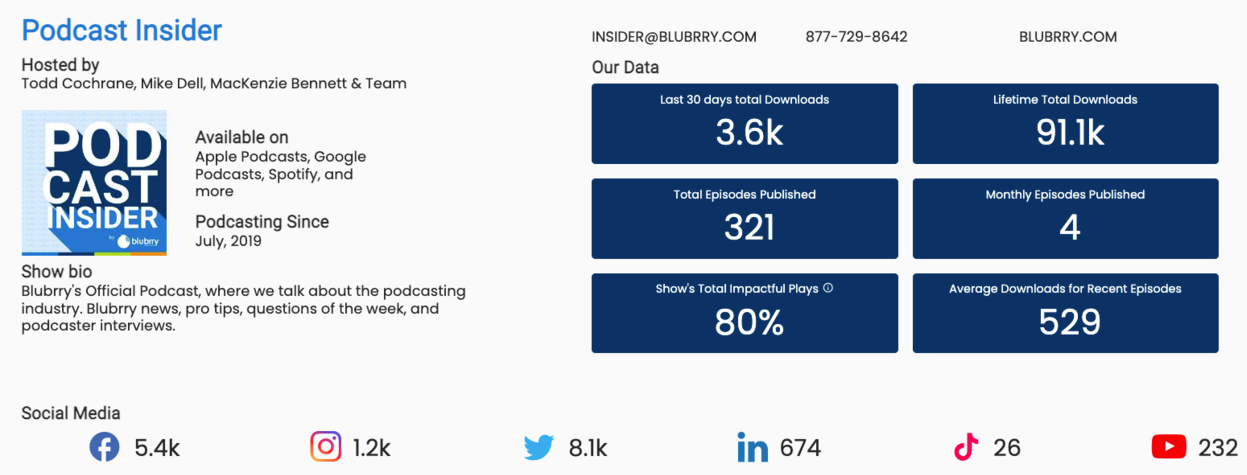
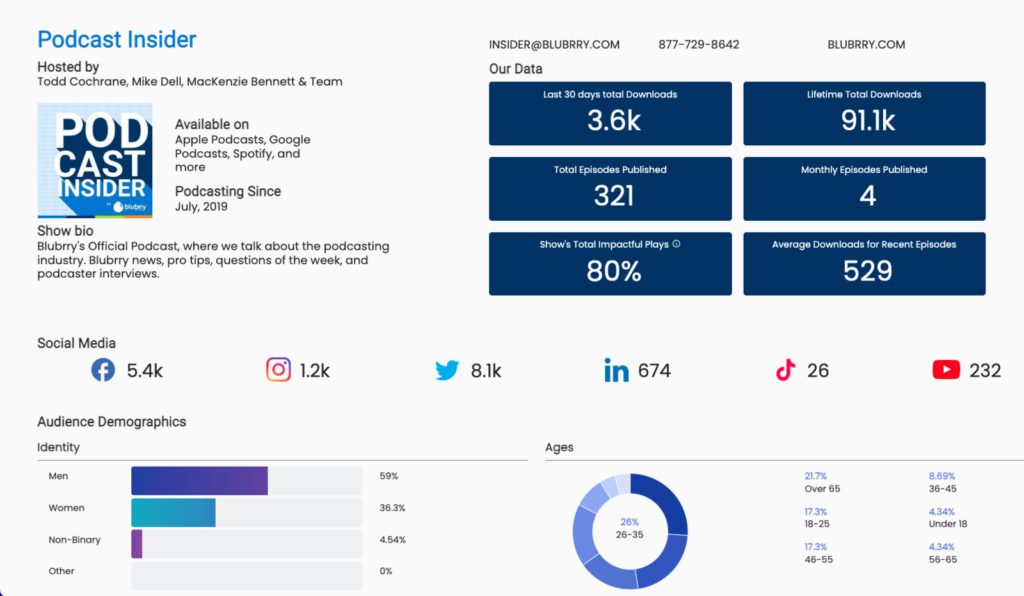
    Blubrry is introducing a podcasting industry first by providing all Blubrry paid customers a podcast media kit that updates daily with information you choose to include. The kit includes data you provide, podcast statistics and audience survey results.

    Podcast Media Kits can be expensive and time-consuming to put together and are always out of date as soon as you publish them. Our media kits are refreshed daily with the newest data.

    Who to Share Your Podcast Media Kit With

    • Advertisers
    • Sponsors
    • Media writers
    • Partnership deals
    • Future guests
    • Event and speaker coordinators

    The data provided in the media kit listed below includes the ability to toggle specific data points on and off, under your discretion.

    Podcast Data Points

    • Podcast website link
    • Show start date
    • Average monthly episodes published
    • Audience survey results (minimum 10 responses)
    • Number of episodes published overall
    • Monthly episodes published
    • Host bio
    • Show description
    • Social media follower count
    • Contact information

    Media Kit example

    Once you’ve completed the media kit, a public URL will be provided in its dashboard. This URL is unique and complex for search engines to index, but it is possible, especially if it’s shared on social media.  Automatic updates to the media kit will be done daily, but podcasters can change/update the media kit whenever they’d like. You can find the media kit within the podcast statistics section of the dashboard.

    Take a look at the Podcast Insider media kit here. We’ve chosen to include all of the data points that are made available. As always, we want your feedback. We came to this version after much debate on how fancy or bare bones to make these media kits, based on how we think they would benefit most podcasters. We know podcasters are eager to point out ways we can improve. So let our support team know here and if you love the final result, share it with your audience on social.

    Get started to showcase your podcast in an accurate, creative way!

  • Your Company Should Be Podcasting

    Your Company Should Be Podcasting

    CompanyIf you’re ready to be nominated for employee of the month, or possibly employee of the year, it’s time to suggest that your company start a podcast. There’s nary a company in existence that wouldn’t benefit from starting its own podcast. Whether you sell a product, offer a service, or anything in between, there’s no downside to promoting your brand on your own terms and own time.


    ON PITCH

    You may clearly see the value of a podcast for your company, but getting the rest of your team on board might take a little more convincing. The higher-ups could be concerned that this would take time away from the tasks you already have. Or, they may not truly understand how their brand fits within a podcasting format.

    Crafting a convincing pitch involves not only mapping out the format and episode details, but also demonstrating that podcasting is a low-time commitment, yet high-impact means to raise brand awareness. Point out the benefits of crafting your company’s message and making that message available 24 hours a day for possibly years to come.

    A podcast can be about more than just a company’s message; it can also be a fun way to bring a staff together. You likely have coworkers that would love to work on the company podcast, which could potentially boost morale and foster an even greater sense of teamwork.

    LOW COST, HIGH RETURN

    As many of Blubrry’s previous articles have already covered, podcast listenership is increasing with each passing day. Sure, many people listen to the chart-topping podcasts, but niche podcasts have incredibly loyal listeners.

    A podcast gear startup kit can be purchased nearly anywhere and be setup in any quiet space. The only other recurring cost is your hosting site, which should be Blubrry so we can help you grow with your show!

    After those costs, it’s truly up to you and your team what kind of bells and whistles, if any, are needed to help customers find your message and content. Your team can release episodes at whatever rate works for your workflow. Adding special episodes for product releases, holiday sales or any sort of special news may be another way to add value to your podcast, without having to add anything to what has already been spent.

    THE MARVELOUS MARKETING DEPARTMENT

    If your company has a marketing department, odds are they already have money earmarked for advertising and innovative ways to promote the brand. Approaching the marketing department with your podcast idea is a great place to start.

    HOOK A HOST

    Some industries have influential people within their field who are looking to diversify their image. Perhaps you work in design and there’s an artist you’ve been dying to connect with. Why not contact that artist to see if they might want to host the show on behalf of your company? Approaching a like-minded, industry-known host can further broaden the potential for the company’s podcast reach and be mutually beneficial for both sides.

    RECORD TODAY, PODCAST FOREVER

    No matter what gear or episode format you choose, once your episodes are posted, they are out there for as long as your company wants them to be. You can have an episode detailing the benefits of a specific aspect of your brand and you only had to record and produce it once. The upfront effort could pay off for your business for years to come.

    LISTEN IN NEXT WEEK…

    No longer do you have to wait for larger media outlets to tell the world what your business is all about. Your team can craft the message you want your customers to know about your company and you can release that message on your timeline, and on your terms. There isn’t another advertising medium available to businesses of all shapes and sizes quite as powerful as podcasting.

    Written by: Tara Jean O’Brien

    Tara Jean O'BrienTara Jean O’Brien has been a writer, actor, improviser, podcaster, and stand-up for nearly 800 years. When not producing, editing, and hosting her podcast, Single Vs. Married, or co-hosting, Cinema Craptaculus Presents: B-sides, she also writers on Medium and recently found a floor safe hidden in her coat closet.

  • Branding For Your Podcast

    Branding For Your Podcast

    Creating a Brand For Your Podcast

    BrandingA podcast with amazing content can easily be overlooked if you don’t have and eye-catching brand. Establishing a brand for your podcast is an important part of podcast audience growth and eventual monetization. Do you know how to create a memorable brand? Or what branding might entail? Keep reading.

    Some of What Branding Entails

    1. Artwork: People say not to judge a book by its cover, but they do. Make sure you’re not losing people because of bland artwork. If you’re not comfortable creating an amazing logo, hire it out. And don’t forget to follow the directory requirements.
    2. Social media presence: Will you be adding this to your current social or creating a podcast identity? Don’t feel the need to be active on all social channels. Consistently participating in one or two platforms is more useful than random interactions on multiple platforms.
    3. Directories: Be found everywhere; submit correctly to each directory. Blubrry can help you make sure you’re following all of the requirements.
    4. Website: Create a homebase. A Blubrry tried and true. A solid website for your podcast, blog posts, links to social, other content, etc. will help you establish yourself online. We provide a WordPress website with all hosting, but you’re able to use any website you’re comfortable with.
    5. Guidelines: Things like colors, logos, fonts, etc. How are you presenting yourself online?

    Creating a brand for your podcast is more than just the minute work. Here are things to keep in mind when creating and executing your new brand.

    Embellish a Bit

    Fake it ’til you make it, right? There is a certain amount of anxiety and uncertainty that comes with establishing a brand and marketing strategy for your podcast, especially if you’re just starting out. If you’re feeling overwhelmed, master the combination of faking it and humorously sharing your pitfalls so far. People like to relate to others and encourage you; however, a bad attitude and woe-is-me attitude can burn your followers out.

    Bring in a Second Opinion

    No one is the best at everything, which means that a second pair of eyes is always beneficial before you release something or make a final decision. This really comes back to the finer details mentioned above. A trusted friend, colleague, etc. can provide feedback that you can either accept or reject. Either way, projects are always easier when you aren’t going it alone.

    Stand Out in the Crowd

    If there are several podcasts similar to yours (and you should know if you’ve done your research) then you need to establish how you’ll be able to stand out above the rest. Offer something that others aren’t, but remember that content is king. Why will you be memorable compared to the other shows similar to yours? 

    Provide Value

    You can have the most amazing marketing and branding around, but if your content doesn’t provide actual value, you’ll find yourself having a hard time building a loyal audience. Demonstrate your high standards and then stick to them. A consistent host is a reliable host. Everyone wants to create a podcast to partake in a community, and you are responsible as the host for setting the tone.

    In a world of around 4 million podcasts, we want you to be proud of yours. If you’re ready to start your podcast or make a major change to the one you already have, follow these steps and as always, reach out to Blubrry for any issues you may run into.