
 One of the first questions new podcasters ask is, “What microphone should I buy?”
Right alongside it is another question that can be just as confusing:
“Which podcast hosting plan is right for me?”
There are plenty of things to figure out when you’re getting a podcast off the ground—what to record with, how often to publish, how long your episodes will be, and where to host them.
Choosing a hosting plan shouldn’t add another layer of confusion.
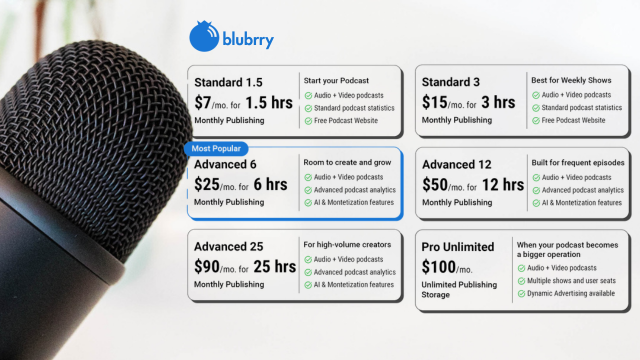
That’s why Blubrry made its hosting plans simpler. Instead of trying to understand complicated storage limits or estimate how much space your files will take up, you can choose a plan based on how much content you actually publish each month.
If you know how often you plan to publish and roughly how long your episodes will be, you already have a much easier way to find the right fit.
Whether you’re creating an audio-only show, a video podcast, or a little of both, you can choose a plan that matches your publishing schedule today and upgrade whenever your podcast grows.
Here’s how to figure out which plan is right for you.
Start With Your Publishing Schedule
The easiest way to choose a hosting plan is to answer two simple questions:
- How long is each episode?
- How many episodes do you publish each month?
Multiply those together and you’ll have a good estimate of your monthly publishing time.
For example:
- Four 30-minute episodes = 2 hours per month
- Two 60-minute episodes = 2 hours per month
- One 90-minute episode = 1.5 hours per month
- Eight 45-minute episodes = 6 hours per month
You don’t need to calculate file sizes or worry about compression.
Simply estimate your monthly publishing time.
If You’re Just Starting a Podcast
Many new podcasters publish one or two episodes each month while they find their rhythm.
If that’s you, one of our entry-level plans will likely be the perfect fit.
These plans are designed for creators launching:
- Personal podcasts
- Hobby shows
- Business podcasts
- Passion projects
- Interview series
You get everything you need to start publishing without paying for more publishing time than you’ll actually use.
Weekly Podcasters
Weekly publishing is one of the most common schedules in podcasting.
If you’re releasing a new episode every week, estimate your average episode length and multiply it by four.
Examples:
- Weekly 30-minute show → about 2 hours per month
- Weekly 45-minute show → about 3 hours per month
- Weekly 60-minute show → about 4 hours per month
Choosing a plan that gives you a little extra room can be helpful if you occasionally publish longer episodes.
Video Podcasts Count Too
More creators are adding video to their podcasts, and Blubrry makes it easy to host both audio and video under the same publishing-time model.
That means you don’t need separate hosting for different formats.
Whether you publish:
- Audio only
- Video only
- Both audio and video
your monthly publishing time works the same way.
If you’re already creating videos for YouTube, you can also use Vid2Pod to turn those videos into podcast episodes for distribution across podcast apps.
Don’t Forget Bonus Episodes
Many podcasters publish more than their regular schedule.
You might release:
- Bonus episodes
- Holiday specials
- Live recordings
- Listener Q&A episodes
- Seasonal content
If these are part of your publishing strategy, include them when estimating your monthly publishing time.
Choosing a slightly larger plan now can help you avoid running out of publishing time during busy months.
Running Multiple Shows?
If you host more than one podcast, don’t estimate each show separately.
Instead, calculate the total publishing time across all your shows.
For example:
Podcast A:
- Weekly 30 minutes = 2 hours/month
Podcast B:
- Weekly 60 minutes = 4 hours/month
Total publishing time:
6 hours per month
As your network grows, you may find that Professional Hosting becomes the better fit.
When Professional Hosting Makes Sense
Professional Hosting isn’t simply for podcasts with long episodes.
It’s designed for creators who need more advanced tools.
Consider Pro Hosting if you:
- Manage multiple podcasts
- Run a podcast network
- Need unlimited storage
- Publish high volumes of audio or video
- Want Dynamic Ad Insertion
- Need multiple users managing content
- Want enterprise-level podcast management
As your podcast grows, your hosting should grow with it.
Why Publishing Time Makes More Sense
Podcast file sizes vary more than most people realize.
Two one-hour episodes may have completely different file sizes depending on:
- Audio quality
- Video resolution
- Editing settings
- Compression
- Export format
That’s why estimating storage has always been confusing.
Publishing time is much easier to understand.
You already know how long your episodes are.
Now your hosting plan reflects that.
You Can Always Grow
One of the best things about choosing a hosting plan based on publishing time is that you’re not locked into your first decision.
As your podcast evolves, you can upgrade to a larger plan whenever your publishing schedule changes.
Maybe you start with one monthly show.
A few months later, you launch a second podcast.
Then you begin publishing video.
That’s growth—and your hosting plan should be able to grow with you.
Find the Plan That Fits Your Podcast

Every podcast is different.
Some creators publish one episode a month, while others release several episodes every week across multiple shows. And podcasts come in all kinds of genres, from business and news to sports, entertainment, education, religion, and everything in between.
The right hosting plan isn’t necessarily the biggest one—it’s the one that matches the way you publish today while giving you room to grow tomorrow.
With Blubrry’s new time-based hosting plans, choosing the right plan is as simple as knowing how much content you publish each month.
Explore Blubrry’s hosting plans today and find the option that’s built for your podcast.

 If you’ve been keeping up with our newsletter, social media, company show

 Podcast burnout is the leading cause of dead podcasts; and trust me, there are tons of dead podcasts. Realizing that success doesn’t come immediately, takes a lot of hard work and may come in different forms than expected is a huge part of avoiding podcast burnout. That can be helpful to hear, but it doesn’t do much when you are in the middle of feeling hopeless or overwhelmed.
 David Day is the co-founder and co-host of Horror Movie Talk Podcast. When he isn’t watching horror movies he is focused on growing the podcast. Listen to his show Horror Movie Talk


 Yndia, the host of Talking Journeys of Belonging 2 Blackness, has been with Blubrry since 2019


 Great podcast interviews usually require some work to find the guests. However, sometimes they find you. After years of podcast productions, Troy Heinritz of
 Kim Krajci, host of
 Is there someone you want to interview for your podcast? Certainly, that big name will boost your audience numbers just by putting that name in the episode title. But, are you sure? Too often, podcasters put their hopes in great podcast interviews but don’t put out the effort to produce them.

 How many emails do you receive on a weekly or daily basis? Probably too many to count, let alone opening and reading all of them. Receive too many emails without worthwhile content? Unsubscribe. End up on an email list you’re completely unfamiliar with? Mark as spam. See spontaneous emails a few times a year? Forgettable. Sometimes it’s easier to lose subscribers than it is to gain them.
 MacKenzie Bennett, has worked in podcasting for seven years, sometimes behind the mic but mainly behind the scenes as part of the marketing team at Blubrry Podcasting.



 The old proverb, “The road to hell is paved with good intentions,” is a great one to keep in mind if you think you have discovered the next “it” podcast . . . yet, have no connection to the “it” subject matter. You might intend to become the next
