Tag: Premium Podcasting

  • Choosing the Right Blubrry Hosting Plan Based on How You Publish

    Choosing the Right Blubrry Hosting Plan Based on How You Publish

    One of the first questions new podcasters ask is, “What microphone should I buy?”

    Right alongside it is another question that can be just as confusing:

    “Which podcast hosting plan is right for me?”

    There are plenty of things to figure out when you’re getting a podcast off the ground—what to record with, how often to publish, how long your episodes will be, and where to host them.

    Choosing a hosting plan shouldn’t add another layer of confusion.

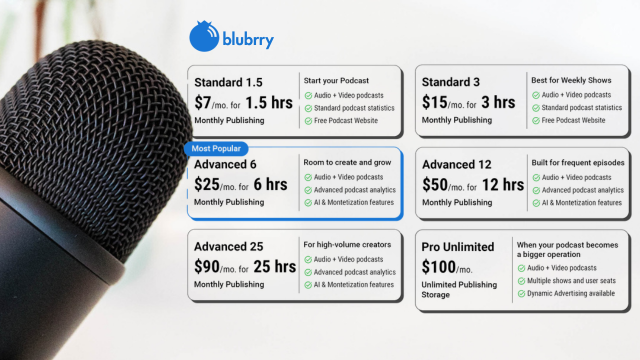
    That’s why Blubrry made its hosting plans simpler. Instead of trying to understand complicated storage limits or estimate how much space your files will take up, you can choose a plan based on how much content you actually publish each month.

    If you know how often you plan to publish and roughly how long your episodes will be, you already have a much easier way to find the right fit.

    Whether you’re creating an audio-only show, a video podcast, or a little of both, you can choose a plan that matches your publishing schedule today and upgrade whenever your podcast grows.

    Here’s how to figure out which plan is right for you.

    Start With Your Publishing Schedule

    The easiest way to choose a hosting plan is to answer two simple questions:

    • How long is each episode?
    • How many episodes do you publish each month?

    Multiply those together and you’ll have a good estimate of your monthly publishing time.

    For example:

    • Four 30-minute episodes = 2 hours per month
    • Two 60-minute episodes = 2 hours per month
    • One 90-minute episode = 1.5 hours per month
    • Eight 45-minute episodes = 6 hours per month

    You don’t need to calculate file sizes or worry about compression.

    Simply estimate your monthly publishing time.

    If You’re Just Starting a Podcast

    Many new podcasters publish one or two episodes each month while they find their rhythm.

    If that’s you, one of our entry-level plans will likely be the perfect fit.

    These plans are designed for creators launching:

    • Personal podcasts
    • Hobby shows
    • Business podcasts
    • Passion projects
    • Interview series

    You get everything you need to start publishing without paying for more publishing time than you’ll actually use.

    Weekly Podcasters
    Weekly publishing is one of the most common schedules in podcasting.

    If you’re releasing a new episode every week, estimate your average episode length and multiply it by four.

    Examples:

    • Weekly 30-minute show → about 2 hours per month
    • Weekly 45-minute show → about 3 hours per month
    • Weekly 60-minute show → about 4 hours per month

    Choosing a plan that gives you a little extra room can be helpful if you occasionally publish longer episodes.

    Video Podcasts Count Too

    More creators are adding video to their podcasts, and Blubrry makes it easy to host both audio and video under the same publishing-time model.

    That means you don’t need separate hosting for different formats.

    Whether you publish:

    • Audio only
    • Video only
    • Both audio and video

    your monthly publishing time works the same way.

    If you’re already creating videos for YouTube, you can also use Vid2Pod to turn those videos into podcast episodes for distribution across podcast apps.

    Don’t Forget Bonus Episodes

    Many podcasters publish more than their regular schedule.

    You might release:

    • Bonus episodes
    • Holiday specials
    • Live recordings
    • Listener Q&A episodes
    • Seasonal content

    If these are part of your publishing strategy, include them when estimating your monthly publishing time.

    Choosing a slightly larger plan now can help you avoid running out of publishing time during busy months.

    Running Multiple Shows?

    If you host more than one podcast, don’t estimate each show separately.

    Instead, calculate the total publishing time across all your shows.

    For example:

    Podcast A:

    • Weekly 30 minutes = 2 hours/month

    Podcast B:

    • Weekly 60 minutes = 4 hours/month

    Total publishing time:

    6 hours per month

    As your network grows, you may find that Professional Hosting becomes the better fit.

    When Professional Hosting Makes Sense

    Professional Hosting isn’t simply for podcasts with long episodes.

    It’s designed for creators who need more advanced tools.

    Consider Pro Hosting if you:

    • Manage multiple podcasts
    • Run a podcast network
    • Need unlimited storage
    • Publish high volumes of audio or video
    • Want Dynamic Ad Insertion
    • Need multiple users managing content
    • Want enterprise-level podcast management

    As your podcast grows, your hosting should grow with it.

    Why Publishing Time Makes More Sense

    Podcast file sizes vary more than most people realize.

    Two one-hour episodes may have completely different file sizes depending on:

    • Audio quality
    • Video resolution
    • Editing settings
    • Compression
    • Export format

    That’s why estimating storage has always been confusing.

    Publishing time is much easier to understand.

    You already know how long your episodes are.

    Now your hosting plan reflects that.

    You Can Always Grow

    One of the best things about choosing a hosting plan based on publishing time is that you’re not locked into your first decision.

    As your podcast evolves, you can upgrade to a larger plan whenever your publishing schedule changes.

    Maybe you start with one monthly show.

    A few months later, you launch a second podcast.

    Then you begin publishing video.

    That’s growth—and your hosting plan should be able to grow with you.


    Find the Plan That Fits Your Podcast
    Every podcast is different.

    Some creators publish one episode a month, while others release several episodes every week across multiple shows. And podcasts come in all kinds of genres, from business and news to sports, entertainment, education, religion, and everything in between.

    The right hosting plan isn’t necessarily the biggest one—it’s the one that matches the way you publish today while giving you room to grow tomorrow.

    With Blubrry’s new time-based hosting plans, choosing the right plan is as simple as knowing how much content you publish each month.

    Explore Blubrry’s hosting plans today and find the option that’s built for your podcast.
  • Audio vs. Video Podcasting: Do You Really Need Both?

    Audio vs. Video Podcasting: Do You Really Need Both?

    Podcasting has changed a lot over the last few years.

    What was once almost entirely audio is now expanding into video. Open YouTube today, and you’ll find podcasts everywhere, from solo creators recording in home studios to professionally produced shows with multiple cameras and dedicated sets.

    At the same time, millions of people still listen through Apple Podcasts, Spotify, Amazon Music, and other podcast apps every day.

    So if you’re starting a podcast, or thinking about growing the one you already have, you’ve probably asked yourself:

    Should I focus on audio, video, or both?

    The answer depends on your goals, your audience, and the type of content you create.

    Why Audio Podcasting Still Matters

    Despite the rise of video, audio remains the heart of podcasting.

    People listen while they’re:

    • Driving to work
    • Exercising
    • Walking the dog
    • Cooking dinner
    • Working around the house

    These aren’t moments when someone wants to sit and watch a screen.

    They’re moments where audio fits naturally into everyday life.

    That’s one reason podcast listening continues to grow. Audio gives your audience the freedom to consume your content wherever they are.

    If your podcast is built around conversations, education, interviews, or storytelling, audio alone can still deliver an excellent experience.

    Why More Creators Are Adding Video

    Video opens up opportunities that audio simply can’t.

    Viewers can connect with facial expressions, body language, demonstrations, and visual storytelling in ways that audio can’t capture.

    For many creators, video also creates more opportunities for discovery.

    Platforms like YouTube help new audiences find your content through search and recommendations, while short clips can be repurposed for Instagram Reels, TikTok, LinkedIn, Facebook, and YouTube Shorts.

    Video also gives sponsors more creative placement opportunities and helps strengthen your personal brand by putting a face behind the microphone.

    You Don’t Have to Choose One or the Other

    One of the biggest misconceptions is that you have to become either an audio podcaster or a video podcaster.

    In reality, many successful creators produce both.

    They record a single episode and publish it in multiple formats:

    • Audio for podcast listening apps
    • Full-length video for YouTube
    • Short clips for social media
    • Highlights for newsletters and blog posts

    Instead of creating separate content for every platform, they’re simply getting more value from each recording session.

    Think About How Your Audience Consumes Content

    When deciding whether to publish audio, video, or both, ask yourself a few simple questions.

    • Where does my audience spend their time?
    • Do they watch or mostly listen?
    • Is my content visual, conversational, or educational?
    • Would video add something meaningful to the experience?

    Some podcasts naturally benefit from visuals.

    Others don’t need them at all.

    Neither approach is right or wrong.

    The goal is to create the experience that best serves your listeners.

    Creating Video Doesn’t Have to Mean Starting Over

    Many podcasters worry that adding video means rebuilding their entire workflow.

    Fortunately, that’s rarely the case.

    If you’re already recording interviews over Zoom or Riverside, or filming your episodes for YouTube, you’re already creating valuable video content.

    The key is finding ways to make that content work harder for you.

    Instead of treating audio and video as separate projects, think of them as different ways to deliver the same conversation to different audiences.

    How Much Podcast Space Do You Actually Need?

    Once you’ve decided whether you’ll publish audio, video, or both, the next practical question is:

    How much hosting space do you actually need?

    That’s exactly what Dave covers in his latest video. He walks through the factors that affect your hosting needs and shares practical advice to help podcasters estimate how much space makes sense based on their publishing habits.

    Whether you’re publishing one episode each month or producing multiple shows every week, understanding your content schedule can help you plan ahead and avoid surprises as your podcast grows.


    The Best Strategy Is the One You’ll Stick With

    It’s easy to feel pressure to do everything.

    Launch on every platform.

    Record video.

    Create Shorts.

    Post reels.

    Write newsletters.

    But sustainable podcasting isn’t about doing everything at once.

    It’s about creating a workflow you can maintain consistently.

    If audio is where you want to begin, that’s a great place to start.

    If video helps you reach your audience and fits naturally into your process, it’s worth considering.

    And if you can comfortably produce both, you’ll give your content more opportunities to be discovered across multiple platforms.

    Ultimately, the question isn’t whether audio or video is better.

    It’s whether your content is reaching the people who want to hear, or watch it.

  • Already Creating Video? Turn It Into a Podcast With Vid2Pod

    Already Creating Video? Turn It Into a Podcast With Vid2Pod

    If you’re already creating videos for YouTube, you’re closer to launching a podcast than you think.
    Every interview, tutorial, webinar, panel discussion, or educational video you’ve published has the potential to reach an entirely new audience—without recording another episode.

    That’s exactly what Vid2Pod is built for.

    Instead of creating a separate podcast from scratch, Vid2Pod automatically converts your YouTube playlists into professionally distributed podcast episodes, helping you reach listeners on Apple Podcasts, Spotify, Amazon Music, and other major podcast platforms.

    The best part?

    You keep creating videos the way you always have.

    You’ve Already Done the Hard Work

    Creating video takes time.

    Planning.

    Recording.

    Editing.

    Publishing.

    Once your video is live on YouTube, most creators move on to the next project.

    But your content still has more to offer.

    Many YouTube videos naturally translate into podcast episodes, including:

    • Interviews
    • Educational content
    • Business discussions
    • Coaching sessions
    • Product demonstrations
    • Webinars
    • Live Q&A sessions
    • Industry updates

    Instead of creating an entirely separate audio version, Vid2Pod helps you get more value from the content you’ve already invested in.

    Turn One YouTube Playlist Into a Podcast

    With Vid2Pod, you don’t need to manually download videos, extract audio, or upload episodes one by one.

    Once you connect your YouTube channel and choose a playlist, Vid2Pod handles the rest.

    As you publish new videos to that playlist, they can automatically become podcast episodes.

    That means less manual work and more time creating content.

    Reach Listeners Beyond YouTube

    Not everyone consumes content the same way.

    Some people enjoy watching videos.

    Others prefer listening while:

    • Driving
    • Exercising
    • Working
    • Traveling
    • Walking

    By converting your videos into podcasts, you’re making your content available wherever your audience wants to consume it.

    Instead of limiting yourself to YouTube viewers, you can also reach millions of podcast listeners across:

    • Apple Podcasts
    • Spotify
    • Amazon Music
    • And many more podcast apps

    Your content works harder without requiring additional production.

    Built for Podcast Growth

    Vid2Pod doesn’t just convert video into audio.

    It gives your content access to the tools that help podcasts grow.

    With Blubrry Hosting, you can:

    • Track podcast downloads with dedicated podcast statistics
    • Distribute your show to major podcast directories
    • Embed episodes on your website
    • Maintain full ownership of your podcast RSS feed
    • Build your podcast brand with a free managed WordPress website

    Unlike YouTube analytics, podcast statistics provide insights specifically designed for podcast publishers.

    Monetize Your Content From Day One

    Your videos can also become another revenue opportunity.

    With Vid2Pod and Blubrry Hosting, you can take advantage of podcast monetization features, including:

    • Programmatic advertising
    • Dynamic Ad Insertion
    • Private sponsorship placements

    Best of all, there are no minimum audience requirements to begin monetizing through Blubrry’s programmatic advertising.

    Instead of relying solely on video revenue, your podcast becomes another way to generate income from content you’ve already created.

    Getting Started Is Simple

    Launching your podcast with Vid2Pod only takes a few steps:

    1. Choose a Blubrry Advanced Hosting plan or higher.
    2. Connect your YouTube channel.
    3. Select the playlist you want to convert.
    4. Customize your podcast artwork.
    5. Publish your show to the world’s leading podcast platforms.

    After that, your workflow stays almost exactly the same.

    Keep publishing videos.

    Vid2Pod takes care of turning them into podcast episodes.

    Stop Creating Twice

    Many creators think they need to record separate audio episodes for podcast listeners.

    You don’t.

    If you’re already producing quality video content, you’ve already created the foundation for a successful podcast.

    Vid2Pod helps you expand your reach without doubling your workload, giving every video another opportunity to connect with a new audience.

    One recording.

    More listeners.

    More platforms.

    More value from every piece of content you create.


    Ready to Turn Your YouTube Channel Into a Podcast?

    Don’t let your content live on just one platform. With Vid2Pod, you can automatically convert your YouTube playlists into professionally distributed podcast episodes and reach listeners on Apple Podcasts, Spotify, Amazon Music, and more.

    Included with Blubrry Advanced Hosting plans and above, Vid2Pod helps you repurpose your videos, grow your audience, track podcast-specific analytics, and unlock monetization opportunities—all without changing the way you create content.

    Start using Vid2Pod today and make every video go further.

  • Video Podcasting Without Starting Over

    Video Podcasting Without Starting Over

    video-podcastingPodcasting has changed.

    What started as an audio-first medium has expanded into video, opening new ways for creators to reach audiences on platforms like YouTube and beyond. As more podcasters explore video, many assume they need to rebuild their workflow, buy expensive equipment, or even switch hosting providers.

    The good news?

    You don’t have to start over.

    If you’ve already built an audio podcast, adding video doesn’t mean abandoning everything you’ve created. It’s about expanding your content, not replacing it.

    Your Podcast Doesn’t Need a Complete Reset

    One of the biggest misconceptions about video podcasting is that it requires an entirely new production process.

    In reality, your podcast already contains the most important part:

    Great conversations and valuable content.

    Adding video simply gives your audience another way to experience your show. Some listeners prefer audio during their commute, while others enjoy watching interviews, discussions, or behind-the-scenes moments.

    Offering both formats allows you to meet your audience where they are.

    Start With What You Have

    Many successful video podcasts didn’t begin with a professional studio.

    You can start with:

    • A webcam
    • Your laptop camera
    • A DSLR or mirrorless camera
    • A smartphone with a tripod

    The goal isn’t Hollywood-level production.

    It’s creating an authentic experience that complements your podcast.

    If you’re already recording remote interviews, adding video can often be as simple as enabling cameras during your recording session.

    Keep Your Existing Workflow

    One concern podcasters often have is whether moving into video will complicate their publishing process.

    It doesn’t have to.

    The best approach is to keep the workflow you’re already comfortable with while adding video as another publishing option.

    Record once.

    Edit once.

    Publish your audio and video together.

    This lets you continue serving your existing podcast audience while also reaching viewers on video platforms.

    Reach More People Without Creating More Content

    Video isn’t about doubling your workload.

    It’s about getting more value from every episode you already produce.

    A single recording can become:

    • Your podcast episode
    • A full-length video
    • Short clips for social media
    • Promotional teasers
    • Website content
    • Email newsletter material

    Instead of creating separate content for every platform, you’re maximizing the content you’ve already invested time into creating.

    Every Blubrry Hosting Plan Supports Video Podcasting

    Some hosting providers reserve video podcasting for premium plans.

    Blubrry takes a different approach.

    Every Blubrry hosting plan supports video podcasting, giving creators the flexibility to publish audio, video, or both without upgrading simply to access video capabilities.

    Whether you’re launching your very first show or growing an established podcast, you can expand into video whenever you’re ready.

    That means you can:

    • Publish audio and video episodes
    • Manage everything from one hosting account
    • Continue using your existing podcast feed
    • Grow your audience across multiple platforms
    • Scale your content without rebuilding your workflow

    Video podcasting becomes another tool for growth not another obstacle.

    Grow at Your Own Pace

    Not every podcast needs a multi-camera production.

    Not every episode needs fancy graphics.

    And not every creator wants to become a YouTuber overnight.

    The beauty of video podcasting is that you can start small.

    Record your conversations.

    Publish consistently.

    Improve your setup over time.

    Your audience cares far more about valuable content than perfect production.

    One Recording. More Opportunities.

    our podcast has already done the hard part.

    You’ve built an audience.

    You’ve found your voice.

    You’ve created valuable conversations.

    Adding video simply helps more people discover them.

    You don’t need to start over.

    You just need to press one more record button.


    Ready to Add Video to Your Podcast?

    Whether you’re producing audio-only episodes today or planning to introduce video in the future, Blubrry makes the transition simple. Every hosting plan supports video podcasting, so you can expand your reach without changing your workflow or switching platforms.

    Start creating once and publishing everywhere with Blubrry supporting your podcast every step of the way.

  • When Is It Time to Upgrade Your Podcast Hosting?

    When Is It Time to Upgrade Your Podcast Hosting?

    Many podcasters start with the basics.

    A simple hosting plan.

    A few episodes.

    A small but growing audience.

    At the beginning, that’s usually enough.

    But podcasts rarely stay the same.

    Episodes accumulate.

    Downloads increase.

    Workflows become more complex.

    And eventually, many podcasters find themselves asking a question:

    Is it time to upgrade my podcast hosting plan?

    The answer isn’t always about download numbers.

    In fact, some of the biggest reasons to upgrade have nothing to do with audience size at all.

    Your Podcast Has Outgrown Your Original Needs

    Most podcasters choose a hosting plan based on where they are today.

    Not where they’ll be six months or a year from now.

    That makes sense.

    Why pay for features you don’t need yet?

    But growth changes things.

    A plan that worked perfectly when you had ten episodes may start feeling limiting when you have one hundred.

    The signs aren’t always obvious.

    Sometimes it’s slower workflows.

    Sometimes it’s storage limitations.

    Sometimes it’s simply realizing that you’re spending more time managing your podcast than growing it.

    That’s often the first indication that your hosting needs have changed.

    You’re Publishing More Content

    One of the clearest signs it’s time to upgrade is increased publishing volume.

    Maybe you’re releasing:

    • Multiple episodes each week
    • Bonus content for subscribers
    • Video versions of your podcast
    • Additional shows under the same brand

    More content means more storage, more bandwidth, and more organization.

    What once felt like plenty of room can start disappearing quickly.

    A hosting plan should support your growth, not force you to constantly manage limits.

    You Need Better Analytics

    Downloads are helpful.

    But eventually, most podcasters want more insight than a simple download count.

    Questions start becoming more specific:

    • Which episodes perform best?
    • Where are listeners located?
    • What apps are people using?
    • Are listeners returning consistently?

    As podcasts grow, decisions become more strategic.

    Better analytics help you understand what’s working and where opportunities exist.

    If you’re making decisions based on guesswork, it may be time for a hosting plan that provides deeper audience insights.

    You’re Managing a Team

    Not every podcast stays a one-person operation.

    As shows grow, additional people often become involved:

    • Co-hosts
    • Producers
    • Editors
    • Marketing teams
    • Virtual assistants

    At that point, account management becomes more important.

    You need systems that allow people to access the tools they need without sharing sensitive account information.

    Features like sub-accounts, permissions, and team management can make running a podcast significantly easier.

    You’re Expanding Beyond Audio

    Today’s podcasts often become much more than podcasts.

    One episode can become:

    • Blog posts
    • Newsletters
    • Social media clips
    • Website content
    • YouTube videos

    The podcast becomes the center of a larger content strategy.

    That means your hosting platform should integrate with the tools that support growth.

    Website functionality, distribution tools, analytics, and content management become more important as your content ecosystem expands.

    You’re Thinking About Monetization

    Monetization changes the conversation.

    When a podcast becomes part of your business, reliability matters even more.

    Sponsors expect professionalism.

    Listeners expect consistency.

    Opportunities depend on trust.

    At that stage, many podcasters start looking for hosting solutions that provide stronger infrastructure, better reporting, and tools designed to support long-term growth.

    The hosting platform becomes part of the business operation itself.

    Audience Engagement Changes

    When you have a small audience, responding to every listener is often manageable.

    As your audience grows, engagement becomes more strategic.

    You may start:

    • Building an email list
    • Creating listener communities
    • Gathering audience feedback
    • Running surveys
    • Hosting live events

    The relationship with your audience remains important.

    The way you manage that relationship simply evolves.

    Support Starts Becoming Important

    This is one factor that often gets overlooked.

    Everything works fine until something doesn’t.

    A feed issue.

    A distribution problem.

    A publishing question.

    A technical challenge.

    When that happens, support matters.

    And not all podcast hosting support is the same.

    Some platforms provide general customer service.

    Others provide support from people who actually understand podcasting.

    That’s a meaningful difference.

    When you’re trying to solve a podcast-specific problem, it helps to talk to people who have launched shows, managed feeds, worked with directories, and understand the challenges podcasters face every day.

    Sometimes the value of a hosting platform isn’t just the technology.

    It’s the expertise behind it.

    The Best Time to Upgrade Is Before You Need To

    Many podcasters wait until they hit a limitation before upgrading.

    Storage runs out.

    Features become restricted.

    Workflows become frustrating.

    But by that point, the problem is already affecting the show.

    The better approach is to recognize growth early.

    If your audience is growing, your content is expanding, or your podcast is becoming a bigger part of your business, upgrading before you reach those limits can save time and frustration later.


    Final Thoughts

    Upgrading your podcast hosting isn’t about having the biggest show.

    It’s about having the right tools for where your podcast is today—and where it’s headed tomorrow.

    Growth creates new opportunities.

    It also creates new demands.

    The right hosting plan should help you handle both.

    If you’re finding yourself managing more content, seeking better insights, collaborating with a team, or turning your podcast into a larger part of your business, it may be time to consider whether your current hosting plan still fits your goals.

    Ready for the Next Stage of Podcast Growth?

    Whether you’re launching a new show or managing a growing podcast operation, Blubrry provides reliable hosting, advanced analytics, website tools, and support from real podcasters who understand the industry.

    Start your free trial today and find a hosting solution built to grow with your podcast.

  • Podcast Growth Stages: From First Episodes to a Larger Operation

    Podcast Growth Stages: From First Episodes to a Larger Operation

    Most podcasts don’t start with a team.

    They don’t start with sponsors, production workflows, or thousands of listeners.

    They start with one person, a microphone, and an idea.

    In the beginning, growth feels simple.

    Publish episodes.

    Share them online.

    Hope people listen.

    But as a podcast grows, so does everything around it.

    The expectations change.

    The workload changes.

    The opportunities change.

    And eventually, what started as a small project begins to look a lot more like an operation.

    The challenge isn’t just growing a podcast.

    It’s understanding what growth actually looks like at each stage.

    Stage 1: Getting the First Episodes Out

    This is where every podcast begins.

    The focus is simple: publish.

    At this stage, most podcasters are figuring out:

    • Recording equipment
    • Editing workflows
    • Hosting platforms
    • Episode formats
    • Publishing schedules

    Downloads are usually low.

    The audience is small.

    And that’s perfectly normal.

    The biggest mistake new podcasters make is obsessing over growth too early.

    The goal of this stage isn’t to go viral.

    It’s to build consistency.

    Because you can’t grow a podcast that isn’t publishing regularly.

    Stage 2: Finding Your Voice

    After the first handful of episodes, something starts happening.

    You become more comfortable behind the microphone.

    You learn what works.

    You discover what doesn’t.

    The podcast begins developing an identity.

    This is where many shows start finding their audience.

    Listeners begin responding to specific topics.

    Certain guests perform better.

    Some episodes generate more engagement than others.

    The smartest podcasters pay attention.

    They’re not chasing trends.

    They’re learning what their audience values.

    At this stage, growth comes from refinement.

    Not volume.

    Stage 3: Building a Consistent Audience

    Eventually, downloads become more predictable.

    You start recognizing listener names.

    Emails come in.

    Reviews appear.

    Guests begin reaching out to you instead of the other way around.

    This is often the first sign that a podcast is becoming established.

    The focus shifts from simply publishing episodes to creating a reliable experience.

    Questions become more strategic:

    • What topics resonate most?
    • What does the audience want more of?
    • How can listeners be better served?

    The podcast is no longer just content.

    It’s becoming a community.

    Stage 4: Creating Systems

    Growth brings complexity.

    What worked when you were publishing a few episodes a month may not work anymore.

    Guest scheduling becomes harder.

    Promotion takes more time.

    Editing starts consuming entire weekends.

    This is where systems become critical.

    Successful podcasts start building:

    • Content calendars
    • Guest management processes
    • Promotion workflows
    • Production checklists
    • Documentation

    Without systems, growth creates chaos.

    With systems, growth becomes manageable.

    Stage 5: Expanding Beyond the Podcast

    At this stage, the show often becomes part of something bigger.

    A podcast might support:

    • A business
    • A personal brand
    • A consulting practice
    • A community
    • A media company

    The audience trusts the host.

    Relationships have been built.

    Opportunities start appearing.

    Speaking engagements.

    Partnerships.

    Clients.

    Sponsorships.

    New content channels.

    The podcast becomes more than a podcast.

    It becomes an asset.

    Stage 6: Delegating Responsibilities

    One of the biggest shifts happens when podcasters realize they can’t do everything themselves forever.

    Growth eventually creates a choice:

    Continue doing everything alone.

    Or start building support around the show.

    This may include:

    • Editors
    • Producers
    • Virtual assistants
    • Guest coordinators
    • Social media support
    • Marketing assistance

    Delegation doesn’t happen because a podcast is failing.

    It happens because it’s growing.

    The goal is not to work harder.

    The goal is to create space for higher-value work.

    Stage 7: Operating Like a Business

    This is where many successful podcasts eventually arrive.

    The show has a clear audience.

    A defined process.

    Reliable publishing.

    Growth systems.

    Revenue opportunities.

    At this point, decisions become more strategic.

    Questions shift from:

    “What should I record this week?”

    to

    “Where do I want this podcast to be next year?”

    The host starts thinking about:

    • Audience retention
    • Monetization
    • Team growth
    • Partnerships
    • Long-term sustainability

    The podcast becomes a business operation rather than a side project.

    The Common Thread at Every Stage

    What’s interesting is that every successful podcast follows a different path.

    Some grow quickly.

    Some grow slowly.

    Some remain niche.

    Others become major brands.

    But the podcasts that survive long-term usually have one thing in common:

    They adapt.

    They understand that growth requires different skills at different stages.

    What works in episode 10 may not work in episode 500.

    The podcasters who continue growing are the ones willing to evolve.

    Growth Doesn’t Happen Overnight

    It’s easy to look at an established podcast and assume it happened quickly.

    Most of the time, it didn’t.

    Behind every successful show are hundreds of small decisions:

    Publishing consistently.

    Improving the content.

    Learning from mistakes.

    Building better systems.

    Serving the audience.

    Growth is rarely one big moment.

    It’s usually the result of doing the right things repeatedly over time.

    Final Thoughts

    Every podcast starts small.

    The early stages are about learning.

    The middle stages are about building systems.

    The later stages are about creating something sustainable.

    The key is understanding that growth changes the game.

    As your audience grows, your workflow, goals, and responsibilities will grow with it.

    The podcasts that scale successfully aren’t necessarily the ones with the biggest budgets.

    They’re the ones that adapt as they move from a handful of episodes to a larger operation.


    Ready to Grow Your Podcast?

    Whether you’re launching your first show or managing a growing audience, having the right hosting platform can make scaling easier.

    Blubrry provides podcast hosting, analytics, website tools, and expert support from real podcasters who understand what it takes to grow a show.

    Start your free trial today and build a podcast that’s ready for every stage of growth.

  • Scaling Your Podcast: What Changes as Your Show Grows

    Scaling Your Podcast: What Changes as Your Show Grows

    When most people start a podcast, the goal is simple:

    Publish episodes.

    Get listeners.

    Keep the show going.

    But eventually, something interesting happens.

    The podcast starts growing.

    Downloads increase.

    Guests become easier to book.

    Opportunities start appearing.

    And suddenly, the systems that worked when you had 100 listeners no longer work when you have 10,000.

    That’s the part many podcasters don’t anticipate.

    Growing a podcast isn’t just about getting more downloads. It’s about adapting how you create, manage, and promote your show as it evolves.

    Growth Creates New Challenges

    A lot of podcasters assume growth makes everything easier.

    In some ways, it does.

    But it also creates new responsibilities.

    A growing podcast often means:

    • More content to manage
    • More guest coordination
    • More listener communication
    • More promotion
    • More analytics to review
    • More opportunities to evaluate

    The casual workflow that worked in the beginning can quickly become overwhelming.

    That’s why scaling isn’t just about audience growth.

    It’s about building systems that can support that growth.

    Consistency Becomes More Important

    When you’re starting out, missing an episode isn’t usually a major issue.

    Your audience is still forming.

    Expectations are still being established.

    As your podcast grows, that changes.

    Listeners begin to expect a schedule.

    Guests expect professionalism.

    Sponsors may expect deliverables.

    A missed episode can have a bigger impact than it did in the early days.

    The larger your audience becomes, the more consistency matters.

    That doesn’t mean publishing more often.

    It means becoming more reliable.

    Planning Replaces Improvisation

    Many podcasters launch with a simple approach:

    “Let’s record this week’s episode and figure out next week later.”

    That works for a while.

    But as your show grows, planning becomes essential.

    Successful podcasts often work several episodes ahead.

    They maintain:

    • Content calendars
    • Guest pipelines
    • Production schedules
    • Promotion plans

    Instead of constantly reacting, they’re operating proactively.

    That shift reduces stress and improves quality.

    Your Podcast Becomes a Brand

    At the beginning, your podcast may simply feel like a project.

    As it grows, it becomes something bigger.

    Listeners start recognizing your show.

    Guests mention your episodes.

    People recommend your content.

    Your podcast develops an identity.

    At that stage, branding becomes more important.

    Questions like these begin to matter:

    • What does your show stand for?
    • What topics are you known for?
    • Who is your ideal listener?
    • Why should someone subscribe?

    The clearer your identity becomes, the easier it is to attract the right audience.

    Analytics Become More Valuable

    Many podcasters obsess over download numbers early on.

    Ironically, analytics become far more useful once your audience starts growing.

    Because now you’re looking for patterns.

    You want to understand:

    • Which episodes perform best
    • Which topics resonate
    • Where listeners are located
    • How your audience is changing over time

    Growth creates more data.

    And better data leads to better decisions.

    The goal isn’t simply to collect numbers.

    It’s to understand what those numbers are telling you.

    Delegation Starts Making Sense

    Many successful podcasts begin as a one-person operation.

    The host handles everything.

    Recording.

    Editing.

    Publishing.

    Promotion.

    Scheduling.

    Eventually, that’s no longer sustainable.

    As your podcast grows, you may find yourself outsourcing:

    • Audio editing
    • Show notes
    • Transcriptions
    • Social media
    • Guest booking
    • Video clips

    Delegation doesn’t mean losing control.

    It means focusing your energy where it creates the most value.

    Audience Engagement Changes

    When you have a small audience, responding to every listener is often manageable.

    As your audience grows, engagement becomes more strategic.

    You may start:

    • Building an email list
    • Creating listener communities
    • Gathering audience feedback
    • Running surveys
    • Hosting live events

    The relationship with your audience remains important.

    The way you manage that relationship simply evolves.

    Monetization Opportunities Increase

    Not every podcast needs to make money.

    But growth often creates opportunities.

    Sponsors may reach out.

    Affiliate partnerships become available.

    Premium content becomes possible.

    Speaking opportunities emerge.

    The key is understanding that monetization usually follows value.

    The stronger your audience relationship becomes, the more options you’ll have.

    Trying to monetize too early can be difficult.

    Building trust first often creates better long-term results.

    Technology Matters More

    A growing podcast puts more pressure on your infrastructure.

    You need reliable:

    • Hosting
    • Distribution
    • Analytics
    • Website management
    • Publishing workflows

    The tools that felt sufficient early on may eventually become limiting.

    This is often when podcasters start evaluating whether their current systems can support their long-term goals.

    Because scaling isn’t just about producing more content.

    It’s about creating a foundation that can support future growth.

    Growth Doesn’t Change Everything

    Here’s the interesting part.

    Some things never change.

    The podcasts that continue growing over time usually focus on the same fundamentals they started with:

    • Valuable content
    • Consistency
    • Audience trust
    • Meaningful conversations

    Growth amplifies what’s already there.

    If your foundation is strong, scaling becomes much easier.

    If it isn’t, growth can expose weaknesses quickly.

    The Biggest Shift of All

    The biggest change isn’t technical.

    It’s mental.

    At some point, you stop thinking episode-to-episode.

    You start thinking long-term.

    You begin asking different questions:

    • Where do I want this podcast to be next year?
    • How does it support my goals?
    • What systems need to improve?
    • How can I serve my audience better?

    That’s when a podcast moves beyond being a hobby or side project.

    It becomes something intentional.


    Final Thoughts

    Every podcast starts small.

    The challenge isn’t getting started.

    The challenge is adapting as your show grows.

    Because growth changes expectations.

    It changes workflows.

    It changes opportunities.

    The podcasters who scale successfully aren’t necessarily the ones who work harder.

    They’re the ones who build systems, stay consistent, and evolve alongside their audience.

    Ready to Support Your Podcast’s Next Stage?

    Whether you’re publishing your first episodes or managing a growing audience, having the right hosting, analytics, and support can make scaling easier.

    Blubrry gives podcasters the tools, insights, and expert support needed to grow with confidence.

    Start your free trial today and build a podcast that’s ready for what’s next.

  • Why Every Business Podcast Needs a Strategy

    Why Every Business Podcast Needs a Strategy

    A lot of businesses start podcasts for the wrong reason.

    Not bad reasons. Just shallow ones.

    “Everyone has a podcast now.”

    “We should probably have one too.”

    That mindset is exactly why most business podcasts quietly disappear after 7 episodes.

    No one talks about this enough.

    The problem usually isn’t the audio quality. Or the logo. Or even the host.

    It’s the lack of direction.

    Because a business podcast without a strategy is just content floating around the internet hoping something happens.

    And hope is not a marketing plan.

    The “Just Start Recording” Trap

    We’ve seen companies spend weeks debating microphones…

    …then spend almost no time discussing why the podcast exists in the first place.

    That’s backwards.

    A podcast is not just content production.

    It’s positioning.

    It’s relationship building.

    It’s brand trust at scale.

    And if the business behind it doesn’t know what outcome it wants, the audience feels that confusion immediately.

    One week the show sounds educational.

    The next week it’s trying to sell something.

    Then suddenly it becomes an interview podcast because someone thought guests would “help with reach.”

    No consistency. No identity. No reason for listeners to stay.

    Downloads Aren’t the Goal

    This is where businesses get stuck.

    They obsess over downloads because it’s the easiest number to measure.

    But here’s the truth:

    A business podcast with 300 loyal listeners can outperform a show with 10,000 random listeners.

    We’ve seen it happen repeatedly.

    Especially in B2B spaces.

    A niche financial consultant. A law firm. A SaaS founder. A real estate group.

    Small audience. Big influence.

    Why?

    Because the right podcast strategy focuses on who is listening, not just how many.

    That changes everything.

    One of the Biggest Mistakes Businesses Make

    They treat the podcast like a campaign.

    Not an asset.

    Campaign thinking sounds like:

    • “Let’s test podcasting for a few months.”
    • “Let’s see if this gets traction.”
    • “Let’s try posting clips.”

    Asset thinking sounds different:

    • “How does this support trust?”
    • “How does this help sales conversations?”
    • “How does this build authority over time?”
    • “How does this strengthen our brand ecosystem?”

    Huge difference.

    The businesses winning with podcasting today are not treating episodes like disposable content.

    They’re building a media asset that compounds over time.

    Nobody Listens to Corporate Podcasts

    At least not intentionally.

    People listen to:

    • insight
    • perspective
    • experience
    • stories
    • clarity

    Not polished corporate language.

    This is why so many business podcasts feel lifeless.

    Everything sounds approved by committee.

    Nobody says anything real.

    The host sounds terrified of having an opinion.

    Look, listeners are smart.

    They can smell “marketing content” instantly.

    And the irony?

    The podcasts that perform best for businesses usually sound the least corporate.

    We Learned This the Hard Way

    Years ago, we worked with a company that launched a business podcast with all the right pieces on paper.

    Professional studio.

    Great branding.

    Strong guest lineup.

    Completely forgettable show.

    Why?

    Because every episode tried to appeal to everyone.

    The marketing team wanted leads.

    The leadership team wanted authority.

    Sales wanted product mentions.

    The host wanted casual conversations.

    So the show became a weird mix of everything.

    No identity.

    No clear audience.

    No reason to return.

    Eventually someone asked:

    “So… who exactly is this podcast for?”

    Nobody had a clear answer.

    That was the real problem.

    Strategy Decides the Role of the Podcast

    This part matters more than people realize.

    Your podcast cannot do everything at once.

    Is it supposed to:

    • build authority?
    • support SEO?
    • nurture leads?
    • strengthen customer loyalty?
    • support sales?
    • create partnerships?
    • attract speaking opportunities?
    • build community?

    Pick the primary role first.

    Otherwise every episode becomes reactive.

    And reactive podcasts rarely last.

    The Best Business Podcasts Build Familiarity

    Not virality.

    Big difference.

    Most listeners won’t buy after hearing one episode.

    But after hearing your voice consistently for months?

    That changes things.

    You become recognizable.

    Trust starts building quietly in the background.

    That’s why podcasting works so well for businesses with:

    • long sales cycles
    • service-based offers
    • consulting
    • coaching
    • B2B products
    • professional services

    People buy faster when they already feel familiar with you.

    Podcasting accelerates that familiarity better than most content formats.

    The Revenue Grind Comes Later

    This is another thing businesses misunderstand.

    Not every business podcast needs ads.

    Honestly, most shouldn’t even think about sponsorships early on.

    The real value often comes from:

    • inbound leads
    • stronger client trust
    • shortened sales cycles
    • speaking opportunities
    • partnerships
    • customer retention
    • brand authority

    That’s where the ROI usually starts.

    The podcast becomes the trust layer underneath the business.

    And trust compounds.

    Strategy Also Prevents Burnout

    This gets ignored constantly.

    Without strategy, business podcasts become exhausting fast.

    Because every episode feels random.

    Every recording session feels forced.

    Every quarter turns into:

    “Are we still doing this?”

    But when there’s structure?

    The process gets easier.

    Topics become clearer.

    Guests make more sense.

    Content flows naturally.

    The team understands the direction.

    That’s how podcasts survive long-term.

    Not through motivation.

    Through systems.

    Most Business Podcasts Don’t Fail Immediately

    They fade.

    Quietly.

    Episodes become inconsistent.

    The energy disappears.

    Meetings get postponed.

    Downloads plateau.

    Then eventually someone says:

    “Podcasting just doesn’t work for us.”

    No.

    The lack of strategy didn’t work.

    That’s different.

    So What Does a Good Podcast Strategy Actually Look Like?

    Not complicated.

    Clear audience.

    Clear positioning.

    Clear purpose.

    Clear role inside the business.

    That’s it.

    You don’t need a 40-page brand document.

    You just need alignment.

    Because once the strategy is clear, the content becomes easier to create.

    And more importantly…

    …it becomes easier for listeners to understand why they should keep coming back.


    One Last Thing

    The businesses getting the most from podcasting today are not necessarily the loudest.

    They’re the most intentional.

    They know:

    • who they’re talking to
    • what the podcast supports
    • why the show exists
    • what success actually means

    That clarity changes everything.

    Because when a business podcast has strategy behind it…

    …it stops feeling like “just content.”

    It starts becoming part of the business itself.

    Get started today and put your expertise to work.

  • Podcasting for Your Business: Setting Realistic Expectations

    Podcasting for Your Business: Setting Realistic Expectations

    Everybody wants the podcast.

    Then reality shows up.

    A few episodes in, the excitement fades, downloads aren’t exploding, nobody’s going viral on LinkedIn, and suddenly the question starts floating around the company Slack:

    “Is this even working?”

    We’ve seen this happen over and over with business podcasts.

    Not because podcasting doesn’t work.

    Because people walk into it with completely broken expectations.

    They think a podcast behaves like paid ads.

    Launch it. Push it. Get leads.

    That’s not how this medium works.

    And honestly? That mindset is exactly why a lot of business podcasts quietly disappear after 12 episodes.

    The “We’ll Start a Podcast” Phase

    This part is always optimistic.

    The marketing team is excited.

    The CEO has ideas.

    Someone says:

    “We already have so much expertise, we should turn it into content.”

    True.

    But expertise alone doesn’t build a podcast people actually return to.

    That’s where companies get blindsided.

    Because podcasting isn’t just information delivery.

    It’s relationship building.

    And relationships move slower than campaigns.

    Downloads Are the Wrong Obsession

    Let’s say this clearly.

    Most business podcasts kill themselves by chasing vanity metrics too early.

    Downloads.

    Subscribers.

    Chart rankings.

    Look, metrics matter. Of course they do.

    But we’ve watched niche business podcasts generate partnerships, clients, speaking opportunities, and inbound leads with numbers that would look “small” on paper.

    Meanwhile, other shows rack up downloads and convert absolutely nobody.

    Why?

    Because attention without trust is useless.

    Business podcasting is not about collecting random listeners.

    It’s about attracting the right people consistently.

    That’s a very different game.

    Nobody Cares About Your Company

    Harsh?

    Maybe.

    Still true.

    People do not wake up hoping to hear a 40-minute branded commercial disguised as a podcast.

    And this is where businesses usually go wrong.

    They build a show entirely around themselves.

    Their updates.

    Their product.

    Their announcements.

    Nobody sticks around for that.

    Listeners stay for:

    • insight
    • perspective
    • stories
    • useful conversations
    • personality

    The companies winning in podcasting understand this fast.

    Their show is not:

    “Look how great we are.”

    It’s:

    “Here’s something genuinely useful for you.”

    Huge difference.

    The Slow Burn Nobody Talks About

    Here’s the part most executives struggle with.

    Podcasting compounds slowly.

    Very slowly.

    A blog post can rank.

    An ad can convert.

    A social clip can spike.

    Podcasting behaves differently.

    You’re building familiarity over time.

    One episode becomes three.

    Three becomes ten.

    Then eventually someone says:

    “I’ve been listening for months.”

    That’s when things start happening.

    Not before.

    And honestly, this is why podcasts work so well for businesses in the first place.

    Trust takes repetition.

    Podcasting delivers repetition better than almost any channel right now.

    We Learned This the Hard Way

    Years ago, we worked with a company that launched a podcast expecting immediate lead generation.

    Classic mistake.

    By episode five, they were frustrated.

    “Where are the conversions?”

    The show almost got canceled.

    But here’s what happened instead.

    A prospect mentioned the podcast during a sales call.

    Then another.

    Then another.

    Not because the show “went viral.”

    Because people started recognizing the brand.

    That changed the entire internal conversation.

    The podcast wasn’t producing instant sales.

    It was shortening trust-building.

    And that matters more long-term.

    Consistency Beats Production Quality

    This part surprises people.

    Businesses love overproducing things.

    Fancy intros.

    Studio upgrades.

    Cinematic trailers.

    Meanwhile, the publishing schedule is falling apart.

    Look, listeners will forgive imperfect audio faster than inconsistent publishing.

    Because consistency builds habit.

    And habit builds audience retention.

    A clean release every week matters more than trying to sound like NPR on day one.

    Your Podcast Is Probably Not a Revenue Stream

    At least not directly.

    And honestly, most companies should stop thinking about podcast cashing-in too early.

    No, your business podcast probably won’t make money through baked-in ads or DAI anytime soon.

    That’s fine.

    Because that’s usually not the point anyway.

    The real ROI often looks like:

    • stronger customer trust
    • warmer sales conversations
    • higher authority
    • easier networking
    • speaking opportunities
    • partnership conversations
    • brand familiarity

    Those things are harder to measure.

    But they matter.

    A lot.

    The Hidden Advantage Business Podcasts Have

    Most independent podcasters are starting from zero.

    No audience.

    No authority.

    No network.

    Businesses already have:

    • customers
    • email lists
    • industry relationships
    • expertise
    • case studies
    • internal knowledge

    That’s a huge head start.

    But only if the company stops trying to sound “corporate.”

    Because corporate podcasting usually sounds dead on arrival.

    The best business podcasts sound human first.

    Brand second.

    Don’t Launch Until You Can Answer This

    Why should someone come back next week?

    Seriously.

    If the answer is:

    “Because we’re experts.”

    That’s not enough anymore.

    People have endless options now.

    The real question is:

    • What ongoing value does the show create?
    • What perspective does it own?
    • What conversation can only your company have?

    That clarity matters more than gear, logos, or launch graphics.


    The Real Expectation

    Here’s the expectation companies should actually have.

    Your podcast probably won’t explode overnight.

    It probably won’t become your biggest traffic source immediately.

    And it definitely won’t fix weak positioning or unclear messaging.

    But over time?

    It can become one of the strongest trust-building assets your business owns.

    That’s the trade.

    Podcasting is slower upfront.

    But deeper long-term.

    And the companies that understand that usually stick around long enough to see the payoff everyone else quits too early to reach.

    See How Blubrry Supports Business Podcasts.

  • Why Sub-Accounts Make Podcast Teams Easier to Manage

    Why Sub-Accounts Make Podcast Teams Easier to Manage

    Let’s be honest.

    Most podcast teams don’t break because of bad content.

    They break because of access.

    Who can log in.

    Who can publish.

    Who just “checked something” and accidentally changed everything.

    We’ve seen this play out more times than we’d like to admit.

    The Login Everyone Shares (And Regrets)

    It usually starts simple.

    One account.

    One login.

    Shared across the team.

    “Just use this for now.”

    That “for now” turns into months.

    Then one day:

    • Someone uploads the wrong file
    • Someone edits a live episode
    • Someone deletes something they shouldn’t

    And suddenly, nobody knows who did what.

    Because everyone had access.

    Control Gets Messy Fast

    Look, the moment more than one person touches your podcast, things change.

    You’re not just creating anymore.

    You’re managing.

    And most teams don’t adjust to that.

    They keep the same setup they had when it was just one person running the show.

    That’s where things start slipping.

    We Learned This the Hard Way

    We once worked with a small team running three shows under one brand.

    They had a shared login for everything: hosting, website, even analytics.

    At first, it felt efficient.

    Until an episode went live… half-edited.

    Wrong title. Draft description. Missing intro.

    No one owned it. No one caught it.

    Everyone assumed someone else had it handled.

    That’s when it clicked.

    Access without structure isn’t teamwork.

    It’s risk.

    Sub-Accounts Fix What Teams Break

    Here’s the shift.

    Instead of one login for everyone…

    You give each person their own access.

    Not full access. The right access.

    That means:

    • The editor can upload—but not publish
    • The host can review—but not change backend settings
    • The manager can publish—but not accidentally break integrations

    Now suddenly, things are clear.

    Who does what.

    Who touches what.

    Who’s responsible for what.

    And more importantly, what they can’t touch.

    Not Everyone Needs the Keys

    This is where most teams hesitate.

    “But we trust our team.”

    Good.

    This isn’t about trust.

    It’s about structure.

    You don’t give everyone full control of your RSS feed the same way you don’t give everyone access to your bank account.

    Not because they’ll mess it up…

    But because if something goes wrong, you need to know where and how.

    Scaling Without Breaking Things

    This matters more as you grow.

    One show turns into two.

    Two turns into five.

    Then suddenly you’re dealing with:

    • Multiple hosts
    • Editors
    • Guest coordinators
    • Maybe even sponsors or partners

    Now imagine running all that through one login.

    That’s not a system.

    That’s a bottleneck waiting to happen.

    This Isn’t Just Theory

    Look at how networks like Gimlet Media or Wondery operate.

    They’re not sharing one login across the team.

    They have producers, editors, hosts, and publishing teams, all with defined roles and controlled access.

    Because at that level, one mistake doesn’t just affect an episode.

    It affects the entire network.

    Here’s the kicker.

    Smaller teams run into the same problems.

    They just feel it faster, because they don’t have structure yet.

    The Publishing Layer Matters More Than You Think

    Here’s the part people underestimate.

    Your podcast isn’t just audio.

    It’s a system:

    • Your RSS feed
    • Your episodes
    • Your metadata
    • Your distribution

    One wrong change can ripple everywhere: Apple Podcasts, Spotify, all of it.

    And once that’s out?

    Good luck pulling it back cleanly across all the RSS scrapers.

    We’ve seen teams spend hours fixing something that started as a small mistake.

    And it’s not instant.

    Feeds cache. Platforms refresh at different times. Errors stick around longer than you expect.

    If you want to see how strict this layer is, Apple literally documents it.

    So yeah. Access control isn’t optional.

    It’s protection.

    The Invisible Stress Goes Away

    Here’s something people don’t talk about.

    When everyone has full access, there’s this quiet tension in the background.

    “Did someone already update this?”

    “Can I change this, or will it mess something up?”

    So people either:

    • Overstep
    • Or avoid doing anything at all

    Neither works.

    Sub-accounts remove that friction.

    You log in. You see your role. You do your job.

    Done.

    This Isn’t About Tools

    You can have the best hosting platform.

    The cleanest workflow.

    The most organized content calendar.

    None of it matters if the wrong person clicks the wrong thing at the wrong time.

    We’ve seen teams blame tools for problems that were really just access issues.

    Fix the structure first.

    Everything else gets easier.

    The Real Benefit No One Talks About

    It’s not just control.

    It’s accountability.

    When everyone has their own login:

    • You know who published what
    • You know who made changes
    • You know where things went wrong

    And more importantly…

    You know where things went right.

    That’s how you improve.

    Teams That Know Roles Move Faster

    This isn’t just about avoiding mistakes.

    It’s about speed.

    When roles are clear, execution gets faster.

    Less back-and-forth. Less second-guessing. Less waiting.

    Even outside podcasting, this shows up everywhere.

    Research from Harvard Business Review shows that teams with clearly defined roles perform better because they reduce confusion and decision friction.

    Same thing here.

    If your podcast team is guessing who owns what…

    You’re already slower than you should be.

    So What’s the Actual Shift?

    Stop thinking:

    “One account for the team”

    Start thinking:

    “A system for the team”

    Because once you separate access, roles, and responsibility…

    Everything becomes clearer.

    Faster.

    Safer.


    Final Thoughts

    Most teams don’t think about this until something breaks.

    An episode goes out wrong.

    A setting gets changed.

    Something disappears.

    Then it becomes urgent.

    But by then, you’re reacting.

    Not building.

    So here’s the real question:

    Are you setting your podcast up to run smoothly…

    Or just hoping nothing goes wrong?

    Because those are two very different approaches.