After years of working with women who felt stuck in cycles of perfectionism, self-doubt, and people-pleasing, Holly saw a pattern: so many were waiting. Waiting to feel “ready.” Waiting until they looked a certain way, or had it all figured out, before allowing themselves to live fully.
Her podcast was born from a simple but powerful realization: What if the life you’re waiting for has been here all along?
The Mission: Reinvention Through Real Talk
Holly Toscanini
How to Lose the ‘Wait’ is equal parts pep talk, therapy session, and heart-to-heart over coffee. Geared toward women over 40 who are ready to stop postponing their joy, the show helps listeners step out of the “waiting room” of life — and into a season of confidence, freedom, and reinvention.
Each episode, Holly unpacks the real, unfiltered truths behindgrowth and self-discovery. From setting boundaries without guilt to rebuilding confidence in midlife, her storytelling is candid, funny, and deeply human.
A bestselling author, empowerment coach, and creator of The Reinvention Code™, Holly brings her signature mix of warmth and wit to every conversation. Her approach is refreshingly down-to-earth — no toxic positivity, no hustle-culture clichés. Just honest, soulful talk about what it means to become who you were always meant to be.
Because Confidence Isn’t Something You Earn — It’s Something You Remember
Listeners often describe How to Lose the ‘Wait’ as a breath of fresh air in a world obsessed with doing more and being “better.”
Holly’s episodes are filled with aha moments, laughter, and reminders that confidence doesn’t come from achieving perfection — it comes from reconnecting with the wisdom you’ve always had.
Whether she’s exploring the art of saying “no,” navigating reinvention after 40, or celebrating the power of intuition, her message is clear: you don’t have to wait for permission to live a life that feels like yours.
About the Host: Holly Toscanini
Holly Toscanini is more than a podcaster — she’s a guide for women ready to rewrite their stories. As a bestselling author and coach, she has helped countless women trade self-doubt for self-trust through her Reinvention Code™ framework.
Her humor, vulnerability, and storytelling create a space where listeners feel seen, understood, and inspired to take the next step — no matter how small. Holly’s superpower lies in making complex emotional work feel doable, even joyful.
Her own journey of transformation fuels her mission: to help women stop waiting for “someday” and start embracing today.
Blubrry’s October Spotlight
Blubrry Podcasting is proud to name How to Lose the ‘Wait’ with Holly Toscanini as October 2025’s Podcaster of the Month.
In every episode, Holly reminds us that life doesn’t start when things are perfect — it starts when you decide you’re ready. Her blend of humor, heart, and honesty makes her podcast not just a listen, but an experience.
For anyone standing on the edge of reinvention, wondering if it’s too late — Holly’s answer is simple: It’s not too late. It’s right on time.
Listen toHow to Lose the ‘Wait’ wherever you get your podcasts and start living the life you’ve been waiting for.
WhenSusan Ruth launchedHey Human in July 2016, she wasn’t setting out to become a podcasting powerhouse. She was trying to make sense of the world. A series of shootings across the United States had left her shaken, frustrated, and searching for a way to bridge divides. What began as a project born from heartbreak has since blossomed into an award-winning, internationally recognized podcast with more than 460 episodes and 350,000 listeners worldwide.
“I was concerned about all the ‘other-ing’ taking place among my fellow humans,” Ruth recalls. “I decided I would start talking with people and, better yet, start listening more deeply with them.”
That philosophy—listening more deeply—is at the very heart of Hey Human. Described best as a human-interest podcast, it has welcomed an astonishingly diverse range of guests: scientists, musicians, activists, actors, gang members, cult survivors, chefs, veterans, and even a former heavyweight champion. From household names to everyday people, each episode explores the vast and fascinating spectrum of human experience.
“Because every human has a story,” Ruth says simply.
The Mission: Connection, Growth, and Understanding
Susan Ruth is an accomplished singer-songwriter, painter, and filmmaker.
The mission ofHey Human is clear: to create space for empathy, understanding, and connection. Episodes unfold not as stiff interviews, but as organic conversations that allow guests to be seen in all their complexity.
Ruth explains: “My hope was, and is, when people hear an episode, even if it’s with someone they don’t agree with or feel a sameness-kinship with, there is space for them to hear some part of themselves in the voice and story of my guest. The moment that happens, growth happens. Understanding happens. Communion happens. And, in some cases, healing happens.”
It’s this commitment to curiosity and compassion that sets the show apart. Hey Human doesn’t shy away from tough topics or controversial perspectives. Instead, it invites listeners to lean in, to listen without judgment, and to find the threads of humanity that tie us all together.
Notable Voices and Stories
Over the years, Ruth has sat across from a stunning lineup of guests. Neuroscientist Dr.Moran Cerf, trans-activistKate Bornstein, music legendsJewel andA.J. Croce, original BeatlePete Best, and activist-physician Dr.Patch Adams are just a few of the well-known names who have shared their stories. But the show is just as likely to feature someone you’ve never heard of before — a prison reform activist, a first responder, or a survivor whose story hasn’t yet been told.
These episodes embody Ruth’s belief that wisdom, resilience, and beauty can be found in every corner of life. “Hey Human began as a project to find hope and connection,” she says. “It has since grown to include people and ideas changing the world through creativity, research, tenacity, and understanding.”
About the Host: Susan Ruth
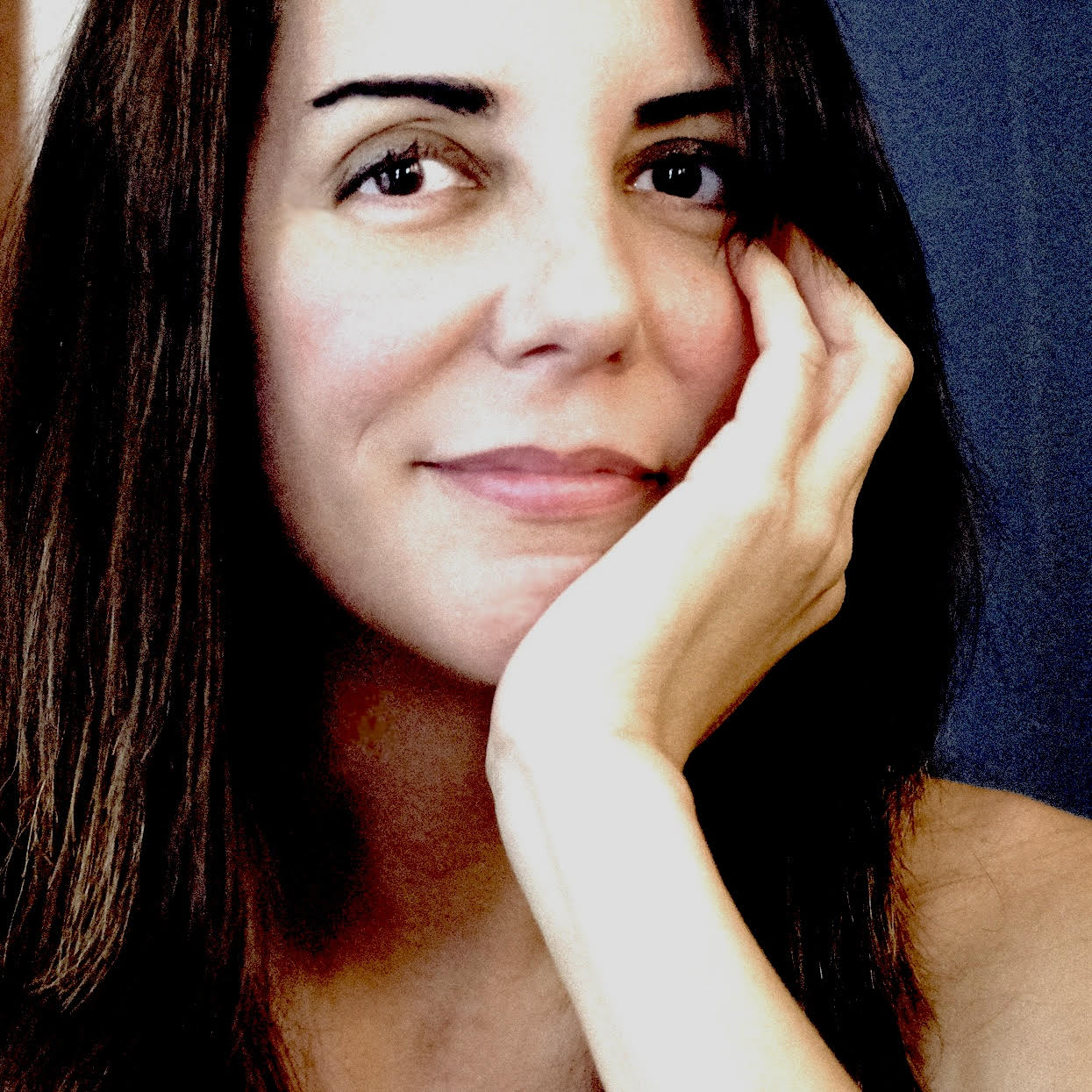
To understand Hey Human, you have to understand its host. Susan Ruth is an accomplished singer-songwriter, painter, and filmmaker with a career spanning multiple disciplines. Born in Seattle, she made her mark as a recording artist before moving to Nashville to write songs for artists such as Reba McEntire and Lonestar. Her music has appeared in film and television, and she has released four studio albums.
Ruth is also an abstract painter — continuing the legacy of her great-grand uncle, noted American Symbolist painterCarl Gutherz — and an award-winning filmmaker, with her short filmThe First garnering accolades. Today, she resides in Los Angeles, California, where she continues to balance her creative pursuits with her work as a podcaster.
Her artistic sensibility infuses every episode of Hey Human. She approaches her guests with the same curiosity and openness that fuels her art, creating a space where stories unfold naturally and meaningfully.
An Ongoing Conversation
Ruth consistently releases a new episode of Hey Human across all major platforms, including Spotify, Apple Podcasts, and iHeart. Ad-free and completely independent, the show’s steady growth speaks to its resonance with listeners hungry for authentic, thoughtful dialogue.
The show has received recognition along the way, including the 2018 Valerie J. Hoffman Award, but for Ruth, the true reward is simpler. “When people hear themselves reflected in someone they thought they had nothing in common with—that’s the real success,” she says.
Blubrry’s September Spotlight
Blubrry Podcasting is proud to name Hey Human with Susan Ruth as September 2025’s Podcast of the Month. In a world where it can feel easier to divide than to unite, Ruth’s work reminds us of the extraordinary power of listening
For those seeking a podcast that challenges, enlightens, and heals, Hey Human is essential listening.
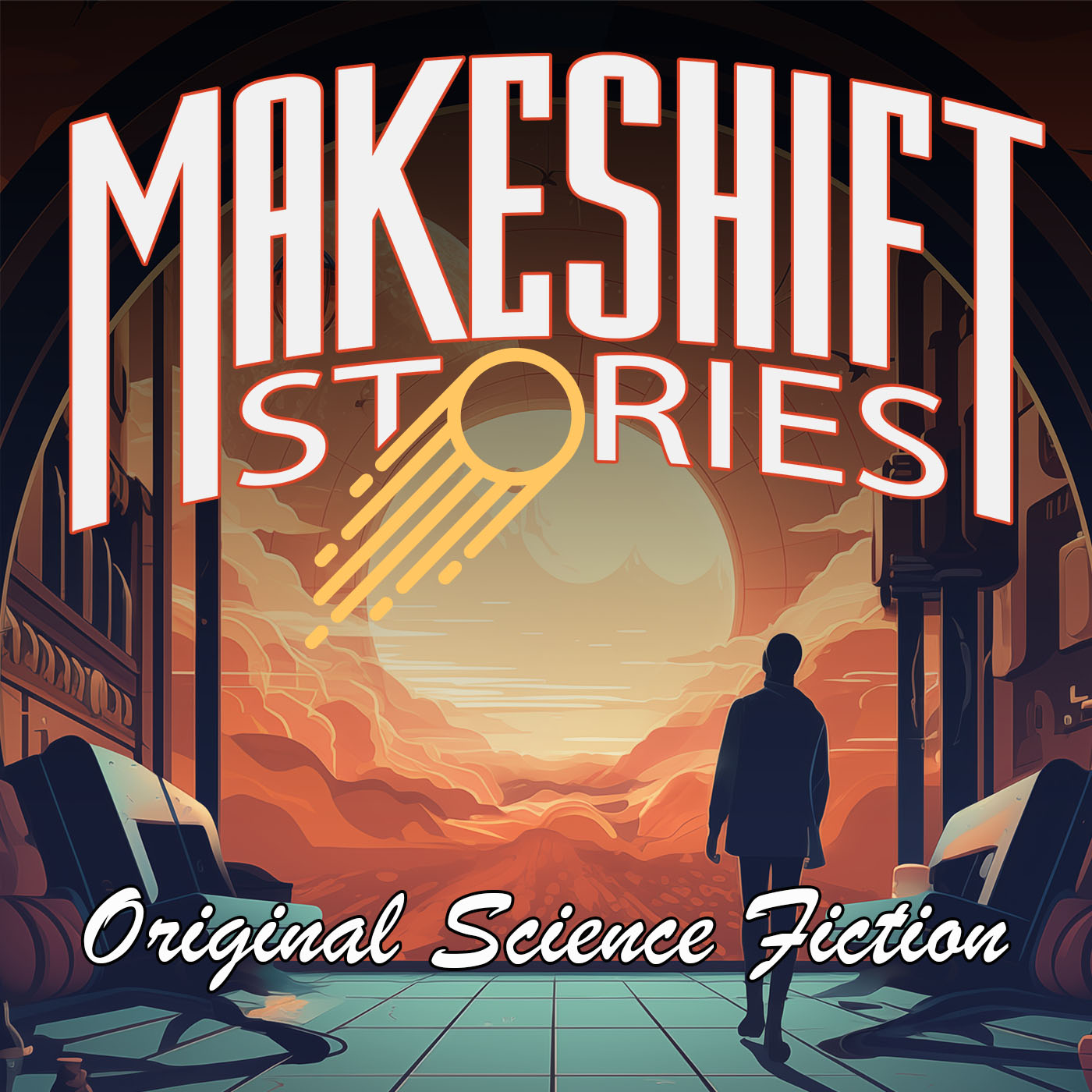
Step into a world where the lines between science fiction, fantasy, and surreal mystery blur — a world crafted on the fly, powered by curiosity, and designed to ignite your imagination. This August, Blubrry Podcasting is proud to spotlightMakeshift Stories as our Podcast of the Month.
At first glance, the name Makeshift Stories might sound humble, but don’t let that fool you. Since 2008, host Vern Hume (also known by his pen name Alan V Hare) has been crafting speculative sci-fi tales that are raw, spontaneous, and filled with wonder. Think of them as concept sketches in audio form — unpolished by design, allowing listeners to fill in the blanks with their imagination.
“The podcast’s name intentionally infers these stories are not polished works of writing,” Vern explains. “Instead, they are ideas, often quite spur of the moment, put out to our listeners to consider in their raw state.”
Vern, left, worked with narrator Mitchell Tew, right.
What started as an experimental storytelling podcast for younger audiences has evolved into something much broader and more compelling. Early episodes were serialized adventures shaped partly by listener feedback. But after a turning point in Episode 22,“The Boy Who Loved Candy” — a story Vern first improvised as a bedtime tale for his son — the podcast took on a new life. Vern pivoted to an anthology format, where each story stands alone, yet sometimes revisits familiar worlds or characters. The result? A collection of stories that defy genre rules, weaving together science fiction, fantasy, surrealism, and speculative mystery into one hypnotic feed.
“Over time, Makeshift Stories has grown into a show that blends science fiction, fantasy, speculative mystery, and surrealism,” Vern said. “It has never confined itself to a single genre, which is part of what keeps it vibrant.”
A flattering comparison!
Vern’s son David (seated) works with Mitchell Tew on scaling. Mitchell narrated ‘Makeshift Stories’ from around episode 80 to 260.
As one listener notes, Makeshift Stories is “A slightly gentler but equally insightful Twilight Zone.”
Vern took that comparison to heart. Like the classic Twilight Zone, Makeshift Stories explores the strange, the unknown, and the what-ifs in a way that’s accessible to all ages. No harsh language, no shock-value horror — just scintillatingly spun tales that open the door to imagination.
“I was flattered by the listener’s comparison of the podcast to the Twilight Zone,” Vern notes. “Their comment finally helped me identify the themes that run through the stories: mystery, wonderment, and the unexplained.”
The themes work!
Among its accolades, Makeshift Stories has been nominated for the Podcast Awards (2022) and the Canadian Podcast Awards.
Another fan favorite in the podcast is theSomewhere Sometime series, one-off tales that live outside of any defined timeline or universe. Bedtime stories for grown-ups and children alike, transporting listeners to other realities while still leaving you wondering, “What if this could really happen?”
Makeshift Stories might be a rare gem in the podcasting world — a show that’s stayed true to its creative core while quietly building a dedicated following for over 15 years. Vern Hume’s commitment to curiosity-driven storytelling, coupled with his willingness to let ideas evolve in real-time, embodies what podcasting is all about: connection, creativity, and a sense of wonder.
If you’ve never listened to Makeshift Stories, now is the perfect time to dive in. You just might find yourself looking at the world a little differently after each episode.
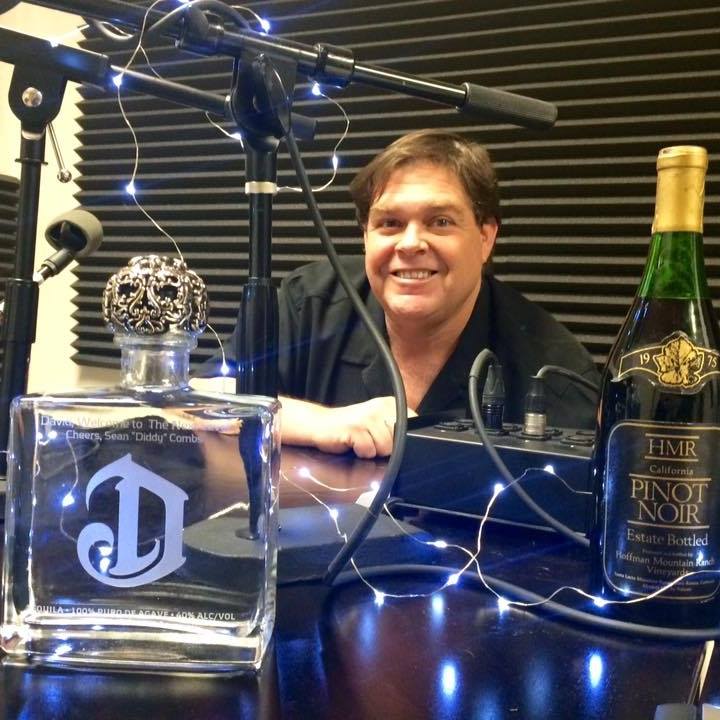
There’s nothing like topping off a meal, sitting in the garden or ending the day with an earthy red, crisp white, or refreshing rosé. No matter the occasion, the world of wines offers endless combinations, palettes of flavors, aromas and textures, each with a unique character and story. Our March Podcaster of the Month, David Wilson, explores and shares those stories as host of the Grape Encounters Radio Podcast. And he does it sans the snootiness of many a sommelier.
Contrary to what hoity-toity critics would like you to believe, wine is meant to be enjoyed by all (at least those of legal age), and Wilson creates a safe space for wine lovers to explore. His extensive audience comprises oenophiles who don’t necessarily care to analyze wine’s harmonious balance of aroma, flavor, body, acidity, tannins or finish (yawn). In other words, these connoisseurs don’t whine about wine.
A marketer and radio personality by trade, Wilson launched Grape Encounters Radio 16 years ago and has traveled the world with an unquenchable thirst for new and exciting vinos and the delectable foods with which they pair. Having moved to Italy from California some two years ago, Wilson retains a deep appreciation for U.S. wines but believes American consumers would be happier if they were enjoying wine the way their European counterparts do – less expensive, greater options, and free-flowing.
As our March Podcaster of the Month, Wilson shares just how he got to the point every dedicated podcaster strives for: His guests are guaranteed and his advertisers are booked indefinitely.
You have a broad set of talents that include public speaking, MCing, advertising and marketing. What about wine piqued your interest and steered you toward that topic for your podcast?
I was a heavy-duty wine enthusiast. I had a wine cellar in my house that could seat about 18 people, so I would have small groups of people come to my house on a pretty regular basis. We would go down to the wine cellar in the evening and remain down there for hours. I was not a wine collector; I wasn’t interested in that. I was interested in wines that were excellent but mostly reasonably priced. I hated, and I mean truly hated, wine snobs, and I would often go into a rant about these people who were going on and on about what they tasted in a wine, knowing in my heart that most of it was total B.S.
The thing is, the wine industry catered to these folks, and they were only maybe 5% of the wine-drinking population. The marketing and wine events catered to these people, and I saw this as an opportunity for some kind of programming that was for everyday people who wanted to know more about wine but were afraid to open their mouths because the vocal 5% would typically make fun of anybody who was a novice.
A guy that I met had a small cluster of radio stations, and he offered me the opportunity to do a show on the weekend. I took him up on it, and within a few months, he called me and told me that he was moving me to a prime slot because my show was the most popular show on the weekends. I would go on the air and rail against wine snobs and offer meaningful information to my audience that did not dumb down wine. I also talked a lot about wine-oriented events and adventures, and even ways to tinker with your wine if you open a bottle and it wasn’t to your liking.
As far as podcasting is concerned, we were posting my shows on a website that we had created specifically for the program, and it wasn’t long before we had a pretty good inventory online for people to hear the show. It was a very organic thing, and though I didn’t really take it all too seriously, we started adding a lot of radio stations.
We went for years without a single advertiser because I just didn’t have enough confidence in myself to ask somebody to pay to listen to me drone on about wine. Eventually, that changed, and the program started paying its own way. And here we are 16 years later. I could never have imagined a run that long.
You moved to Italy two years ago, awesome! What part of Italy and what was the philosophy behind the move?
David Wilson enjoys spending time with community in his new home in Italy.
I interviewed a winemaker on the eastern side of the country who had a very interesting project. They were recreating wines in the way that wines were made 2000 years ago. Not long after that, he sent me some wine, and it was terrific.
Some months after that, things were beginning to open up, and I took a trip to Italy to visit this fellow and also explore the Abruzzo region, which is in the central-eastern part of the country and extends from the middle of the country to the Adriatic Sea. I visited the winemaker in the village of Atri; a very tiny village about seven or eight miles from the Adriatic Sea.
The people there were so lovely, and I kept saying to myself, “David, maybe the time has come for a monster change in your life.” On the third day of my visit, I rented a house. The cost was about U.S. $350 for a really lovely little apartment right in the center of this historic village.
The philosophy behind my move is that I had been doing my show for 14 years in California, and since California produces 90% of the domestically produced wine consumed nationwide, I realized that the focus of my radio program was largely centered on the California industry.
There’s a whole world out there and I was missing most of it and I had come to believe and understand that people in other parts of the world see wine very differently and they don’t pay ridiculous prices for it like we do. American consumers would be so much happier if they were enjoying wine the way their European counterparts do. I still talk about California wines because they are still my favorites by and large. But, now I am located in a place that allows me to visit dozens of wine-producing countries and share that information and lots of cultural and travel insights with my audience.
How has the move benefited the podcast and you personally?
In my village of 11,000 people, they treat me like a celebrity just because I’m on the radio and have the podcast. I would recommend to anybody who wants to live abroad to go for a small community. In small towns ancient culture is thriving and there’s a festival almost every week and shops close down at 1 o’clock and remain closed until four so that people can enjoy the prime hours of the day.
The series from Spain was exciting! How many road trips do you take and what do you look for in studio space when at a remote location?
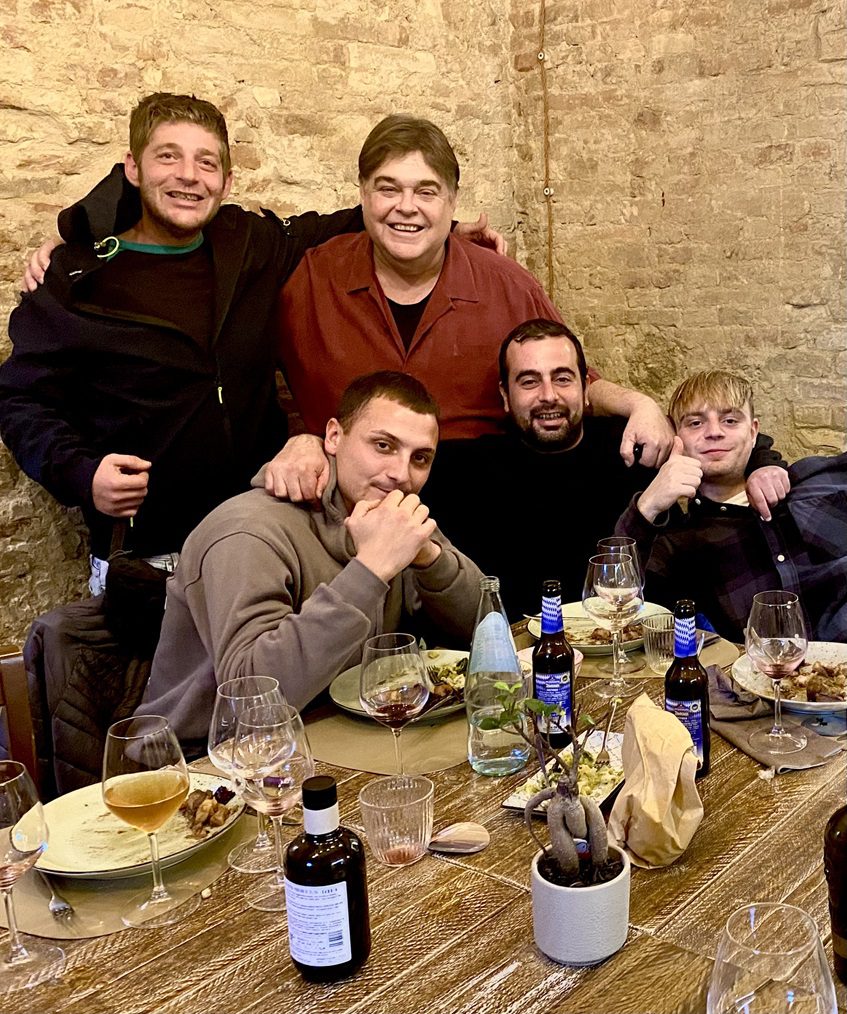
David enjoys spending time with members of his community, here shown with men who work for a wine project he is consulting on.
The first year and a half I pretty much remained in Italy. It takes a long time to get a residency permit here, and until you have that, you can only stay 90 days at a time. Now all that is settled and I’m starting to travel a lot more. I should point out that if I only did stories about wine in Italy, I could do that for the rest of my life and it would never get boring.
Now I’m committed to traveling once or twice a month. When I land in a particular country, I’m going to do several episodes … Usually, I try to do four or more. My next adventures will probably be in Georgia, the country, and possibly Moldova.
As far as traveling on the road is concerned, I’m a big fan of ambient sound so if I’m in a wine cellar or wine cave someplace, I want that echo … But I will tone it down during the editing process and there are some fabulous tools available to play with audio.
Where do you record when you’re not on the road?
When I’m at home I record in a small studio in my house. Having a fancy studio is not necessary any longer. The room where I record has 3-foot thick stone walls because the building is many hundreds of years old. The acoustics are quite good inside a stone fortress! These days, I use software solutions to get great audio.
Your recording equipment is top-tier. Are there any recommendations for our audiences?
I’m not sure if I wanna answer this question, as I would be giving away a fabulous trade secret. OK, I’m going to give your readers the best advice on the planet. Get a decent four- or eight-channel mixer. The one I use is made by Soundcraft. The mixer is connected to my Mac. I would say to anybody who’s anticipating the purchase of a computer for podcasting, it’s Mac or nothing.
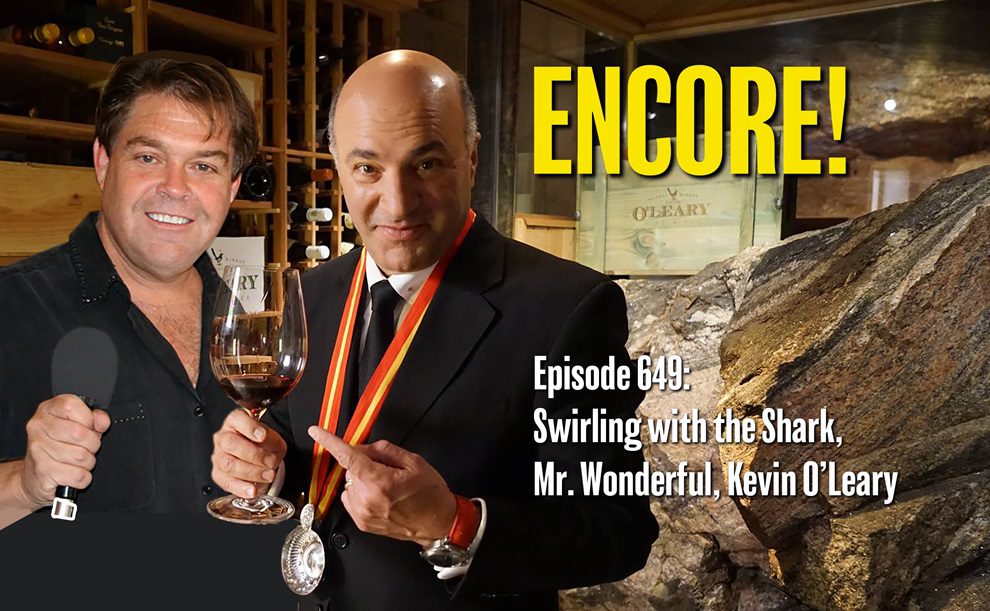
David on the cover of Encore with Kevin O’Leary
For microphones, I use the legendary SM58. This is the classic rock ‘n’ roll microphone that has been used for many decades. The reason I love this mike is because you could pound nails into a board with it. When you’re traveling and things are getting knocked around, the mic is bulletproof.
I now thoughtfully use artificial intelligence. I process all of my audio through a company called Descript. What they can do is simply out of this world. They use artificial intelligence to process audio and give you the most incredible sound. It’s the kind of quality you would get in a major studio. After I process my audio it sounds like I am in the same room with my guest.
I use a piece of software to get my volume levels perfect. I can’t stand listening to a recording that fluctuates too much. I also take out excessive silence. Not too much, but I definitely reduce the big gaps because listeners want you to keep the energy going and sometimes guests pause for a long time while they’re giving their answers to your questions.
All of these things that I do in production are a lot of extra work but I get true broadcast-quality audio. Right now the tools available to podcasters to achieve exceptional sound are just off the charts and that’s my fancy studio.
What fun guests you have! How do you find them . . . or do they often find you?
I have to admit that I really do get exceptional guests. I am very fortunate that I’ve been doing this for a long time, and the best piece of advice that I can give is to shoot for the best. Ask for top-tier people to come on your show. It helps to have a good press kit or something that gets them excited about being on with you.
The main thing is you have to develop relationships, and the most important relationships are with PR companies. Once you get on their list, you’ll start receiving press releases and the good opportunities will start coming into your inbox with any luck.
I have had the biggest names in wine ask their marketing people to contact me so I would say that I don’t really have to seek out guests for my show. But obviously, I look for unusual guests and then just go after them.
What’s coming up?
We’re about to launch a new streamlined version of the program and that will likely use some cutting-edge advertising tools once we get it going. That’s going to happen in the next 30 days. It’s a supplement to the main program but only a couple of minutes long. We call it a microcast.
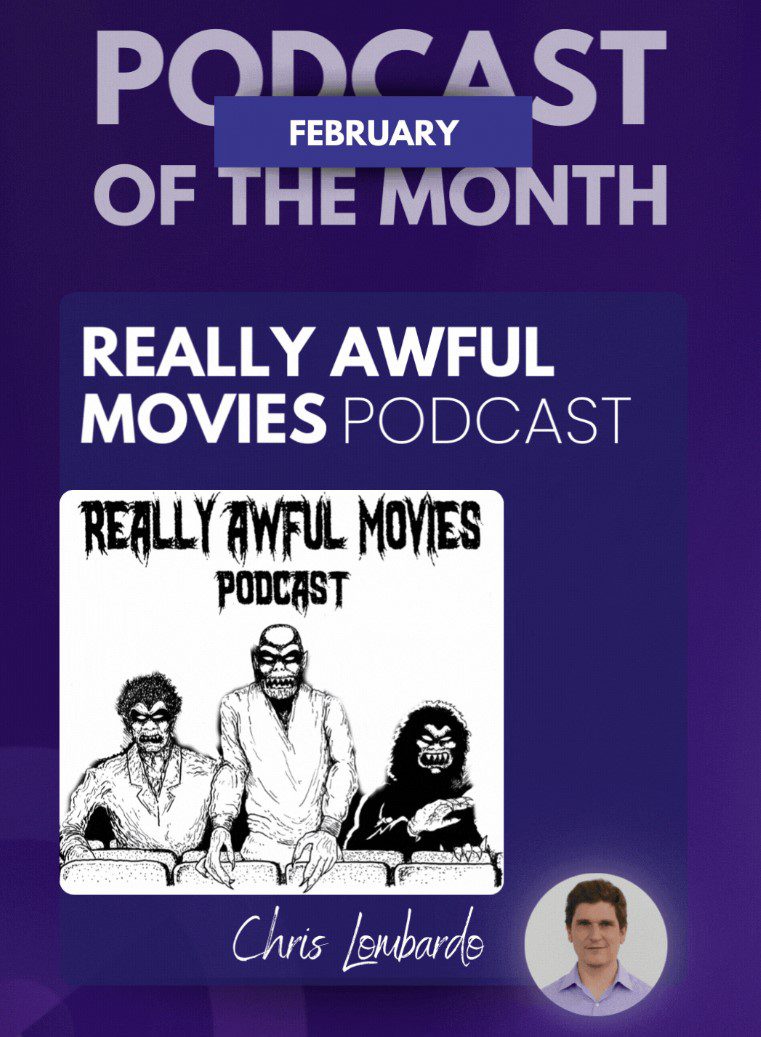
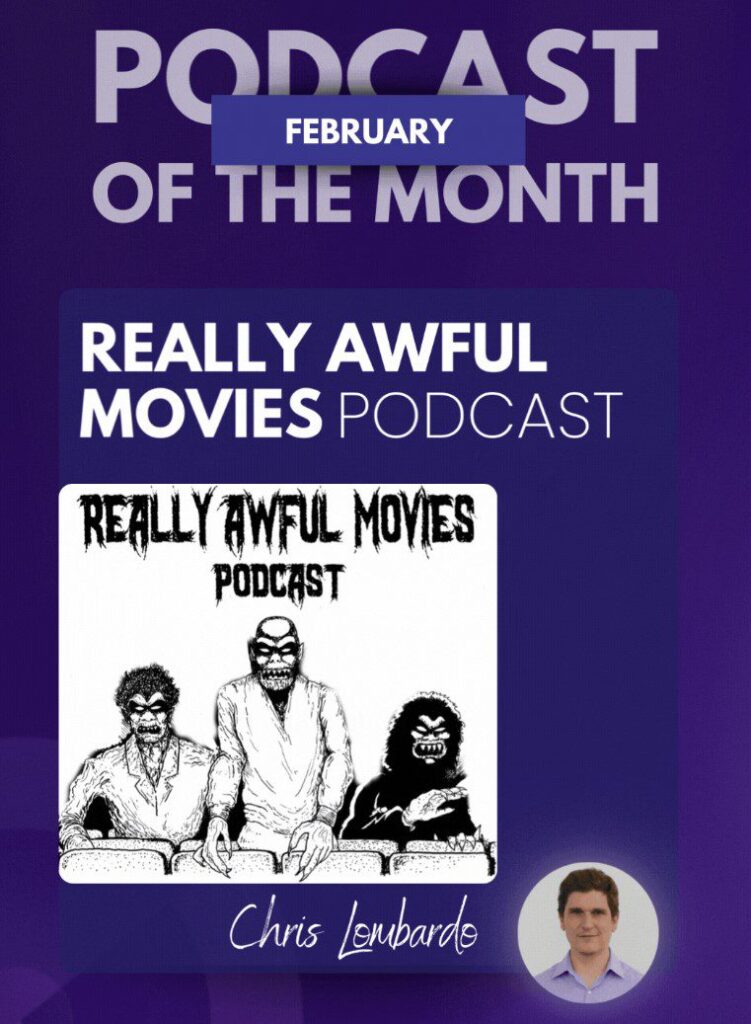
Stroll with us through the misty veils of blackened back alleys and beware of bullets and bandits as we explore the guts and ‘gory’ of cinematic shoestring thrillers. Our guide, Christopher Lombardo, is eager to lead us on a tour of the best of the worst in big-screen, low-budget entertainment in the Really Awful Movies podcast.
Our February Podcaster of the Month, Lombardo launched the weekly podcast in 2015. It offers movie buffs killer insights into low-budget horror and action flicks, along with other genres of cinema, such as musicals, monster movies and sci-fi gems – films Lombardo says “get no love or have been relegated to the far reaches of YouTube, Tubi or Netflix.”
Creep with Lombardo down the dimly lit corridors of the oft-abandoned non-blockbusters:
How would you describe your audience? When you’ve received feedback, what are some fan favorites?
For whatever reason, our audience is vastly and disproportionately British and American, and not so much Canadian where I’m based. But then again, podcasting is a truly global medium and people don’t need to be parochial in their listening habits. And it’s not for lack of trying! I routinely talk about low-budget Canadian horror cinema like Pin, Rabid, Rituals and My Bloody Valentine and wax poetic/philosophic about their individual merits.
We have a select group of diehards and engage with them on a regular basis through Insta. I’ve sent out copies of the two nonfiction books I’ve co-authored to SoCal, London, and Calgary. And it’s been crazy getting cult film recommendations (and even physical movies) sent to us from around the world. In one notable instance, a longtime fan in the Pacific Northwest suggested that we cover a terrible movie from the 80s, Longshot, with a plot based around, of all things, foosball!
Have you ever used or explored the inclusion of clips, audio, etc. in your episodes that would fall into fair use as you’re reviewing the content?
I have a busy day job: I’m a business journalist. So even finding time to podcast and edit can be trying. In the rare instance, I have a free afternoon to do more thorough editing, I’ll definitely add a small portion of a film trailer into the podcast intro, especially if it’s something with irredeemably cheesy dialogue.
You have interviewed producers, writers, etc. of the shows in these genres. Have you ever heard back from anyone associated with the films after publishing your review? And/or have you ever partnered with anyone to promote a show?
Christopher Lombardo
For better or for worse, my podcast show name sounds click-baity and I’ll bet it’s disappointed people googling and looking to see a film trashed that I’ve given plaudits. This was not my intention. It was a phrase my mom used when she asked a teenaged me, why I watched those “Really Awful Movies.”
Occasionally, I will have indie filmmakers post my reviews on their social pages, with the inevitable comment from someone who’s not read (or heard) my positive review, saying “What are they talking about, it’s not really awful!” In a way, Really Awful Movies is a good pod and blog handle, as you can weed out people with low attention spans who have not actually engaged with what I’ve said, and just assume it’s an excoriation.
I don’t do nearly as many partnerships as I could/should, and last did one mid-pandemic with Killer B Movies. If I do anymore, I am going to do video casts, with the added benefit now of being able to freely get a haircut in preparation.
As a longtime Blubrry customer, what made you decide on Blubrry? What advances are you looking forward to or hoping for moving ahead?
There were two well-regarded choices, Blubrry and Libsyn. I’ve used both and find the user interface far better for Blubrry. In fact, Libsyn was a real pain in the ass as they were in between regular and I think beta-tested versions. It just wasn’t intuitive and had a dated backend look. For the future, I’d like more design options for the site, and perhaps integration with a standard blog or other URLs.
You’re using programmatic advertising. Awesome! Have you found this an effective way to monetize? Are there others you’re using, have tried or would like to try?
The jury’s out on whether it’ll be effective. It’s simply too new! And besides, my numbers tend to take a dip around Christmas, when people (shocking, I know) have better things to do than listen to movies about ninjas, zombies, masked psychopaths, and South Asian drug cartels. I am a bit reticent about Patreon, as I’ve often held the view that to support the show, listeners should just buy my cinema books instead of donating. But I could lean into that eventually.
What are your next steps as you ascend the stairs of screams or explore the emerging annals of action?
I would like to get to newer horrors, faster. But I have a young child at home, and it’s not nearly as easy to rush out and catch the latest offerings in cinema. Also, the ‘90s represent a bit of unexplored territory for me on the podcast, for both horror and action, but for different reasons. While the ’90s can boast some of the craziest, ridiculous, and entertaining action films of all time, it is my contention that the same cannot be said about the ’90s for horror. It was a bit of a weak decade, Candyman excepted. Thus, I’d like to put that thesis to the test and see if it holds up.
The winter holidays are a special time for friends and family. So it’s fitting that our January Podcaster of the Month is a celebrated friend and family member of Blubrry: Dave Clements. A highly valued and forward-thinking member of the Blubrry team for four-plus years, Dave does massively more than assist customers within the support team. He is always thinking about the future of Blubrry and the podcast industry. Most recently, he is the father of Concierge Onboarding, Blubrry’s revolutionary new service that helps those wanting to start a podcast bypass the burdensome technicalities – and jump straight into recording and publishing.
Dave’s collaborative nature within the team is the natural progression of who he is – a podcaster for more than a decade affiliated with myriad ‘geeky’ podcasts along with other like-minded podcasters.
One of Dave’s stand-out collaborations is Playing Games with Strangers, launched in April 2020. The ensemble comprises eight distinct talents, and recently wrapped up its first campaign. Although not really based on anything in particular, the first campaign drew heavily from the Dungeons & Dragons fifth edition, he said.
“For our next campaign, we’ll be using a similar system, but we occasionally have one-shot episodes where we’ll use other tabletop role-playing systems like Monster of the Week or Kids on Bikes, among others,” Dave said.
Playing Games with Strangers is a cast-led show, Dave explains. There’s not truly a host outside of whoever is the game master of the campaign or one-shot. “Playing Games is completely improvised and we use D&D as a structure for various things that we want to do during a session.”
Admittedly, the podcast players are no longer strangers. Cast members dot the U.S, from states such as.:
Indiana – Dave and his sister-in-law, Amanda
Washington (state) – John, primary game master
Illinois – Katherine, who the audience knows as “Squid”
Kansas – Josiah
Louisiana – Celeste
“We also had a couple of other cast members who have moved on to other things at different times during our first campaign. (Hi JS, Steve and Eric!),” Dave said.
Dave Clements
In addition to PGWS, Geek This! is a review show Dave cohosts with one of his best friends, David Hunt, where they primarily review movies and television shows. “The show is laid back and meant to be just two friends enjoying (or not enjoying) pop culture,” he said. Dave is also involved with other shows in some form or another, including Supersonic PodComics, Casual Gamer Society with John from Playing Games with Strangers, and he’s part of the Geek Devotions Network, The Bottom Shelf, Boomstick Video Club, and his daughter’s first podcast, Lorewoven.
Learn more about Dave and his colleagues:
Dave, what drew you to podcasting all those years ago and how did you start? (first part answer here, leading into . . . )
I’ve been podcasting since December 2012, so just over 11 years. That’s when I released the first episode of Geek This! all by my lonesome. Just myself, Audacity, and a cheap $5 stick microphone.
What systems or routines do you have in place to ensure consistency?
We record one session every other week and turn it into two one-hour episodes. Other shows like ours will do episodes that are sometimes up to four hours, which we don’t feel is easily digestible. One thing we’re working on for Campaign Two is to change to an every-other-week release schedule. It gives us more time to edit and achieve the quality we’re striving for.
Among the PGWS ensemble, it seems all of you are connected through another vocation – can you tell us what that vocation is, some of the external gigs everyone has undertaken, and what some favorite roles? We actually met through Supersonic PodComics – none of us are professional voice actors. We all heard about Supersonic through other podcasts that we listened to and decided to audition.
When Supersonic was on a hiatus during the COVID-19 pandemic, JS Earls, who was a writer for the show asked if any of the Supersonic cast was interested in playing D&D and recording it for filler material.
John took up the game master role and Steve, Josiah, Squid, and JS took character roles. It was only supposed to be a handful of episodes, but it was so much fun that the cast grew, with Celeste and Dave being added a few months later. Amanda wasn’t involved with Supersonic, but was actually one of our most dedicated Patrons, so we extended a cast chair at the virtual table when Eric had to leave in order to pursue a small business venture. Now here we are with a show that has released over 130 episodes in the last three-ish years.
How does podcasting support the cast’s other roles in voice acting; and how have their careers in voice acting impacted Playing Games with Strangers? We don’t really have careers in voice acting outside of PGwS or Supersonic, but we’d never turn down the opportunity if one came up! Some of us have done some audiobooks and other roles in podcasts. We did, however, get to play D&D with Katie Leigh, who voiced Sheila The Thief in the 1980’s Dungeons & Dragons cartoon, which was a fun, wild ride that we’ll never forget.
I would love to know some cast members’ ‘why’ when it comes to podcasting! Such as, what is your biggest takeaway from Playing Games with Strangers? What are your greatest hopes? (From Katherine “Squid” Czerwinski)
Katherine “Squid” Czerwinski
For me, podcasting has always been about stories. It’s what drew me to tabletop games initially, and what got me into podcasting. I believe that stories are innately human and that we all seek them out one way or another. It’s easy to get swept away in the fast-paced environment of the world now and not pause to seek out stories; be it through podcasting, reading, or just talking to people you don’t know. This podcast, and others, have provided me with an avenue to really engage with that concept. It has not only given me a way to share and create stories with others so that the audience can hear and connect with them, but it’s let me connect more deeply with the cast members who started out, quite literally, as strangers! My hope in podcasting, no matter how popular we become, is always that we put out a story that someone will be able to hear and then see themselves represented in. I hope that we give voice to stories that not everyone has the freedom or the platform to share, or those who may not yet know what words they need to use to share them. For the few hours that we sit down and make jokes and tell stories and play games and maybe even cry, I hope that we put out a podcast that doesn’t just feel like a ‘product’ (although I hope we have a good and entertaining product too), but something that taps into that shared human experience. I hope it shows whoever listens that there are others out there who like the same things they do, that we experience the same good and bad things as them, and that we’re hoping we can one day listen to the stories they want to share as well.
What Blubrry features has the cast found most helpful as your podcast(s) continue(s) to grow? We’ve utilized the Audience Survey, which has helped us get a better understanding of who is listening. We’re taking that information into consideration with merchandise designs, pricing, and our Patreon tiers so we can make the extras feasible for anyone. We also love the Retention and Episode Comparison information in Listener Statistics. It was part of what prompted us to move to 1-hour episodes versus the 4-hour releases that some other, more popular shows are doing; we want our episodes to be consumable. In the near future, we’ll be taking advantage of the Live Item Tag functionality in PowerPress, as well as Chapters. There’s so much at our disposal as Blubrry PowerPress users that it’s hard to find time to incorporate it all.
Andy Mort is not your stereotypical rebel. A podcaster, ambient sound artist, songwriter and professional life coach, Mort calls himself a Slow Coach. Having gone through his own renaissance and revival, our September Podcaster of the Month offers inspiration and support for others’ gentle rebellion. He helps people “connect with our natural rhythms, release the hold of alienating external demands, and freely infuse everyday life with our unique creative spirits.”
“I love making spaces for weary travelers who are exhausted by the pace and pressure of modern existence,” Mort says. One of these spaces is The Haven, a virtual village in which people can escape to find the “needs beneath the noise.”
Mort’s podcast, The Gentle Rebel is an extension of that haven, offering listeners a weekly note of encouragement for more than a decade. Through music, art and outreach, he reaches introverts and highly sensitive people. Mort helps them break free from their constraints and the narratives they’ve internalized about themselves.
You started The Gentle Rebel a decade ago, then ended that chapter and rebooted in April 2022. What differentiates these chapters and what can listeners look forward to in the months/years to come?
I’ve been doing the Gentle Rebel Podcast since 2010. It has been through several iterations or chapters. The most recent one started in April 2022 when I realized after 365 episodes there was a lot of stuff I had covered a few times in different ways over a decade of exploring. I had also reached a better understanding of many of the ideas I had been circling. I wanted to consolidate the ideas in those shows so that I had a simple focused archive to refer people to when looking for support and information about particular things. Podcasting is a wonderful way to think out loud and bounce ideas around. Eventually you reach a firmer position about certain things. That’s what happened. I wanted to mark that.
I have reached the end of that consolidation process now, so I am enjoying exploring what the podcast wants to be next. The big focus is allowing space for music and practice to become part of episodes. Rather than just talking ABOUT theories and ideas in a world of abundant access to information, I want to connect with the humanness we share and provide valuable resources that give people an energizing and connecting experience to counter the frazzle and overwhelm that so many people are reporting feeling at the moment. So there will be more of that. Reflections on what it means to be human in a world of machines and plenty of space to explore that creatively.
Andy, you are a Sound Artist, Songwriter, and Slow Coach. How do these areas interconnect in your podcast, The Gentle Rebel? (And how do you define a slow coach?)
The podcast is where my creative and professional passions converge. It’s why I love the medium so much. I use podcasting as a conversation with my listeners, a place to share my stories/experiences/observations (often from my life as a performer/songwriter), and a platform to create practical experiences that leave people feeling a positive shift after listening. That final part is often where my slow coaching philosophy interweaves with my creativity.
The idea behind slow coaching is that we don’t make good long-term/big picture decisions when we’re feeling rushed or in a heightened state of stress/alertness. I want to help people see the possibilities for their lives through a state of rest and deep connection so they can make grounded decisions that reflect who they are and where they want to go next.
The world is so noisy and there are so many competing demands and voices that tell us what we should want, do and value. I want the podcast to be somewhere people can come to as a way to reconnect with themselves and the needs, feelings and sensations beneath that noise. I bring my ambient instrumental music into certain episodes as a way to help listeners connect with different states of being. I am always aware of the rhythm and pace of an episode and how important it is to create that sense of hope and possibility as somewhere to finish each one.
What approaches have you found effective for introverted individuals versus people who are more outgoing?
This focus emerged organically when the first iteration of the podcast started in 2010. It actually began life as an independent music podcast where I would share songs by artists I had played with and who were under the radar of the mainstream music industry. I began to speak between the songs and on a few occasions, talked about challenges/observations from my life as a musician. People would get in touch to say “I get that too,” especially when I spoke/blogged about things I later saw as characteristic of introversion and high sensitivity. So I naturally moved down that line, talking more about those things. And as I did so, I got more listeners looking for support and a sense of community with people who see the world through a similar lens. Knowing that you’re not alone in your experiences is a big part of what we all look for, and this is especially true if the world feels oriented toward another way of operating. I guess it comes back to permission to explore your own natural pace and rhythms and to listen to what you need to manage your energy, focus deeply on what matters most to you, and not get burned out by trying to keep up with the flow of demands and pressures from a fast and noisy world.
How have you found that music – such as your music – reaches and supports the individuals you’re touching through your podcast and through your one-on-one coaching?
Music is the language that transcends language – it speaks to us (and through us) in ways we might not be able to describe with words. I love it as a metaphor to help us navigate the challenges we face and our relationships with ourselves. And the experience of music (I do online gigs, host sound anchor rest sessions, and share/talk about songs from my Atlum Schema back catalog), which allows me to support people in different ways. I love sharing my music with other people; there is something beautiful about the energy that comes from a live stream, where we have the same experience as other people worldwide. It’s a gently rebellious joy in an on-demand world.
The language of creativity helps me to work with clients to explore their inner landscapes, dreams, challenges and everyday possibilities in playful ways. We can go deep without it feeling heavy. We can explore with curiosity and joy. As I said before, music is also a tool I use to help people return to a place of calm inner connection and grounded hope after we adventure into those new horizons.
In what ways do you think your podcast helps introverted listeners feel more connected and understood?
I guess it comes down to being a companion to people who might see and experience the world differently to the people around them. It’s the great thing about the podcast medium – it feels personal and real. Someone who you resonate with can chat about things that are important to you as you go about your day. At the broader level, podcasting has increased our collective understanding of introversion and high sensitivity. The Gentle Rebel Podcast has been a great chance to explore listener questions and observations as they come in over time. It’s just lovely to feel like I can be the voice of “someone like me” to a person who might be feeling disconnected and alone.
Are there any memorable stories, feedback or experiences from your listeners that showcase the positive effects of your podcast and your coaching in general on their lives?
There is a story that speaks to the power of podcasting in creating connections and gently transforming lives of those who encounter them. I was invited to speak, lead a workshop and perform at a gathering for highly sensitive people in Finland – all sparked by a listener who reached out and joined my Haven community. She put me forward as a potential guest at the gathering. Tuula has since become a close friend and creative collaborator. The event itself was memorable for many reasons. One in particular sticks out when it comes to thinking about the unforeseen positive effects of the podcast. At the end of a day of workshops, a Q&A and a live gig in the evening, someone came up to me and said, “Thank you so much. I love playing the piano but I’ve never played to anyone else. After hearing you speak and perform today, I realize I have the strength to do it. I now know that I want to do it.” That blew my mind. It was one of those “ahh yes, this is what makes it all worthwhile” moments.



 To understand
 Ruth consistently releases a new episode of
 Step into a world where the lines between science fiction, fantasy, and surreal mystery blur — a world crafted on the fly, powered by curiosity, and designed to ignite your imagination. This August, Blubrry Podcasting is proud to spotlight


 I was a heavy-duty wine enthusiast. I had a wine cellar in my house that could seat about 18 people, so I would have small groups of people come to my house on a pretty regular basis. We would go down to the wine cellar in the evening and remain down there for hours. I was not a wine collector; I wasn’t interested in that. I was interested in wines that were excellent but mostly reasonably priced. I hated, and I mean truly hated, wine snobs, and I would often go into a rant about these people who were going on and on about what they tasted in a wine, knowing in my heart that most of it was total B.S.

 Stroll with us through the misty veils of blackened back alleys and beware of bullets and bandits as we explore the guts and ‘gory’ of cinematic shoestring thrillers. Our guide,



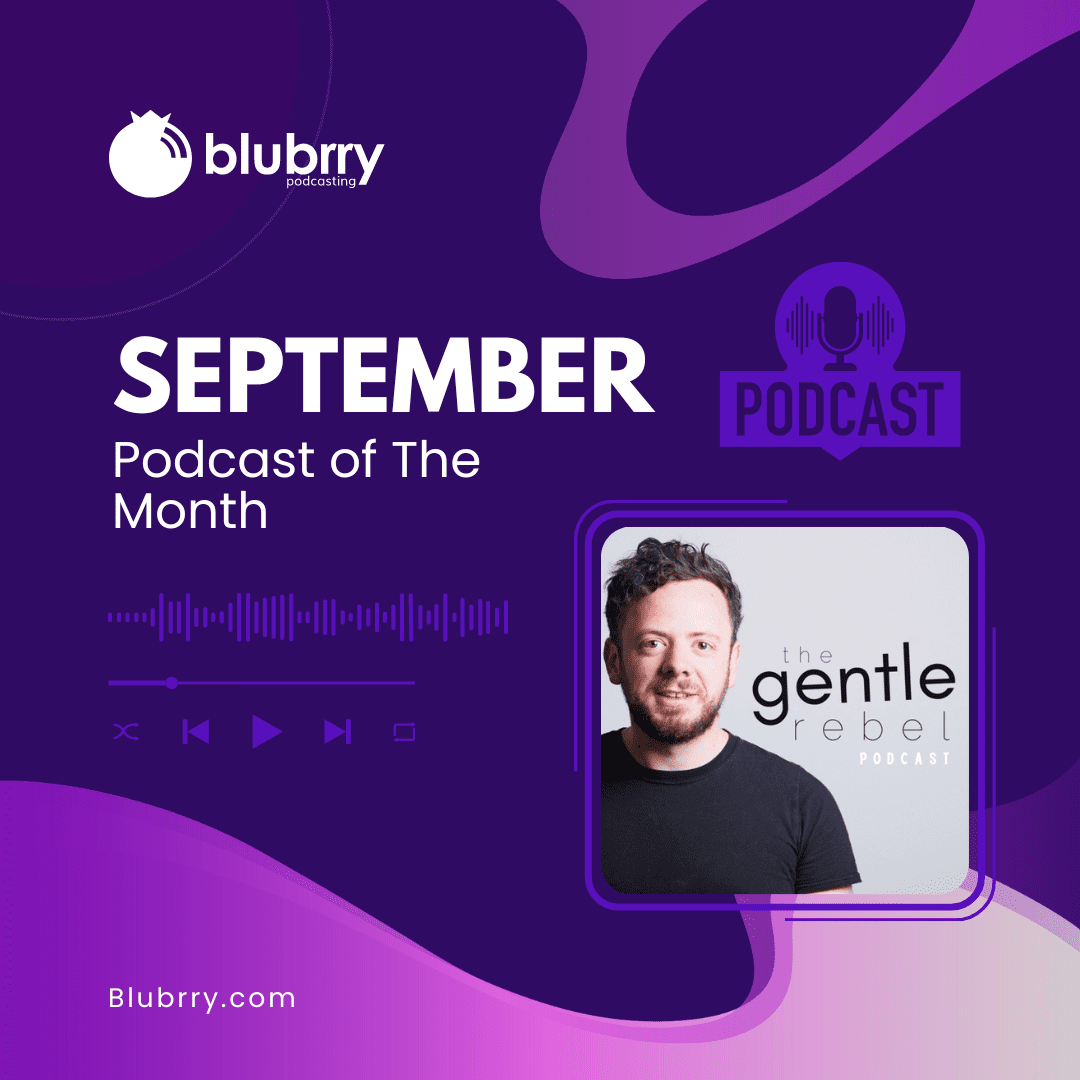
 Andy Mort is not your stereotypical rebel. A podcaster, ambient sound artist, songwriter and professional life coach, Mort calls himself a Slow Coach. Having gone through his own renaissance and revival, our September Podcaster of the Month offers inspiration and support for others’ gentle rebellion. He helps people “connect with our natural rhythms, release the hold of alienating external demands, and freely infuse everyday life with our unique creative spirits.”