Category: Statistics

  • Podcast Statistics Partial Play Data

    Blubrry Introduces Play Tracking with Advanced Stats

    Play tracking listener retention percentage

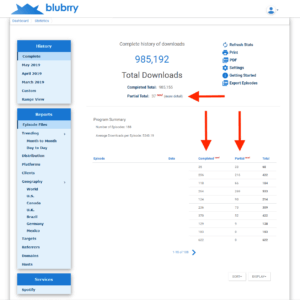
    Blubrry’s Advanced Stats has a new feature: play tracking. If you’re already using these stats, you understand how valuable the listener retention data is. And now you can see how long your episode was played in the web player we provide for each episode.

    Available at the episode level, podcasters can assess how many people listened via the Blubrry player. This information will be useful if you’re looking for more insight when you publish episodes using the Blubrry player on your website.

    If you suspect your audience is skipping over certain parts of your episodes, play tracking helps you find out for sure. This vital information is beneficial if you’re doing any kind of advertising in your episodes as well. For those already using Advanced Stats, you’ll find a new category in the Stats section.

    Plays and partials statistics per podcast episode

    If you’re not already using Advanced Statistics, now is the time to give it a shot. You don’t know what you don’t know until you take a look at all of the information available to you. And you can easily add Advanced Stats to your hosting. Got questions related to Advanced Stats or our player? Contact our support team. 

    This from our CEO, Todd Cochrane: “Play tracking data is going to vary from podcast to podcast. We looked at a lot of shows — some have a handful of web plays while others had hundreds per episode. This new data could be a marketing opportunity to remind listeners they can catch the show on the web.”

    P.S. Did you know that you can change the colors of our player to match your website and branding? You can do this in Blubrry’s Podcaster Dashboard or in PowerPress. And speaking of the player … we want your feedback! Tell us what you’d like to see in an audio player.

  • 10 Tips for the First Two Minutes of Your Podcast

    Best Practices for Your Podcast’s First 120 Seconds

    Seconds timerThe first two minutes of your podcast are the most important of your show. And even if you don’t agree with that statement, you surely agree that your podcast must quickly achieve the following goals:


    1. Confirm your branding and the ‘feel’ of your show.
    2. Let your audience know what to expect with your episode.
    3. Make your audience want to listen more.

    Since these first 120 seconds of your show are so important, here are 10 tips to ensure those two minutes do what they should.

    1. Limit your intro music. Your intro music helps to set the ‘feel’ of your show, but playing unaccompanied instrumental music for an extended time without a voiceover does not further any of the above goals. Make sure your listener hears someone’s voice within the first few seconds during your intro.
    2. Use a brief prerecorded intro to convey the ‘feel’ of your show. Having a professional, scripted, prerecorded intro to your show elevates your show’s image.
    3. Let your audience hear your voice as soon as possible. Having a prerecorded introduction with a professional voiceover artist has its benefits, but keep in mind that your audience is tuning in to hear you. Make sure every second of your prerecorded intro serves the goals above.
    4. If you use a ‘highlight’ clip from your episode as part of your intro, make it brief. Hearing a clip particularly funny or meaningful in the first two minutes of your show may keep your audience listening. However, some listeners may view a longer ‘highlight’ clip at the beginning of the show as off-putting and a delay to the real content of the show.
    5. Share key takeaways that your audience can expect from listening to the episode. If you do not use a ‘highlight’ clip consider sharing a quick preview of your episode in the first few seconds of your show. You will have time later to present your main topic in full context, but saying something like, “by the end of this episode you will be able to…” will entice listeners to keep listening.
    6. Greet the listener. Many people love the personal connection they develop with the hosts of their favorite podcasts. To strengthen this connection, include a personal greeting at the beginning of your show. Phrases like, “I hope you are doing well,” or “It is good to know you are here” impact your listeners.
    7. Segue into the main part of your show. Be clear when you finish your show’s introduction. Tell your audience when you are entering the second phase of your show even if it is just a hard stop of the background music or even the words, “Now, let’s start the show.”
    8. Seek the best audio quality. You never have a second chance to make a first impression. And that is true for the audio quality of your show. Including bad audio in the first 120 seconds of your show is damaging to your professional image.
    9. Validate that your first 120 seconds is connecting with your audience through podcast analytics and statistics. Luckily for Blubrry hosting podcasters, you can find out when listeners stop listening, via Blubrry’s Advanced Statistics that lets you know what percentage of your show has been consumed. As you are tweaking your intro, use these tools to determine what intro practices encourage your audience to listen past the introduction.
    10. Do not alter the first 120 seconds frequently. Your listeners like consistency: Do not drastically change the format of the beginning of your show once you have created something both you and your audience like.

    Do you have a podcasting host that actively wants you to succeed? Blubrry wants you to succeed and offers the weekly Podcast Insider Podcast and Blog with tips, tricks and techniques to help you and your podcast. Make Blubrry your Podcast Hosting company today.

  • How Do I Know People Are Listening to My Podcast?

    How Do I Know People Are Listening to My Podcast?

    Blubrry’s statistics are IAB Certified. That means that the largest organization that offers a meaningful definition of a podcast download has examined how Blubrry counts your podcast statistics and certified that Blubrry is doing it the right way. IAB’s Podcast Measurement Technical Guidelines ensure that your podcast statistics (“download numbers”) reflect the number of times that your podcast is downloaded for actual human consumption. Knowing that number is more valuable to you, the podcaster, than knowing the total number of times that people, and internet bots and spiders, and social media posts and ads access your MP3. Blubrry’s statistics have value.

    Oct. 20 is World Statistics Day and the theme this year is “Connecting the world with data we can trust”. Statistics (podcast and otherwise) have been recently given a bad name. One of the best examples of the zeitgeist’s opinion of statistics is a quote from the book number9dream by British author, David Mitchell. He wrote, “Over 85% of statistics are made up on the spot.” World Statistics Day elevates the importance of accurate and reliable statistics and the value that data science and statistics offer in our daily lives. 

    Many podcast experts say the measure of a podcast’s success is if it achieves the podcast producer’s vision for the show. Arguably, this does not capture a full measure of success since it does not have a measurable outcome. One’s vision for their podcast could be as undefinable as self-expression, or to connect with other like-minded people, or to share a message of hope and encouragement. How can you know you are expressing yourself to others, or connecting, or sharing without reliable podcast statistics that accurately reflect how often your work is being received by other real human beings? Buried in each podcaster’s vision for their show is the desire to share their show with others. Reliable, accurate podcast statistics are the best measure of this. You can trust Blubrry’s statistics for that task.

  • Focus on Features: Blubrry Free Stats

    Focus on Features: Blubrry Free Stats

    Focus on Features is an ongoing series that explores the catalog of tools/services offered by Blubrry.

    Every podcast needs good stats. But not all podcast-publishing solutions provide stats. Blubrry can help bridge that gap. Blubrry offers two tiers of stats; Free Stats and Standard Stats. We’ll be looking at Free Stats this week.

    What it is: Blubrry Free Stats is a free service that can be used by anyone, as long as their publishing platform supports third-party stats. Blubrry Media Hosting is not required in order to use Free Stats.

    How it works: Sign up for a free Blubrry account and log in to your Podcaster Dashboard. Click the Sign Up for Free Basic Statistics link inside the Podcast Statics box and complete the Stats signup process. Click the Getting Started link to find your show’s unique Blubrry statistics prefix URL. Prepend your show’s media file links with your Blubrry stats prefix URL and Blubrry will begin tracking your downloads.

    What it isn’t: Blubrry provides media-download statistics only. Blubrry Stats aren’t for “feed hits” or “subscriber counts.” Also, Blubrry values listener privacy and doesn’t employ user tracking or attribution technology.

    Not sure how your podcast is performing? Blubrry Free Stats are a comprehensive, industry-leading solution for both brand new and longtime podcast producers. Sign up today and start counting those downloads!

  • Get the Best Podcast Statistics for the Best Reason

    Get the Best Podcast Statistics for the Best Reason

    Using Podcast Statistics to boost more than your ego…

    Many podcasters think that the number of podcast downloads are the best measure of their success. But a thoughtful analysis of your podcast download statistics offers the podcaster so much more actionable information than just total downloads. As a matter of fact, the best thing about podcast statistics is what it tells you about your listeners.

    The leading podcasters have a mental image of their ideal listener (often called an avatar). During a podcaster’s early episodes this avatar is completely created by the podcaster’s opinions and goals for the show. A thoughtful podcaster can review their download statistics and clarify much more about their audience.

    Below are a few examples of actions you could take based on the information provided by Blubrry’s different levels of podcast statistics plans.

    Blubrry’s Free Statistics Plan is free, really free. You can use most any podcast host and still use Blubrry’s powerful, free, basic podcast statistics to learn a lot about your listeners. Here are two examples that demonstrate how your audience listens to your show can guide your practices for better engagement.

    • You discover by using Blubrry’s Free Stats that a majority of your listeners are listening to your podcast via a Windows computer. Knowing this, you can add a segment of your show where you can talk about resources on your podcast website and ask your listeners to open up a new browser window and click through to your website while they are listening to your show. That is an easy way to boost listener engagement.
    • You discover that a large segment of your audience listens from Australia. As you are planning your next episode you find two equally qualified experts on your episode’s topic, one from Norway and the other from Australia. Which one are you going to reference on your show and maybe ask for an interview? Of course, the expert from Australia would be the best choice.

    You can make those types of decisions based on Blubrry’s Free Basic Statistics Plan.

    There are a few more actionable data points included in Blubrry’s Standard Podcast Statistics Plan that can help you make even more decisions.

    • Your podcast has made you a known expert in your field and you have been invited to speak at two separate events on the same day. Unfortunately, one is in Santa Fe, NM, and the other is in Burlington, VT — which to choose!? You can look at your Blubrry Standard Statistics and determine which state is home to more people who listen to your show and let that be your deciding factor. You could speak at the event during the day and host a meet-up with your listeners in the evening and everybody wins.
    • With an add-in of Advanced Statistics you can see how long your audience listens to each episode if they stream your episodes. With this type of review you may discover that many of your listeners stop listening after the first 15 minutes. Knowing this you can do two things:
      • Change things up about about 15 minutes into your episode, do something different that keeps them listening, remember it is your show and you can do what you want.
      • If you have an advertisement on your show, play the ad while most of your listeners are listening. There is no reason to wait for the arbitrary midpoint or the end of your episode for your ad (unless you are not contractually obligated). Having more people hear your ad will help you sell more of your T-shirts or get more people to buy audio books.

    As you can see, these are powerful tools for you and your show. The question is, which Blubrry statistics service plan gives you what you need? With these plans you will see that the two phrases, ‘Free is good’ and ‘You get what you pay for’ definitely apply. Feel free to review the full features of each plan and choose what will help you learn more about your listeners.

  • Downloads: A Micro View

    Downloads: A Micro View

    As expressed in our previous article about download numbers, we at Blubrry like to take a multifaceted assessment of every issue. At the same time we were looking at global download statistics (Click here for that assessment) we also requested feedback from individual podcasters. This offers a micro-level review of the COVID-19 effect on podcasting.

    In late March we shared a poll on our Facebook feed that asked:

    “Blubrry podcasters, with the ongoing COVID-19 pandemic are you seeing your podcast stats increasing or decreasing?”

    We offered three responses from which people could choose: whether downloads of their podcast increased, decreased or stayed the same. The results are surprising — about half of everyone who responded reported that their downloads were the same as they were four weeks ago. In other words, what we see on the news and what is taking up our social media feeds is not affecting the downloads of half of the podcast producers. The other half of the survey respondents were split equally. Half of those remaining reported their downloads were up and half reported their downloads were down. Below is a pie chart of these results.

    Survey Results
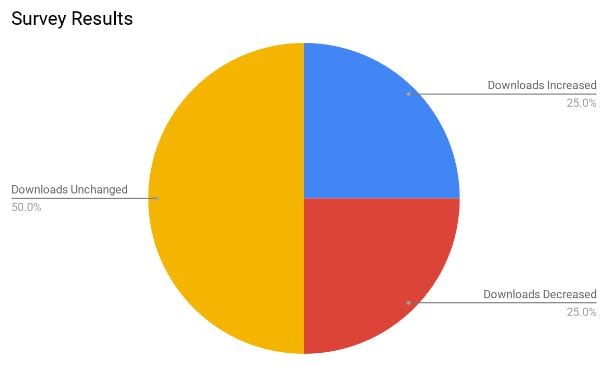
    These results are interesting. However, the sample size of this group was not statistically significant, so these percentages should be viewed as anecdotal. To add a personal perspective to these results, below are vignettes from three podcasters who responded to the survey.

    We asked Carolynn ni Lochlainn from the Ancestors Alive! Genealogy, From Paper To People Podcast to further discuss why she responded that her downloads have stayed the same in recent weeks. She shared a little bit about her podcasting history and offered some details about her recent downloads. 

    “I started my podcast at the beginning of January 2018. I was motivated by a couple of entrepreneurial friends who suggested having a podcast was a way to build up the video teaching series I started in 2017. I’m no longer sure that I want to release that video series, but the podcast has been a lot of fun! I really enjoy teaching newcomers genealogy and family history, and how to use online databases, genealogy websites, DNA, folklore, blogging, Twitter and cooperation to discover their own roots. I use lessons, interviews and examples of my own research to teach beginners how to take ancestors from names on paper to multidimensional people who lived, breathed, loved, lost and helped us to be who we are.”

    Ms. ni Lochlainn shared that during this COVID-19 crisis she has seen a recent increase of 13%-25% in her downloads. However, this increase does not make up for a general dip in downloads since October 2019. Her numbers now are about the same as her numbers in late 2019, so she reported that her downloads are about the same (even though she has seen fluctuations over that time). 

    Roderick Wilborn with the Anime Pad Podcast said he has seen a definite increase in his downloads. When asked to provide more detail about his podcast and the numbers he shared:

    “I’ve been an anime fan since I was 6 years old. As I became an adult people would always talk with me about anime and other items of Japanese pop culture. Using that as my prompt, I started my blog, Anime Pad; my YouTube page, Express Team Wave (ETW); and my podcast. You usually don’t hear from African Americans in the anime space so I am unique.

    “I have been podcasting since May of 2018. I try to create a space for Blerds (‘Black Nerds’) to discuss anime shows, manga, Tokusatsu, Japanese pop culture, Japan and conventions. I am proud to say that through my online efforts many anime voice actors, directors, animators, writers and loads of listeners are now my friends.

    “When the news of COVID-19 broke I knew that people would be confined to their households and need entertainment, just like me. Coincidentally, just before the virus hit my show was accepted to Pandora and I released an episode recorded at the Chicago Comic and Entertainment Expo (C2E2). Since then I’m seeing a 100% increase in my daily downloads. It’s great that people are enjoying the podcast and maybe I can take their minds off the world for a while. Yet, I wish this was under different circumstances.”

    John Wilkerson answered the Blubrry survey that he has seen a decrease in downloads. His detailed response is interesting. Wilkerson shared:

    “I’ve been podcasting in various forms since 2005. The two podcasts with download changes I have noticed are The Wired Homeschool and Struggling for Purpose. The Wired Homeschool has actually seen a recent increase in downloads. However, I stopped producing the podcast back in July 2019 and just left the content available. Downloads (understandably) dropped until February. I saw a slight rise in downloads in February probably because parents began entertaining the possibility of having to homeschool their children. In March my downloads have tripled over February. Now download numbers for this show that I no longer produce are what they were before I ended the podcast.

    “Struggling for Purpose has seen a recent decrease in the number of downloads. This podcast has seen about a 10% drop-off. This podcast is active and gets released every 10 days or so.”

    Knowing just the aggregate number of podcast downloads only allows a partial view of COVID-19’s impact on podcasting. Reading the individual stories from podcasters also offers a compelling aspect of our current situation. The vignettes above offered just a few stories. How are you and your podcast doing? Please comment below and add your experience to the unfolding story of how the COVID-19 crisis is affecting podcasting.

  • Downloads: Up or Down?

    Downloads: Up or Down?

    In the past few days, several reputable sources for podcast information have shared inconsistent reports about how the current COVID-19 crisis is affecting podcast downloads. While one article reports downloads are down, another publishes that downloads are not affected and another shares that downloads are increasing.

    At Blubrry, we take a multifaceted assessment of every issue. We decided to look into download numbers as compared to four weeks ago in a variety of ways. Let us look at an assessment of the aggregate number of downloads across the Blubrry directory. This will allow us a high-level view of the effects of our current situation on podcasting.

    Yes, we can confirm that the average daily downloads of podcasts have slightly decreased in March as compared to February. What is surprising is the scant amount of change. Total downloads were only down one-half of 1%. To put this in a non-technical context. Recite to yourself what you can remember from the Gettysburg Address. There is not much to remember, only 267 words with 1,467 characters (including spaces). “Foursco” is .5% of Abraham Lincoln’s most memorable speech. As you can see, the overall size of the February to March decrease in podcast downloads is de minimis.

    A closer look inside the aggregate data reveals some points to consider.

    • The last week of March saw the sharpest decline compared to the previous weeks in the month. Unfortunately, a sample size of one week is too small to extrapolate anything meaningful.
    • We can confirm an uptick in podcast consumption on weekends.
    • Podcasts in the Sports category have decreased, understandably.
    • Podcasts in the Religion category have increased.

    We will continue to look at aggregate downloads here at Blubrry and whether the fluctuations listed above build into trends. We will keep you informed.

    In conclusion, let us again revisit Abraham Lincoln’s Gettysburg Address. The beauty and pointiency of that address lives in the larger 99.5 percent of the work and not in the first .5 percent. If we as a community of content creators and producers focus only on the .5 percent decrease in downloads we are at risk of missing what is going right in podcasting currently.

    To that end, our next post will look at how the COVID-19 crisis is affecting podcasting from another perspective. We will look at the results of our recent Facebook Poll and share some individual podcaster’s experiences. Stay tuned…

  • Podcast Partial Download Reporting

    Podcast Partial Download Reporting

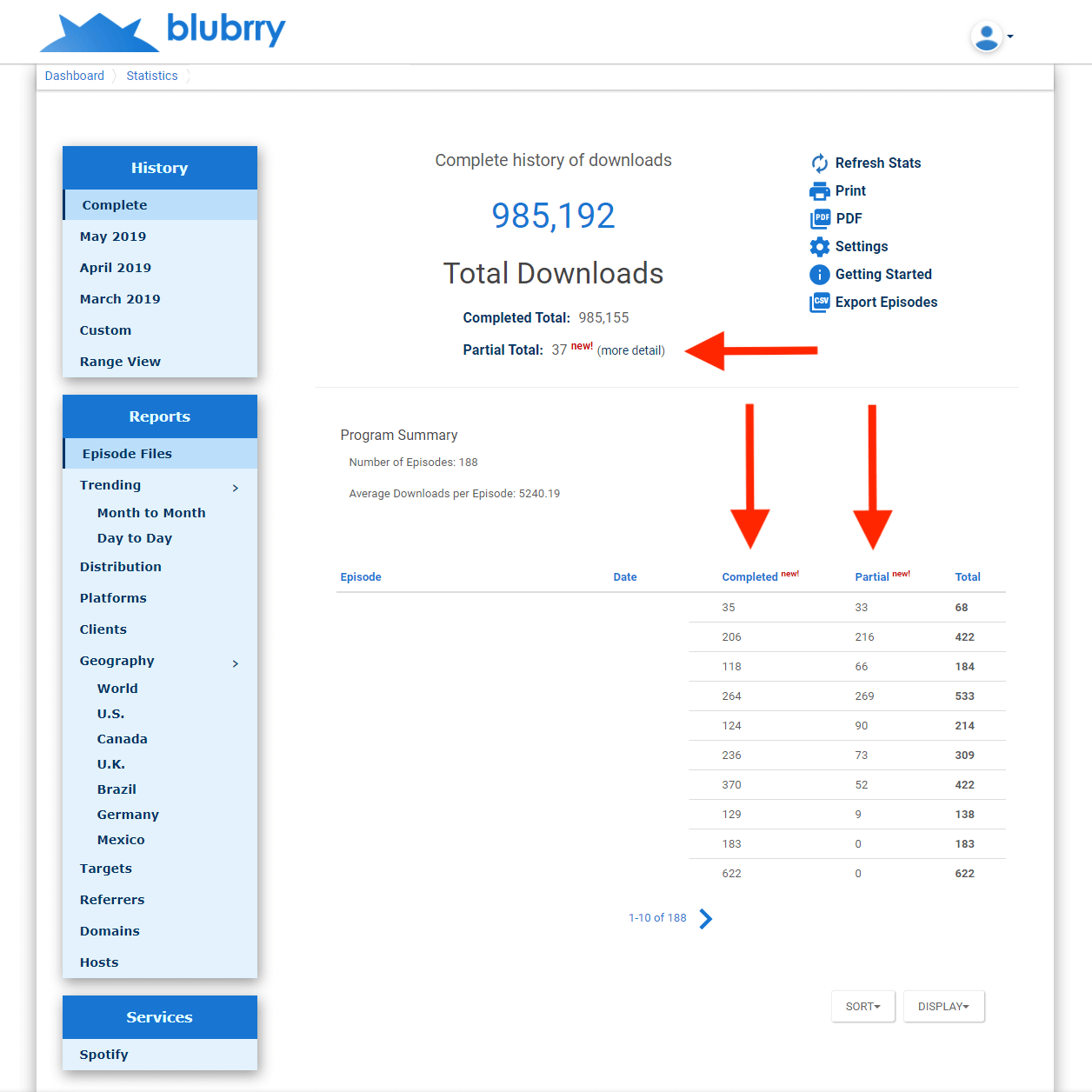
    Sometimes, big improvements come in small packages. Such is the case with a brand new feature you’ll find in your Stats Dashboard if you’re a Blubrry Podcast Hosting customer: Partial Download Reporting. (not a podcast hosting customer yet? We have great podcast hosting options for just about any podcaster.)

    Partial download reporting: what it is and why you need it

    Blubrry was the first podcast host with an IAB Tech Lab Certified podcast stats platform. Kind of a big deal, if we do say so ourselves. That industry leading stats platform just got a great upgrade. Partial Download reporting, now available as a free upgrade to our hosting customers for a limited time, partial download reporting helps podcasters understand their audience’s consumption patterns better. Our proprietary system sifts through your downloaded data to determine which downloads were complete and which weren’t. That means you’ll be able to tell when & where you might have lost your audience’s attention. Which means you have another tool in your arsenal to keep improving your podcast content, pacing, and format.


    Read more here, or go to your stats dashboard and check it out.

    Get partial download reporting for free today.

    If you’re already a Blubrry Podcast Hosting customer, this is a limited-time free offer. This is a premium feature of which there will be a small upgrade fee beginning July 1.

    Gimme My Stats!

    If you’re not yet a Blubrry Podcast Hosting customer, sign up today. This is a limited-time free upgrade when you sign up for hosting.

    Host With The Most!

  • Podcast Stats Soundbite: A Prediction About Apple Podcasts

    Podcast Stats Soundbite: A Prediction About Apple Podcasts

    Podcast Stats Soundbites

    Podcast Stats Soundbite: A Prediction About Apple Podcasts

    As part of our continuing series Podcast Stats Soundbites, this week we’re going to take a look at a treasure trove of podcast media download statistics. Specifically, podcast download clients–Apple Podcasts, Spotify, Stitcher, etc.–some trends we see, and what that might mean for the podcasting space overall.

    Podcast Stats Soundbite 1: Apple Podcasts Still Rules

    Based on proprietary Blubrry Pro Podcast Stats data, Apple Podcasts, formerly known as iTunes Podcasts, is still the most used podcast download platform. In 2018 it was nearly 3x as large as the next nearest ecosystem (Google’s various devices and apps), and nearly twice as large as Google, Stitcher, Microsoft, Spotify, and Amazon combined.

    Podcast Stats Soundbite 2: Apple Is Cannibalizing Itself

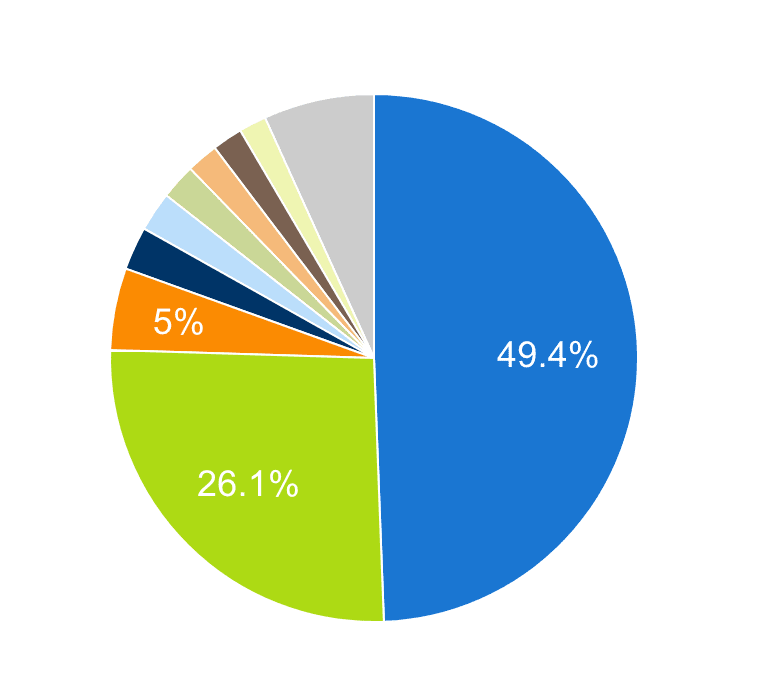
    From January 2018 through December 2018, Apple Podcasts consumption moved from iOS to WatchOS in a big way. From January through August, Blubrry Pro Podcast Stats data show that Apple Podcasts on iOS grew from ~45% market share to ~50% market share. From September through December, Apple podcasts decreased to ~27% market share. That’s almost half. Where’d that market share go? Primarily Apple Watch, which grew from nothing to nearly 9% market share in that same period. What about the rest of that market share– where’d it go? Death by a thousand cuts. Everything from Stitcher (minor growth from 2.5% to 2.7%), to Spotify (grew from 0% to 1%), to CastBox.fm (which appears to be inversely correlated to Apple Podcasts: when Apple gains, CastBox.fm loses, and vice versa). As a market matures, it is common to see fragmentation as new entrants divide up existing market share. However, seeing such a precipitous drop by Apple Podcasts is not common.

    Podcast Stats Soundbite 3: Apple Will Embrace Alexa

    Based on the podcast stats data outlined above, we predict that Apple will create an Apple Podcasts Alexa skill as a way to hedge their podcast download market leader position. Amazon reportedly has 100 million Alexa enabled devices in the market. Among the primary use cases for these devices is listening to music and podcasts. So, just as Apple added Apple Music to the growing list of Alexa skills is 2018, it makes good sense, strategically, to have Apple Podcasts represented in this growing market. As an aside, while Google has more Google Assistant devices in the market, Google’s phones and Android also compete directly with Apple’s golden goose: iPhone.

    —

    Apple Podcasts is still huge, but it’s losing market share to… Apple Watch and a bunch of (relatively) new entrants. So we’re predicting that Apple’s going to produce an Alexa skill for Apple Podcasts. Bold or blah? What do you think, and why?

  • Podcast Stats Soundbite: 3 Surprising Stats about Religious Podcasts

    Podcast Stats Soundbite: 3 Surprising Stats about Religious Podcasts

    Podcast Stats Soundbites

    Podcast Stats Soundbite: 3 Surprising Stats about Religious Podcasts

    Maybe podcasting is a modern continuation of the prophets, town criers, and sages of old (which is pretty dang cool, if you think about it). Maybe podcasting is yet another channel where we create self-selecting “filter bubbles” lacking any diversity in life experience or perspective (but there are things you can do to fix that.) Whatever category, whatever reason over the past decade or so Blubrry has had the great fortune to be home to hundreds of thousands of podcasters in our Podcast Directory and our Podcast Stats & Podcast Hosting platforms. This year, we’re going to be focusing a bit on Podcast Statistics, making some predictions, and calling out what we believe are interesting factoids. We hope you’ll come along on this journey with us find some interesting, useful factoids.

    The Inevitable Disclaimer

    Let’s get this out of the way first: we are not here to promote one religion (or no religion) over another. This is simply looking at the production and consumption of religious-themed podcasts.

    Podcast Stats Soundbite 1: Religious Podcasts Dominate

    Of the 660,000+ podcasts in the Blubrry Podcast Directory, there are just over 92,000 podcasts in the Religious category. That’s almost half again as many podcasts in the Religious category than the next largest category, Culture & Travel which has nearly 65,000. Religious podcasts account for nearly 15% of total podcasts.

    Podcast Stats Soundbite 2: Religious Podcasts Listenership Has Grown at an Astronomical Rate

    Over the past decade, Religious podcast listeners (as measured by downloads) has increased by 85%. On average. Per year. 85%. That’s a phenomenal growth rate. Interesting side note: most of that enormous growth rate happened in 2015, when we saw a jump from roughly 110M downloads in Q4 2014 to nearly 680M estimated downloads in Q4 2015. If we remove that anomalous year, the growth rate still averages nearly 30% per year, which is nearly triple the average growth rate of all podcast estimated downloads.  

    Podcast Stats Soundbite 3: Religious Podcasts Have Fewer Listeners Per Podcast

    Ok. We’ve established Religious podcast have seen huge growth in both creation and listenership. But what about how many listeners each podcast can expect to attract? Well, Religious podcasts fall slightly below average on this measure. Religious podcasts attracted, on average, 8.75% fewer downloads per podcast (4,166 for religious podcasts vs. 4,565 for all categories) in Q4 over the past decade. This makes sense when you consider the massive number of religious podcasts that are created: it’s fragmenting the listener base. 

    Not only are Religious podcasts the largest category–by far–but they’re also growing more quickly than average, both in terms of podcasts created and listeners (as measured by downloads). But they are slightly below the average number of listeners per podcast. Be sure to check back next week when we’ll be discussing Apple vs. Amazon and making a fairly bold prediction for 2019.