Category: Podcast Hosting

  • Your Video Content Deserves a Bigger Audience

    Your Video Content Deserves a Bigger Audience

    You already put the work into creating great video content. Maybe it’s a YouTube series. Maybe it’s a webinar your team spent weeks preparing. Maybe it’s an online class, an interview, a livestream, or a recorded presentation.

    But what happens after the video is published?

    For many creators and organizations, the answer is simple: it lives on one platform and waits for people to find it.

    It doesn’t have to.

    With Blubrry’s Vid2Pod, you can take video content you’re already creating and turn it into an audio podcast, giving your content another way to reach people through podcast apps.

    You May Already Have a Podcast Hiding in Your Video Library

    Creating a podcast doesn’t always mean starting from scratch.

    If you already produce video, you may have hours of content that can work as podcast episodes.

    Think about the content you already have:

    • YouTube videos — Turn a video series into an audio podcast for people who prefer to listen.
    • Webinars — Give attendees and people who missed the live event another way to consume the content.
    • Online classes — Make lessons available as podcast episodes for learning on the go.
    • Interviews — Let audiences listen to conversations without needing to sit down and watch.
    • Livestreams — Extend the life of a live recording by making it available as a podcast.
    • Recorded presentations — Turn educational or business presentations into content people can access anywhere.

    The idea isn’t to create more content.

    It’s to get more from the content you’ve already created.

    How Vid2Pod Works

    Vid2Pod is designed for creators who already publish video on YouTube and want to reach podcast listeners without creating a separate audio workflow.

    With Vid2Pod, you can turn a YouTube playlist into a Blubrry-hosted podcast and make your video content available to audio-first audiences across podcast apps.

    Getting started is simple:

    1. Get Podcast Hosting: Create a Blubrry account and choose an Advanced plan or higher.

    2. Connect YouTube: Connect and sync your YouTube channel from your Blubrry dashboard.

    3. Choose a Playlist: Select the YouTube playlist you want to turn into a podcast.

    4. Customize Your Podcast: Create custom podcast artwork or use your YouTube channel image.

    5. Publish Everywhere: Distribute your podcast to major listening apps and platforms.

    The workflow is designed to make it easier to turn content you’re already creating into a podcast — without having to start from scratch.

    Create your video → Publish it to YouTube → Select your playlist in Vid2Pod → Reach podcast listeners

    Instead of choosing between YouTube and podcasting, you can use both to reach more people.

    Give People More Ways to Consume Your Content

    People don’t always consume content the same way.

    Someone might watch your interview on YouTube at home. Another person might listen to that same interview while driving. Someone else might catch it during a workout or while doing chores.

    The content hasn’t changed.

    The way people access it has.

    Podcasting gives your existing video another format and another opportunity to become part of someone’s regular listening routine.

    For businesses and organizations, this can also make existing educational and thought-leadership content more useful. A webinar doesn’t have to disappear into an archive after the event. An online class doesn’t have to live only inside a learning platform. A recorded presentation can continue reaching people long after the original event.

    You Don’t Need to Start From Zero

    One of the biggest advantages of Vid2Pod is that you’re not being asked to completely change your content strategy.

    If video is already part of your workflow, you can build podcasting into what you’re already doing.

    You don’t necessarily need to:

    • Record a separate audio episode
    • Create an entirely new content calendar
    • Re-record your existing interviews
    • Produce a completely different version of every video

    Instead, you can look at your existing library and ask:

    “Which of this content would make sense as a podcast?”

    You may already have dozens of potential episodes sitting in your YouTube channel or video archive.

    Vid2Pod Is Part of Your Blubrry Hosting Workflow

    It’s important to understand where Vid2Pod fits.

    Vid2Pod isn’t a separate podcast hosting plan. It’s a video-to-podcast publishing method available with Blubrry hosting. Blubrry’s hosting plans include Vid2Pod alongside other podcast publishing tools.

    That means you’re not adding another hosting service just to turn your videos into podcast episodes.

    You’re adding another publishing option to your existing podcast workflow.

    And because Blubrry’s current hosting plans support both audio and video publishing, you can choose the approach that fits your content rather than building separate systems for every format.

    Start With What You Already Have

    You don’t need to turn your entire video library into a podcast overnight.
    Start small.

    Look through your recent content and find a handful of videos that would work well in audio format. Interviews, educational content, presentations, and longer conversations are often natural places to start.

    Then see how your audience responds.

    If people are already watching your videos, there’s a good chance some of them would appreciate another way to consume that same content.

    Your next podcast episode might not need to be created. It might already be sitting in your video library.

    Turn Your Videos Into More Podcast Content

    If you’re already creating video, Vid2Pod can help you extend that content to podcast listeners without creating an entirely separate production workflow.

    Learn more about Vid2Pod

    Create once. Publish in more places. Reach more people.
  • What Happens When Your Podcast Schedule Changes?

    What Happens When Your Podcast Schedule Changes?

    Your podcast schedule probably won’t stay the same forever.

    You might start with one episode a month, then move to a weekly schedule as your audience grows. Maybe you add bonus episodes, start recording longer interviews, take a seasonal break, or decide it’s time to add video.

    That’s part of podcasting.

    As your content changes, though, your hosting needs can change with it.

    The good news? You don’t need to completely rethink your podcast workflow every time your schedule changes. You just need to understand what you’re publishing and make sure your hosting plan can keep up.

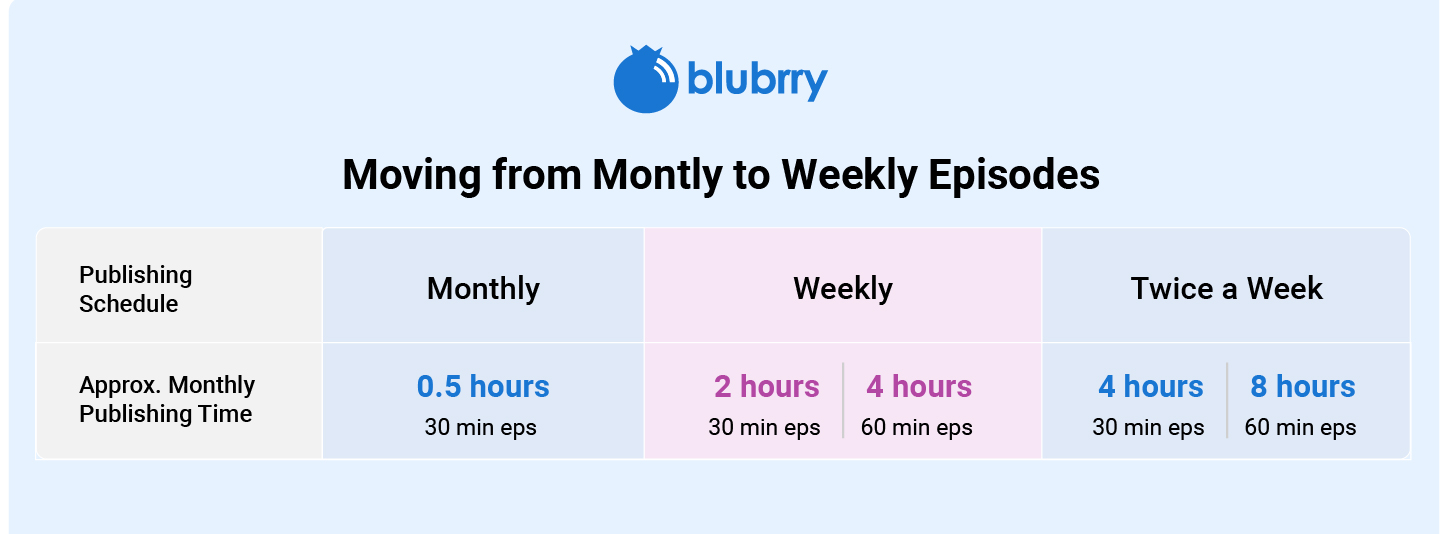
    Moving From Monthly to Weekly Episodes

    One of the biggest changes a podcast can make is simply publishing more often.

    Imagine you start with one 30-minute episode each month.

    That’s about 30 minutes of content per month.

    Then you decide to publish every week. Now you’re publishing roughly 2 hours of content each month.

    If those weekly episodes eventually become 60-minute interviews, you’re at roughly 4 hours per month.

    Publishing Schedule Episode Length Approx. Monthly Publishing Time
    Monthly 30 minutes 0.5 hours
    Weekly 30 minutes 2 hours
    Weekly 60 minutes 4 hours
    Twice a week 60 minutes 8 hours

    These are simple estimates, but they give you a useful way to think about your hosting needs.

    The question isn’t just “How often do I publish?”

    It’s:

    “How much content am I publishing each month?”

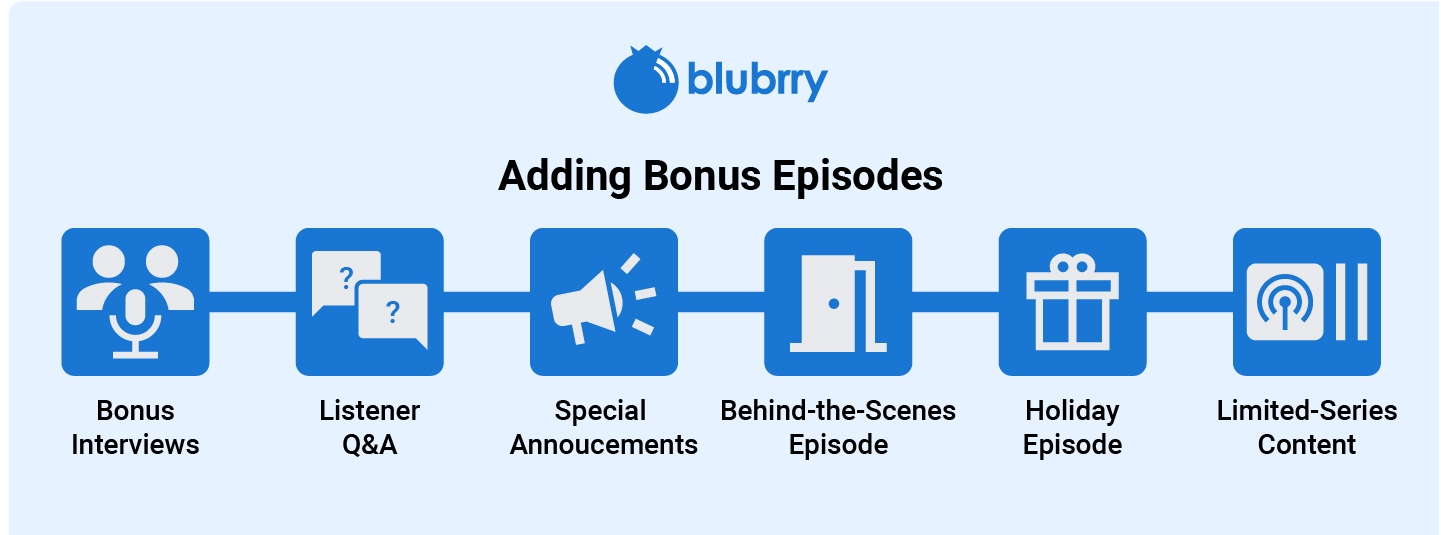
    Adding Bonus Episodes

    Your regular schedule isn’t always your entire publishing schedule.

    You might normally publish once a week but occasionally add:

    • Bonus interviews
    • Listener Q&As
    • Special announcements
    • Behind-the-scenes episodes
    • Holiday episodes
    • Limited-series content

    Those extra episodes add to your monthly publishing time.

    You don’t necessarily need to change your hosting plan every time you publish a bonus episode. But if bonus content becomes a regular part of your podcast, it’s worth including it when you estimate how much content you publish each month.

    A little breathing room can make it easier to experiment without worrying about your hosting limits.

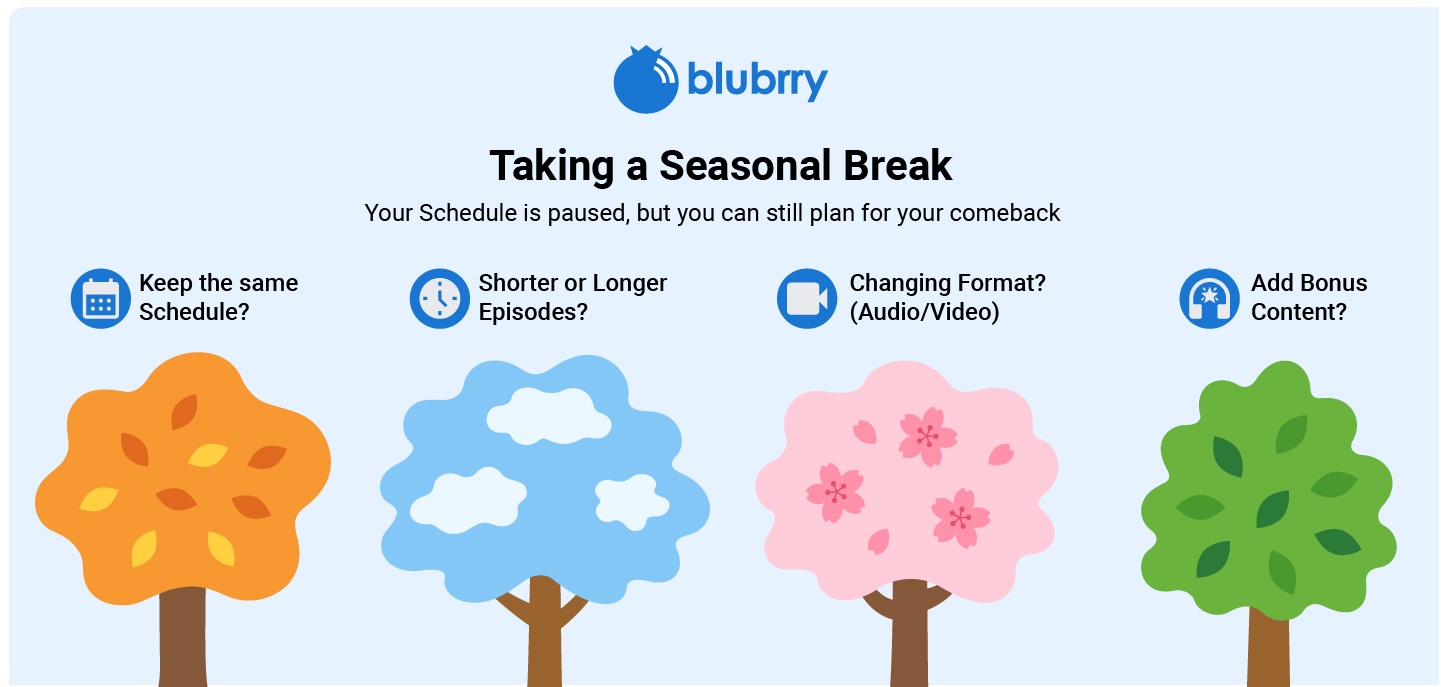
    Taking a Seasonal Break

    Not every podcast publishes year-round.

    Some shows work in seasons, with several episodes followed by a planned break.

    You might publish for three months, take the summer off, and return in the fall. Or you might simply pause for a few weeks before starting your next batch of episodes.

    A break doesn’t necessarily mean your hosting needs disappear.

    It can actually be a good time to look at your podcast as a whole and ask:

    • Will I return to the same publishing schedule?
    • Will my episodes be longer?
    • Am I changing the format?
    • Will I add bonus content?
    • Am I planning to introduce video?

    Your schedule may be paused, but your plans for the next season can still be changing.

    Publishing Longer Interviews

    Publishing frequency is only part of the equation.

    Episode length matters, too.

    A podcast publishing four 30-minute episodes per month has very different publishing needs from one publishing four 90-minute interviews.

    Long-form interviews can be a great format, especially when your guests have plenty to say. But if your average episode length keeps increasing, your monthly publishing time increases with it.

    That’s why it’s useful to check your average episode length from time to time.

    You don’t need to predict exactly how long every future episode will be. Just look at what you’re actually publishing and plan accordingly.

    Adding Video to Your Podcast

    Another major change for podcasters is moving from audio-only content to audio and video.

    You may have started with a microphone and an audio editor. Later, you decide to record your interviews on camera, publish video versions of your episodes, or bring existing video content into your podcast.

    Adding video can become another part of your regular publishing workflow.

    Blubrry supports both audio and video podcast publishing, so you can expand your format as your podcast evolves.

    If you’re already creating video content, Vid2Pod can also help turn YouTube videos into podcast episodes, giving you another way to bring existing content into your podcast workflow.

    The important thing is that you don’t have to decide between audio and video forever. Your podcast can evolve as your content strategy evolves.

    How Much Hosting Time Do You Actually Need?

    When your schedule changes, start with the basics.

    Look at a typical month and estimate:

    Number of episodes × average episode length = approximate monthly publishing time

    For example:

    4 weekly episodes × 45 minutes = 3 hours per month

    Then consider anything else you regularly publish, such as bonus episodes or special content.

    If you’re adding video, factor that into your publishing plans as well.

    You don’t need to make the calculation complicated. The goal is simply to have a realistic idea of how much content you’re publishing.

    Don’t Choose a Plan Based Only on Your Current Schedule

    It’s important to choose a plan that fits what you’re doing today.

    But it can also help to think about what you’re likely to do next.

    If you’re publishing one short episode a month now, you probably don’t need a plan designed for a high-volume podcast.

    But if you’re already planning to move to weekly episodes, add longer interviews, or introduce video, those changes are worth considering before choosing your plan.

    Think about your realistic next step, not an imaginary five-year plan.

    Your Podcast Can Change Without Your Workflow Becoming Complicated

    Changing your publishing schedule doesn’t have to mean rebuilding your entire podcast workflow.

    Keep a few simple things in mind:

    Track your publishing time

    Know roughly how much content you’re publishing each month.

    Watch your episode length

    If your 30-minute episodes are becoming 60- or 90-minute conversations, your hosting needs are changing.

    Account for bonus content

    Extra episodes count toward your overall publishing volume.

    Plan for format changes

    If you’re considering video, make sure your hosting setup supports where you want your podcast to go.

    Give yourself some room

    You don’t need the biggest plan available, but having a little flexibility can make future changes easier.

    The goal is not to over-plan your podcast.

    It’s to avoid being caught off guard when your podcast grows or changes direction.

    A Quick Checklist

    If your podcast schedule is changing, ask yourself:

    • How many episodes am I publishing each month?
    • What’s my average episode length?
    • Am I adding bonus or special episodes?
    • Am I taking a seasonal break?
    • Are my interviews getting longer?
    • Am I adding video?
    • Could I start another show?
    • Does my current hosting plan give me enough publishing time?

    These questions don’t take long to answer, but they can help you make a much more informed hosting decision.

    Your Podcast Will Change. Your Hosting Can Change With It.

    There isn’t one perfect publishing schedule for every podcast.

    Some creators publish once a month. Others publish several times a week. Some take seasonal breaks, while others publish year-round. Some stick with audio, while others eventually add video.

    Your podcast is allowed to change.

    Your hosting plan should be flexible enough to change with it.

    Blubrry’s time-based hosting plans make choosing a plan simpler by focusing on how much content you publish each month.

    Instead of trying to estimate complicated storage requirements, start with one straightforward question:

    How many hours of content do I publish each month?

    From there, you can choose the plan that makes sense for your podcast today and adjust as your publishing needs evolve.

    Find the Hosting Plan That Fits Your Podcast

    Your podcast schedule isn’t set in stone and your hosting plan doesn’t have to be either.

    Whether you’re moving from monthly to weekly episodes, adding bonus content, publishing longer interviews, taking seasonal breaks, or expanding into video, it’s worth making sure your hosting setup can support the way you want to create.

    Review Blubrry’s time-based hosting plans and find the option that fits the way you publish.

  • The Podcast Publishing Checklist: Is Your Hosting Setup Ready for What You Want to Create?

    The Podcast Publishing Checklist: Is Your Hosting Setup Ready for What You Want to Create?

    Starting a podcast is one thing. Keeping it going as your ideas, schedule, and audience grow is another.

    A hosting plan that works perfectly when you publish one short episode every other week might not be the right fit once you start releasing longer episodes, adding video, launching bonus content, or managing multiple shows.

    That’s why it’s worth thinking about not just what you publish today, but how you expect your podcasting workflow to grow.

    For creators managing multiple podcasts, teams, or more complex publishing needs, Pro Hosting can provide the additional flexibility needed to manage a larger podcast operation without having to juggle separate hosting setups for every show.

    The goal isn’t to choose the biggest hosting plan available. It’s to choose a setup that matches the way you actually publish—and gives you enough room to grow without making your workflow unnecessarily complicated.

    1. How Often Are You Planning to Publish?

    Your publishing schedule is one of the biggest factors to consider.

    Are you planning to release:

    • One episode a month?
    • A weekly show?
    • Multiple episodes every week?
    • Regular bonus episodes between your main releases?

    Publishing frequency matters because every episode uses part of your available publishing time.

    For example, a weekly podcast with 30-minute episodes uses roughly:

    30 minutes × 4 episodes = 2 hours per month

    But if you publish twice a week, that same format becomes:

    30 minutes × 8 episodes = 4 hours per month

    And that’s before adding bonus episodes, trailers, or special releases.

    Your checklist:

    • Decide how many episodes you expect to publish each month.
    • Estimate your average episode length.
    • Add extra time for bonus episodes or special releases.
    • Make sure your hosting plan gives you enough publishing time for your schedule.

    Planning for your typical month—not just your first month—can help you avoid outgrowing your plan too quickly.

    2. How Long Are Your Episodes?

    Not every podcast needs the same amount of publishing time.

    A 20-minute weekly interview show has very different hosting needs from a two-hour weekly conversation.

    Consider your average episode length and how often you publish.

    For example:

    Publishing Schedule Episode Length Approx. Monthly Time
    Weekly 30 minutes 2 hours
    Weekly 60 minutes 4 hours
    Twice weekly 30 minutes 4 hours
    Twice weekly 60 minutes 8 hours
    Weekly 90 minutes 6 hours

    These are estimates, but they give you a useful starting point when comparing hosting plans.

    Your checklist:

    • Estimate your average episode length.
    • Calculate your expected monthly publishing time.
    • Leave some room for longer episodes.
    • Account for bonus content and special releases.

    If your episode length changes frequently, having some extra room in your plan can make your publishing workflow much easier.

    3. Are You Publishing Audio, Video, or Both?

    Podcasting isn’t limited to audio anymore.

    Many creators are recording video alongside their podcast and publishing their shows in multiple formats. Others are starting with audio and planning to add video later.

    If video is part of your plans, make sure your hosting setup supports the type of publishing you want to do.

    With Blubrry, hosting plans support both audio and video podcast publishing, giving creators the flexibility to build their shows around the formats that make sense for them.

    You can also use tools such as Vid2Pod to turn existing video content into podcast episodes.

    Your checklist:

    • Decide whether you’re publishing audio only.
    • Consider whether you’ll add video later.
    • Check whether your hosting plan supports your desired format.
    • Consider how video fits into your existing production workflow.

    You don’t have to publish video just because it’s available. But if it’s part of your future plans, it’s better to choose a hosting setup that won’t force you to rethink your workflow later.

    4. Will You Publish Bonus or Special Episodes?

    Your main publishing schedule isn’t always the whole story.

    You might eventually want to publish:

    • Bonus episodes
    • Trailer episodes
    • Q&A episodes
    • Limited-series content
    • Behind-the-scenes recordings
    • Seasonal specials
    • Guest episodes
    • Replays or extended conversations

    These episodes can quickly add up.

    A plan that gives you exactly enough time for your regular schedule may leave little room for experimentation.

    Your checklist:

    • Estimate your regular monthly publishing time.
    • Add time for bonus content.
    • Consider seasonal or limited-series episodes.
    • Leave room to experiment with new formats.

    If you know you’ll be creating additional content, include it in your hosting plan from the beginning.

    5. Are You Planning to Run More Than One Show?

    One podcast can eventually turn into two—or three.

    Maybe you want to launch a second show. Maybe your company has several podcasts. Or perhaps you’re working with a team that manages multiple programs.

    Your hosting setup should make it practical to manage your publishing workflow as your podcast operation grows.

    Your checklist:

    • Are you managing one show or multiple shows?
    • Will other team members need access?
    • Do you need to separate different podcast projects?
    • Could you launch another show in the future?

    Thinking about this early can save you from having to rebuild your workflow later.

    6. What Features Will You Need as Your Podcast Grows?

    Hosting isn’t just about getting an episode online.

    As your podcast develops, you may need more tools to understand your audience, manage your content, publish consistently, and grow your show.

    Ask yourself what you’ll actually need six or twelve months from now.

    You may eventually want:

    • More publishing time
    • Audio and video support
    • Podcast analytics
    • Listener insights
    • Episode performance comparisons
    • Audience trends over time
    • Podcast website options
    • Monetization tools
    • Additional publishing or production tools
    • Support when something goes wrong

    The right hosting setup should support your workflow—not get in the way of it.

    7. Don’t Just Plan for Your First Episode

    One of the easiest mistakes new podcasters make is choosing a hosting plan based entirely on what they need today.

    Your first few episodes might be short.

    You might only publish once a month.

    You might have no plans for video.

    But what happens if your podcast takes off?

    What if you decide to publish every week? Add video? Bring on guests? Start a second show? Release bonus episodes?

    Your hosting needs can change quickly.

    That’s why the best plan isn’t necessarily the cheapest plan. It’s the one that gives you the right amount of room for the way you actually plan to publish.

    The Podcast Publishing Checklist

    Before choosing your hosting plan, run through these questions:

    Publishing

    • How many episodes will I publish each month?
    • How long will my typical episodes be?
    • Will my publishing schedule change?

    Content

    • Will I publish bonus episodes?
    • Will I create trailers or special episodes?
    • Am I planning a limited series?

    Format

    • Am I publishing audio?
    • Will I publish video?
    • Could I add video later?

    Growth

    • Will I launch additional shows?
    • Will I need more publishing time as my audience grows?
    • What analytics or audience insights will I need?

    Workflow

    • Will other people help manage my podcast?
    • What tools will I need as my production process becomes more involved?
    • Does my hosting plan give me enough room to grow?

    Is Your Hosting Plan Ready?

    Your podcast hosting plan should fit the podcast you’re actually trying to build.

    If you’re publishing occasionally, you may not need a large amount of publishing time. If you’re publishing long episodes every week, producing video, adding bonus content, or managing multiple shows, you’ll want to make sure your plan can keep up.

    The good news is that you don’t have to guess.

    Take a look at your expected publishing schedule, estimate how much content you’ll produce each month, and compare that with the features and publishing time available in each plan.

    Ready to Find the Right Fit?

    Take a look at Blubrry’s podcast hosting plans and find an option that matches how you publish today—and where you want your podcast to go next.

    Review Blubrry’s Hosting Plans →

    Your podcast may start with one episode.

    Your hosting setup should be ready for everything that comes after it.

  • Choosing a Podcast Host in 2026: What Actually Matters?

    Choosing a Podcast Host in 2026: What Actually Matters?

    Choosing a podcast host used to be simple: upload your episodes, generate an RSS feed and publish your show.

    Today, hosting platforms can include analytics, video, websites, monetization, AI tools and more, which makes comparing them more complicated.

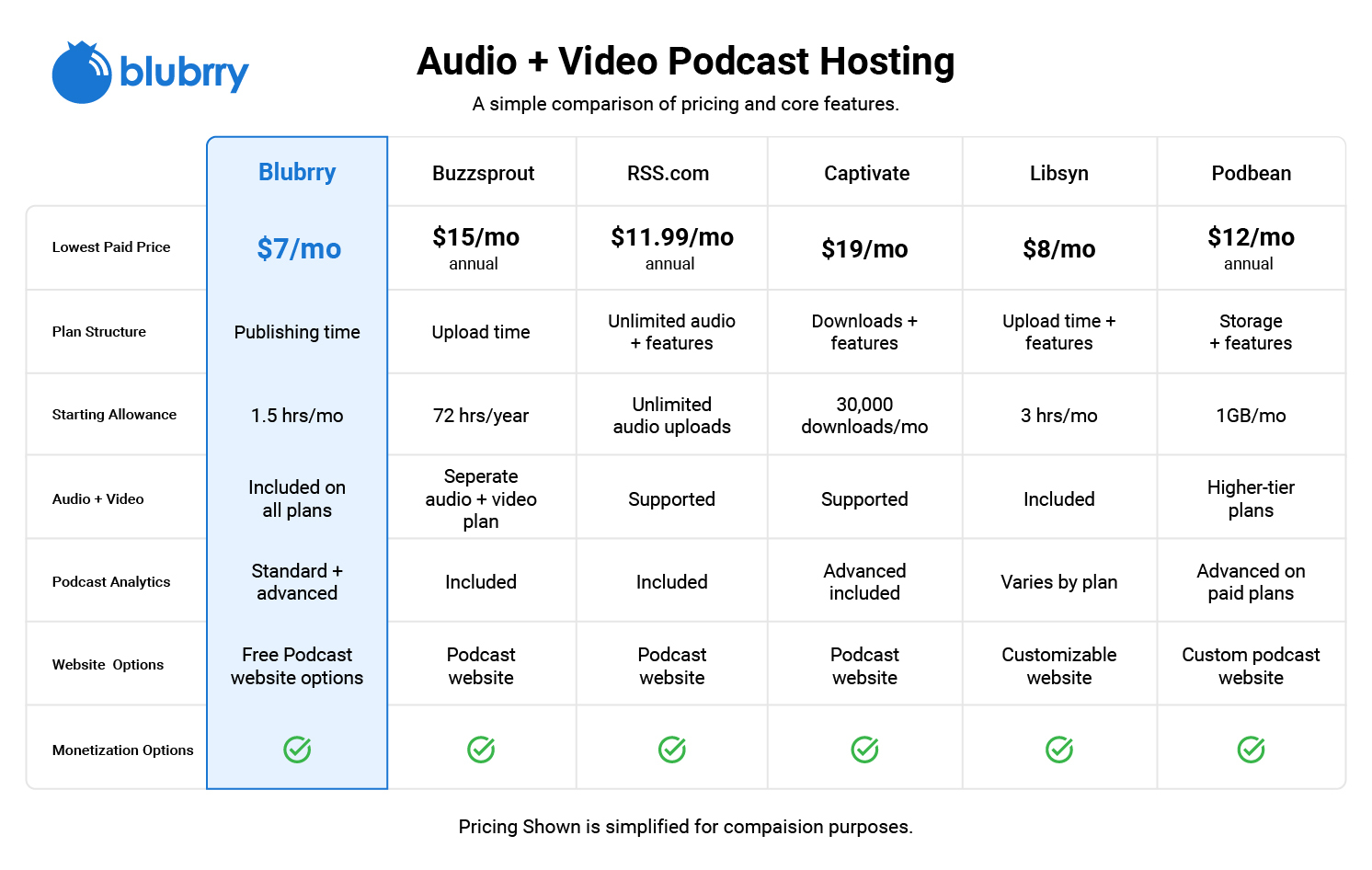
    When looking at Blubrry Podcasting, Buzzsprout, Libsyn, Podbean and other hosts, it’s easy to focus on price or feature lists.

    But the better question is:

    Which podcast host fits the way you actually plan to podcast?

    Here are the most important things to compare.

    1. How Does the Podcast Host Structure Its Plans?

    Podcast hosts structure their plans in different ways. Depending on the provider, limits may be based on storage, upload time, bandwidth, downloads or included features.

    That means two plans with similar prices may work very differently.

    Blubrry: Hosting Based on How Much You Publish

    Blubrry hosting plans are based on monthly publishing time—not megabytes or file size.

    For example:

    • 1.5 hours per month — $7
    • 3 hours per month — $15
    • Additional plans offer more monthly publishing time for creators who produce longer or more frequent content.

    Your monthly time can be used for audio or video, making it easier to choose a plan based on how much content you actually publish.

    Instead of estimating file sizes, the question becomes much simpler:

    How many hours of content do you publish each month?

    2. Does the Host Support How You Want to Publish?

    There was a time when podcasting meant recording an MP3, uploading it, and calling it a day. Those days are long gone.

    Today, creators are publishing audio, video, YouTube clips, private podcasts, bonus episodes, and entire podcast networks. That’s why choosing a host isn’t just about getting your RSS feed online anymore.

    Others are publishing:

    • Audio podcasts
    • Video podcasts
    • YouTube content
    • Multiple shows
    • Short-form and long-form content
    • Private or premium content

    There is no single correct way to podcast.

    What matters is whether your hosting platform supports the way you want to create.

    A podcaster starting with audio today may decide to experiment with video later.

    A solo creator may eventually launch a second show.

    A business may need multiple team members managing content.

    You should not choose a host only for the podcast you have today.

    Think about what you may reasonably want to do next.

    Audio and Video With Blubrry

    Blubrry hosting plans support both audio and video podcast publishing.

    Creators who are already producing video content for YouTube can also use Vid2Pod, a publishing method available with Blubrry hosting that helps turn existing YouTube videos into podcast episodes for distribution through podcast listening platforms.

    You can choose the format that makes sense for your content without feeling like video is required to have a successful podcast.

    Apple

    Blubrry also supports HLS (HTTP Live Streaming) for Apple Podcasts video delivery, providing adaptive streaming that automatically adjusts video quality based on the listener’s connection and device. This creates a smoother viewing experience while meeting Apple’s preferred video streaming requirements.

    3. What Kind of Podcast Analytics Do You Actually Need?

    Almost every podcast host offers some form of statistics.

    The important question is what those statistics tell you.

    A new podcaster may initially want to know:

    “How many people listened?”

    As a podcast grows, the questions often become more detailed.

    Where are people listening?

    Which episodes perform best?

    Are there meaningful audience trends?

    How does performance change over time?

    Which data can I confidently use when talking with advertisers, sponsors or stakeholders?

    Analytics become especially important when a podcast is connected to a business, organization or monetization strategy.

    Blubrry’s Approach to Podcast Statistics

    Podcast analytics have been a major part of Blubrry’s platform for years.

    Blubrry provides podcast statistics designed to help creators better understand audience activity and podcast performance, with more advanced analytics available for podcasters who need deeper reporting.

    For some creators, basic statistics may be enough.

    For others, analytics become one of the most important parts of their podcast infrastructure.

    Know which type of podcaster you are before choosing a platform.

    IAB

    4. How Much Control Do You Want Over Your Podcast?

    This is one of the most overlooked questions when comparing podcast hosts.

    Your podcast is more than a collection of audio files.

    Over time, it can include:

    • Your RSS feed
    • Your website
    • Your episode archive
    • Your audience
    • Your analytics
    • Your search presence
    • Your monetization
    • Your publishing workflow

    Think about how much control you want over those pieces.

    Some creators prefer having everything contained within one simple platform.

    Others want greater flexibility to connect their podcast hosting with their own website, publishing tools and broader digital presence.

    Neither approach is automatically right or wrong.

    But they are different.

    Ownership Has Always Been Important at Blubrry

    Since the early days of podcasting, we’ve believed creators should own their podcast, not rent it.

    That’s why we’ve invested in tools like PowerPress, podcast websites, detailed analytics, and flexible RSS management. They’re designed to give you control over how and where your podcast grows, instead of locking you into a single ecosystem.

    5. What Happens When Your Podcast Changes?

    Most podcasters don’t outgrow their microphone first, they outgrow their hosting.

    The show you launch today probably won’t look the same a year from now.

    Maybe you’ll start publishing video. Maybe you’ll launch a second show. Maybe your hobby podcast becomes part of your business.

    Good hosting should make those changes easier, not force you to start over.

    You might go from:

    One show → Multiple podcasts

    Audio only → Audio and video

    Basic statistics → Advanced analytics

    Solo creator → Multiple team members

    Hobby project → Business asset

    Publishing episodes → Monetizing an audience

    That does not mean every podcaster needs the most advanced hosting plan from day one.

    You probably do not.

    But it is worth understanding what options will be available if your needs change.

    Look at more than the least expensive plan.

    Look at the entire platform.

    6. What Kind of Support Is Available?

    Support is not always the first thing people think about when shopping for podcast hosting.

    Until something goes wrong.

    Maybe your RSS feed is not updating correctly.

    An episode is not appearing where you expected.

    You are moving an established podcast from another host.

    You have a question about Apple Podcasts, Spotify or another distribution platform.

    Suddenly, support matters quite a bit.

    When comparing hosting providers, look at:

    • What support channels are available?
    • Can you reach an actual person?
    • Does the support team understand podcasting?
    • Is educational help available when you need it?

    Blubrry’s support team includes people with hands-on podcasting experience who regularly help creators work through publishing, RSS, distribution, statistics and other podcasting questions.

    Sometimes the most important feature of a hosting platform is the person who can help you when something does not work as expected.

    7. Look Beyond the Monthly Price

    Everyone compares the monthly price first.

    That’s understandable.

    But after years of helping podcasters move their shows from other platforms, we’ve learned that price is rarely the reason people switch.

    More often it’s because they’ve hit a limit, need better analytics, want to publish video, or simply need support from someone who understands podcasting.

    Ask:

    What publishing limits apply?

    Is audio and video supported?

    What analytics are included?

    Does the plan include a podcast website?

    Are AI or publishing tools included?

    What happens if I need more publishing capacity?

    What support is available?

    Can the platform accommodate multiple shows or team members later?

    Most importantly:

    Does the platform fit the way I want to build my podcast?

    That question is much more useful than simply asking which host has the longest feature list.

    Blubrry vs. Other Podcast Hosting Platforms

    Podcast hosts are built with different priorities.

    Some platforms emphasize a streamlined experience for quickly starting a show.

    Others offer large ecosystems of creator tools.

    Some have been serving podcasters for many years and support a wide variety of publishing needs.

    Blubrry’s approach centers around giving podcasters the infrastructure to publish, measure and manage their content while maintaining flexibility and control over their broader podcast presence.

    That includes:

    • Time-based hosting options based on how much you publish
    • Audio and video podcast support
    • Podcast analytics
    • Podcast website options
    • WordPress integration with PowerPress
    • AI podcast tools
    • Monetization opportunities
    • Vid2Pod publishing
    • Options for individual creators, businesses, teams and networks
    • Support from people who understand podcasting

    The right podcast host ultimately depends on what matters most to you.

    Think Beyond Episode One

    There is no universal “best” podcast host for every podcaster.

    And that is probably a good thing.

    A hobby podcaster publishing once a month may have completely different priorities from a company producing several shows.

    Someone recording their first episode has different needs from a podcast network managing years of content.

    The goal should not be to find the platform with the most features.

    It should be to find the platform whose features, pricing structure and philosophy match the way you want to podcast.

    Think about what you need today.

    But also think about what happens next.

    Your next format.

    Your next 100 episodes.

    Your next show.

    Your growing audience.

    Your business.

    Your podcast host is part of the infrastructure supporting all of it.

    Choose accordingly.

    Ready to Explore Blubrry Podcast Hosting?

    Blubrry offers podcast hosting options for creators publishing everything from a few episodes each month to high-volume shows and podcast networks.

    Choose a plan based on how much you publish, with tools for audio and video podcasting, analytics, websites, monetization and more.

    Explore Blubrry Podcast Hosting Plans


  • Blubrry Introduces New Time-Based Hosting Plans

    Blubrry Introduces New Time-Based Hosting Plans

    Choosing a podcast hosting plan should be simple.

    You should not have to calculate file sizes, guess how many megabytes your episodes will use, or worry that one larger file will throw off your plan. You already know what matters most: how often you publish and how long your episodes usually are.

    That’s why Blubrry has introduced new time-based hosting plans focused on monthly publishing time instead of storage limits.

    What changed?

    Blubrry now offers new hosting plan options based on the number of hours of audio and video podcast content you publish each month.

    Instead of choosing a plan based on megabytes, podcasters selecting a new plan can now choose based on their publishing schedule. Whether you release one episode a month, publish weekly, create video podcasts, or produce multiple episodes each week, there is a plan designed to fit how you create.

    We have also introduced a new $7/month plan, giving new podcasters a more affordable way to start publishing with Blubrry.

    What does this mean for current hosting customers?

    If you already host your podcast with Blubrry, you do not need to take any action.

    All hosting plans will move to the new time-based model, and your plan will automatically transition based on the plan you currently have. You can continue podcasting as you do today without selecting a new plan or changing your workflow.

    Meet the new plans

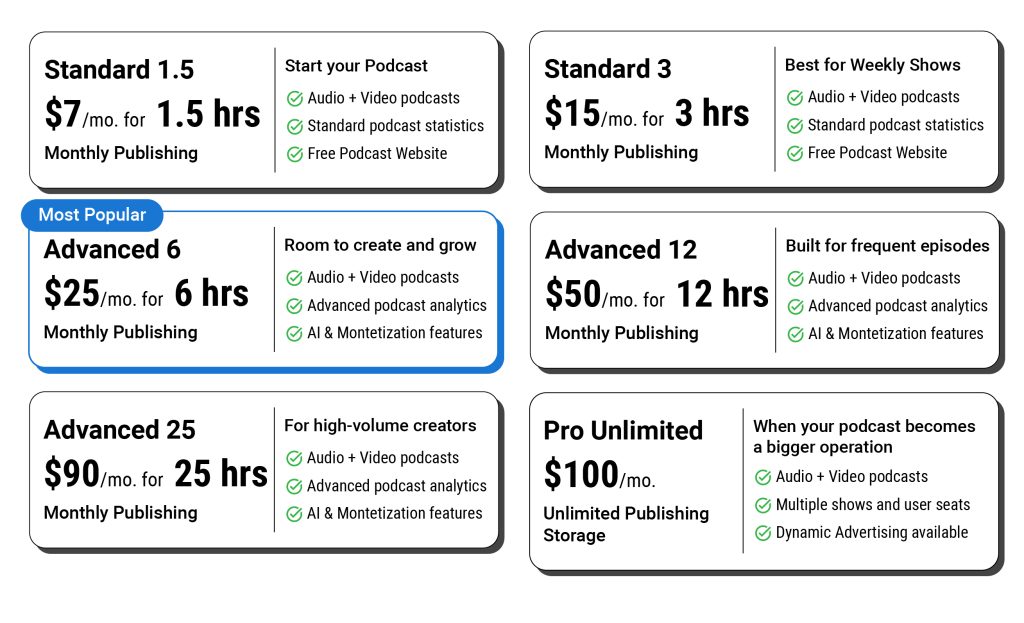
    Standard 1.5 — $7/month

    Standard 1.5 is the easiest way to start your podcast. It includes up to 1.5 hours of audio and video podcast content each month, along with the essential tools you need to get your show online.

    This plan is a great fit for new podcasters, shorter shows, or creators who want to launch without committing to a larger publishing plan right away.

    Standard 3 — $15/month

    Standard 3 is built for weekly podcasters. With up to 3 hours of audio and video content each month, it gives creators room to publish consistently while still keeping the plan simple and affordable.

    Advanced 6 — $25/month

    Advanced 6 gives growing shows more room to create. With up to 6 hours of monthly publishing, plus advanced podcast statistics, this plan is a strong fit for podcasters who publish more often or want better insight into their audience.

    Advanced 12 — $50/month

    Advanced 12 is designed for frequent publishing. If you produce multiple episodes per week, longer-form content, or a mix of audio and video podcast episodes, this plan gives you more flexibility.

    Advanced 25 — $90/month

    Advanced 25 is for high-volume creators who publish often and need plenty of room each month. It is a strong option for creators using podcasting as a key part of their business, content strategy, or regular production schedule.

    Pro Unlimited — $100/month

    Pro Unlimited is built for podcast networks, businesses, organizations, and teams managing larger podcast operations. It includes unlimited audio and video publishing, multiple shows and users, dynamic advertising, podcast network tools, advanced AI tools, and enterprise-level flexibility.

    Why time-based hosting makes sense

    Podcasters do not usually think in megabytes. They think in episodes, minutes, and hours.

    By offering time-based publishing plans, Blubrry is making it easier to understand which plan fits your show. A weekly podcaster can choose a plan based on their publishing schedule. A video podcaster can plan around total content time. A show changing their average length can upgrade when it needs more room.

    It is a clearer way to choose a hosting plan — and a better fit for how podcasting works today.

    What is included?

    Blubrry hosting plans include the tools podcasters need to publish and manage their shows, including:

    – Audio and video podcast publishing
    – Distribution to Apple Podcasts, Spotify, YouTube, and more
    – Podcast statistics
    – A free managed WordPress website
    – AI podcast tools
    – Monetization features on eligible plans

    Need more publishing time?

    You can upgrade your plan anytime. If you need more monthly publishing time, your billing will be prorated automatically.

    Whether you are starting your first show, publishing weekly, creating video content, or managing multiple podcasts, Blubrry now offers hosting plan options that fit how much you publish — not how large your files are.

    View the updated hosting plans

  • What Makes Blubrry’s Hosting Perfect for Podcasters Starting Out

    What Makes Blubrry’s Hosting Perfect for Podcasters Starting Out

    Starting a podcast is exciting — and a little intimidating.

    Most new podcasters don’t get stuck because they lack ideas. They get stuck trying to figure out everything else: where to upload episodes, how distribution works, what stats matter, and whether they’re choosing the “right” tools.

    That early stage is less about doing everything perfectly and more about removing friction so you can actually publish.

    That’s where your hosting platform comes in.

    Blubrry’s Standard Hosting Plan is built for creators who want to get a show off the ground without overthinking every technical decision — while still knowing they’re set up the right way.

    Here’s why it works well for podcasters just starting out.

    1. It Covers the Basics Without Feeling Overwhelming

    When you’re new, simplicity matters more than bells and whistles.

    Standard Hosting includes things every podcast needs — like unlimited downloads, reliable delivery, and enough storage to publish consistently — without pushing advanced features you won’t touch yet.

    You get 125MB of monthly storage (roughly two hours of audio), which is plenty for most new shows publishing weekly or bi-weekly. And because downloads aren’t capped, you don’t have to worry about success becoming a problem.

    It’s enough to launch confidently, without feeling locked into something you don’t understand.

    2. You Get a Podcast Website (Without Having to Build One)

    A lot of new podcasters don’t realize this at first, but relying only on Apple Podcasts or Spotify means you don’t really own your show’s home.

    With Standard Hosting, you have the option to use a free WordPress podcast website — already set up, secured, and backed up — so your episodes have a permanent place to live.

    That means:

    • A central home for your episodes and show notes
    • More control over how your show appears online
    • Better visibility through search
    • No need to manage hosting, updates, or security yourself

    You can customize it as much (or as little) as you want, and if you decide to use your own domain later, it’s easy to connect.

    For many beginners, this alone removes a big technical hurdle.

    3. You Can Publish the Way You’re Most Comfortable

    Not everyone starts podcasting the same way — and Blubrry doesn’t force you into one workflow.

    You can publish episodes through:

    • The Blubrry Podcaster Dashboard
    • Your included WordPress site
    • Or the free PowerPress plugin if you already use WordPress

    No matter which option you choose, your podcast can be submitted to major directories like Apple Podcasts and Spotify.

    If your process changes as you learn more, that’s okay — you’re not locked into a single setup.

    4. Stats That Make Sense When You’re New

    Podcast analytics can get confusing fast.

    Standard Hosting includes Blubrry’s Standard Statistics, which focus on helping you understand how your show is performing without drowning you in data.

    You’ll see things like:

    • How episodes compare to each other
    • Where listeners are tuning in from
    • What apps and devices they’re using
    • Estimated audience size

    It’s enough insight to help you learn and adjust — without turning analytics into another source of stress.

    5. Built-In Tools That Help You Stay Consistent

    One of the hardest parts of podcasting isn’t recording — it’s keeping up with everything around it.

    Every Blubrry hosting plan includes access to Podcast AI tools that can help with things like:

    • Planning episodes and topics
    • Writing show notes and summaries
    • Creating transcripts
    • Generating social captions and clips

    These tools don’t replace your voice or creativity — they just help reduce the time spent staring at a blank page.

    For new podcasters, that support can make consistency feel much more achievable.

    6. Help From People Who Actually Know Podcasting

    At some point, everyone has a question.

    With Standard Hosting, support isn’t just a knowledge base — you can reach real people by phone or email who understand podcasting and the platforms you’re working with.

    Whether it’s a feed question, a submission issue, or a “did I do this right?” moment, having experienced help available can make the early days feel far less stressful.

    7. It’s Easy to Grow Without Starting Over

    Standard Hosting isn’t meant to be your forever plan — it’s meant to be a starting point.

    As your podcast grows, you can upgrade to access more advanced analytics, storage, monetization tools, and professional-level features without moving your show or rebuilding your setup.

    Everything you’ve built stays in place.

    Final Thoughts

    Blubrry’s Standard Hosting works well for new podcasters who want to focus on creating — not troubleshooting.

    It gives you:

    • A straightforward way to publish
    • Ownership of your content and website
    • Clear, trustworthy stats
    • Tools that support consistency
    • Access to real human support

    Starting a podcast should feel exciting, not exhausting.

    The right hosting setup won’t do the work for you — but it can make the work feel manageable.

  • 🎙 Why Blubrry Hosting Prices Are Changing (For the First Time in 20 Years)

    Since 2005, Blubrry has proudly supported tens of thousands of creators in launching, growing, and monetizing their shows. From day one, our mission has been to give podcasters the tools, support, and freedom they need to thrive.

    Today, we’re announcing our first-ever Standard and Advanced hosting price update, which will take effect on Oct. 1, 2025.

    We’re sharing this news with more than a month’s advance notice because we believe in transparency — and because we want to give you time to explore your options, ask questions, and plan accordingly.

    Here’s everything you need to know.

    🙏 Why This Change Is Happening

    Over the past 20 years, we’ve maintained the same pricing while consistently reinvesting in our platform — expanding bandwidth, improving reliability, offering human-powered support, and launching new tools.

    Like many businesses, we’ve seen our operating costs rise significantly. But we’re not increasing prices just to keep up — we’re doing so to deliver more value to you.

    This pricing update supports our continued investment in:

    • Scalable infrastructure and bandwidth
    • Industry-leading support and onboarding
    • Feature development and innovation
    • New tools designed to help you grow

    🧠 Starting Oct 1st: Blubrry Podcast AI Tools Included

    Alongside the price adjustment, we’re introducing a suite of Blubrry Podcast AI Tools — included in your hosting plan.

    These tools are designed to:

    • Automatically generate show notes and titles
    • Create transcripts for SEO and accessibility
    • Assist in social media and promotional content
    • Help you create more and spend less time doing it

    They’ll be available to all Standard and Advanced hosting customers and integrated into your dashboard — no separate tools or subscriptions required.

    💵 What’s Changing: The New Pricing

    These changes will go into effect on October 1, 2025, for all new customers and existing monthly subscribers on the Standard and Advanced plans.

    Plan

    Current Monthly New Monthly

    New Annual

    Standard (125MB) $12 $15 $155
    Advanced (400MB) $20 $25 $260
    Advanced (800MB) $40 $50 $540
    Advanced (1600MB) $80 $90 $970

    Note: Annual plans will also be adjusted on Oct. 1, unless locked in before the deadline (see below).

    🔒 How to Lock In Your Current Rate

    We know price changes are never ideal. That’s why we’re offering a way to keep your current rate for the next 12 months.

    If you’re a monthly customer, you can:

    1. Switch to an annual plan before Oct. 1, 2025.
    2. Pay upfront for the year.
    3. Keep your current rate (e.g., $12/month) for a whole year.
    4. To lock in current rates until Oct. 1, 2026, go to Billing in the Dashboard, select Manage Plan, Switch to Annual, and check out.

    👉 Log in to your dashboard to lock in your rate

    This option is our way of saying thank you — and giving you control over how and when the change affects you.

  • 🎙 Why Blubrry Hosting Prices Are Changing (For the First Time in 20 Years)

    Since 2005, Blubrry has proudly supported tens of thousands of creators in launching, growing, and monetizing their shows. From day one, our mission has been to give podcasters the tools, support, and freedom they need to thrive.

    Today, we’re announcing our first-ever Standard and Advanced hosting price update, which will take effect on Oct. 1, 2025.

    We’re sharing this news with more than a month’s advance notice because we believe in transparency — and because we want to give you time to explore your options, ask questions, and plan accordingly.

    Here’s everything you need to know.

    🙏 Why This Change Is Happening

    Over the past 20 years, we’ve maintained the same pricing while consistently reinvesting in our platform — expanding bandwidth, improving reliability, offering human-powered support, and launching new tools.

    Like many businesses, we’ve seen our operating costs rise significantly. But we’re not increasing prices just to keep up — we’re doing so to deliver more value to you.

    This pricing update supports our continued investment in:

    • Scalable infrastructure and bandwidth
    • Industry-leading support and onboarding
    • Feature development and innovation
    • New tools designed to help you grow

    🧠 Starting Oct 1st: Blubrry Podcast AI Tools Included

    Alongside the price adjustment, we’re introducing a suite of Blubrry Podcast AI Tools — included in your hosting plan.

    These tools are designed to:

    • Automatically generate show notes and titles
    • Create transcripts for SEO and accessibility
    • Assist in social media and promotional content
    • Help you create more and spend less time doing it

    They’ll be available to all Standard and Advanced hosting customers and integrated into your dashboard — no separate tools or subscriptions required.

    💵 What’s Changing: The New Pricing

    These changes will go into effect on October 1, 2025, for all new customers and existing monthly subscribers on the Standard and Advanced plans.

    Plan

    Current Monthly New Monthly

    New Annual

    Standard (125MB) $12 $15 $155
    Advanced (400MB) $20 $25 $260
    Advanced (800MB) $40 $50 $540
    Advanced (1600MB) $80 $90 $970

    Note: Annual plans will also be adjusted on Oct. 1, unless locked in before the deadline (see below).

    🔒 How to Lock In Your Current Rate

    We know price changes are never ideal. That’s why we’re offering a way to keep your current rate for the next 12 months.

    If you’re a monthly customer, you can:

    1. Switch to an annual plan before Oct. 1, 2025.
    2. Pay upfront for the year.
    3. Keep your current rate (e.g., $12/month) for a whole year.
    4. To lock in current rates until Oct. 1, 2026, go to Billing in the Dashboard, select Manage Plan, Switch to Annual, and check out.

    👉 Log in to your dashboard to lock in your rate

    This option is our way of saying thank you — and giving you control over how and when the change affects you.

  • What Is the Best Podcast Platform for Students?

    What Is the Best Podcast Platform for Students?

    Hosting with Blubrry: A Smart, Affordable Teaching Tool for College Students and Beyond

    Blubrry Podcasting provides a powerful and flexible platform for educators and students alike. Not only does Blubrry support innovative classroom instruction with free pro hosting for educators, but verified college students also receive 50% off hosting for a full year, significantly lowering entry barriers to launching your own podcast.

    🎓 A Discount Designed for Student Voices

    Verified college students are eligible for a 50% hosting discount for one year. The goal? To empower ambitious young creators — especially those sharing stories, research, or creative ideas — with affordable access to an exceptional hosting infrastructure  with Blubrry Podcasting. Whether documenting discoveries, launching an interview series, or supporting student journalism, Blubrry is ensuring the price is not a factor.

    🏛️ Why Podcasting Works in the Classroom – for All Ages

    Education students learningPodcasting serves as a multi-age educational tool, effective for K-12, undergraduate, graduate, and adult learners .

    • For students, creating or listening to podcasts supports research, scriptwriting, public speaking, technical skills in audio editing, and team collaboration . Pushing beyond the traditional textbook, podcasts allow self‑expression, peer engagement, and deeper learning via storytelling and reflection.
    • For educators, instructors can distribute lectures or supplemental content asynchronously, allowing students to engage with material at their own pace. Podcasts foster accessibility and inclusivity—students can replay difficult concepts and catch up if they were absent.

    🎧 Blubrry’s Platform: Built for Education

    Blubrry supports education-focused podcasting with feature‑rich, reliable tools:

    • Professional-grade hosting and uptime: a scalable infrastructure ensures students’ podcasts stay live and accessible worldwide.
    • Analytics and listening data: IAB‑certified stats let teachers and students see how and when content is consumed, empowering data‑driven course planning and feedback.
    • Vid2Pod and conversion tools: instructors can convert lecture videos to podcast audio, making content available for learners on the go.
    • Transcript and closed‑caption support: promotes accessibility, supporting students with hearing needs or non‑native English proficiency.
    • AI assistant: Blubrry PAI, for planning, producing, and promoting your show.
    • Multiple shows and subaccounts: student podcast classes can each manage their show under a teacher’s educator account, enabling collaboration and safe oversight.
    • Dedicated support: educators and students receive responsive help via documentation, concierge setup, and customer service.

    🌱 Enhancing Learning with Creative Podcast Projects

    Blubrry emphasizes the pedagogical power of podcasting for experiential learning. Student‑created episodes can range from academic summaries to storytelling, interviews, news, or opinion journalism. These projects build academic and soft skills: writing, critical thinking, collaboration, technical competency, and digital literacy.

    Podcast assignments also serve assessment purposes: students might critique existing podcasts or produce their own episode as part of coursework. This approach promotes deeper engagement, retention, and real‑world applicability.

    ✅ Why Blubrry Podcasting Is an Ideal Platform for College Students and Educators

    • Affordable: 50% student discount makes professional hosting accessible to more learners.
    • Professional: enterprise‑grade reliability, audio quality, and platform features support academic use.
    • Educationally tuned: Instructor and student subaccounts, transcripts and closed captioning, analytics, and supportive tools build a solid learning ecosystem .
    • Flexible: Works across disciplines—from English, journalism, and history to STEM fields and media studies. Podcasting fits classroom, remote, and hybrid formats.

    Podcasting with Blubrry offers a transformative opportunity for college students and educators to amplify voices, extend learning beyond the classroom, and cultivate essential digital and communication skills. With a generous 50% off hosting for a year, and feature‑rich infrastructure tailored to educational use, Blubrry makes podcasting accessible, reliable, and pedagogically powerful. Whether you’re teaching or learning, it’s an ideal medium to enrich curriculum, deepen engagement, and prepare for a multimedia-first future.

    If you’re interested in starting a student podcast or podcast‑based course, check out Blubrry’s educator resources and student discount details to get launched today!

  • How College Students Can Start a Podcast on a Budget

    How College Students Can Start a Podcast on a Budget

    Fall semester is right around the corner, and at Blubrry, we know finances can get tight for college students. Between tuition, textbooks, and campus expenses, adding a creative project like a podcast might feel out of reach. But here’s the good news: launching a podcast as a student is more affordable than you might think, especially with Blubrry’s 50% off student hosting discount.

    If you’ve ever wondered how to start a podcast as a student, the answer is simpler—and more accessible — than ever. Not only is podcasting a fun way to share your ideas, but it’s also a powerful tool for academic growth and career development.

    Why Start a Podcast in College?

    Podcasting can be a game-changer for students looking to build real-world skills while still in school. When you launch your show, you’re not just talking into a mic — you’re learning:

    • Content creation and storytelling: Whether you cover campus news, pop culture, sports, or academic topics, podcasting strengthens your communication skills.
    • Technology and production: Recording, editing, and publishing episodes teaches you audio production basics and how to use podcasting software.
    • Marketing and audience growth: Promoting your show on social media, writing episode descriptions, and tracking your stats builds digital marketing experience that’s valuable in almost any career.
    • Networking and collaboration: Interviewing guests, working with classmates, and engaging with listeners helps expand your professional connections.

    Many professors even encourage podcast projects as part of coursework, and a podcast can double as a standout portfolio piece for internships and jobs.

    How to Start a Podcast as a Student (Affordably)

    Hand dropping change into a piggy bankBlubrry is committed to helping students get started without breaking the bank. Here’s a simple, budget-friendly path:

    1. Plan Your Show: Choose a topic you’re passionate about, decide how long your episodes will be, and outline a few ideas for your first season.
    2. Record for Free: Use your phone or laptop to record. Free software like Audacity or GarageBand makes editing easy for beginners.
    3. Get Hosting (With 50% Off!): With Blubrry’s student discount, you’ll save half the cost of podcast hosting. Plans start as low as $6/month after the discount—making it one of the most affordable options for students.
    4. Publish and Share: Once your podcast is hosted with Blubrry, you’ll be guided through distributing it to major platforms like Spotify and Apple Podcasts. You’ll also have access to detailed stats to track your growth.
    5. Promote Your Podcast:** Share your episodes on campus social media groups, club newsletters, and with friends and family to start building your listener base.

    Learn More and Sign Up

    At Blubrry, we believe podcasting is more than a hobby—it’s a hands-on learning tool that helps students develop creative, technical, and marketing skills all at once. And with our 50% off hosting for students, starting your own show has never been more accessible.

    If you’re ready to find out how to start a podcast as a student, check out the details and sign up for your discount here: Blubrry’s Student Discount